

A Practical Guide to Mounting Ceiling Speakers
Mounting ceiling speakers is about so much more than just cutting holes. It’s a carefully considered process, designing an audio layout that works with your room's acoustics and looks the part. The real goal is to create immersive, high-quality sound that seems to come from everywhere and nowhere at once, all while keeping that clean, minimalist aesthetic.
Planning Your In-Ceiling Speaker Layout
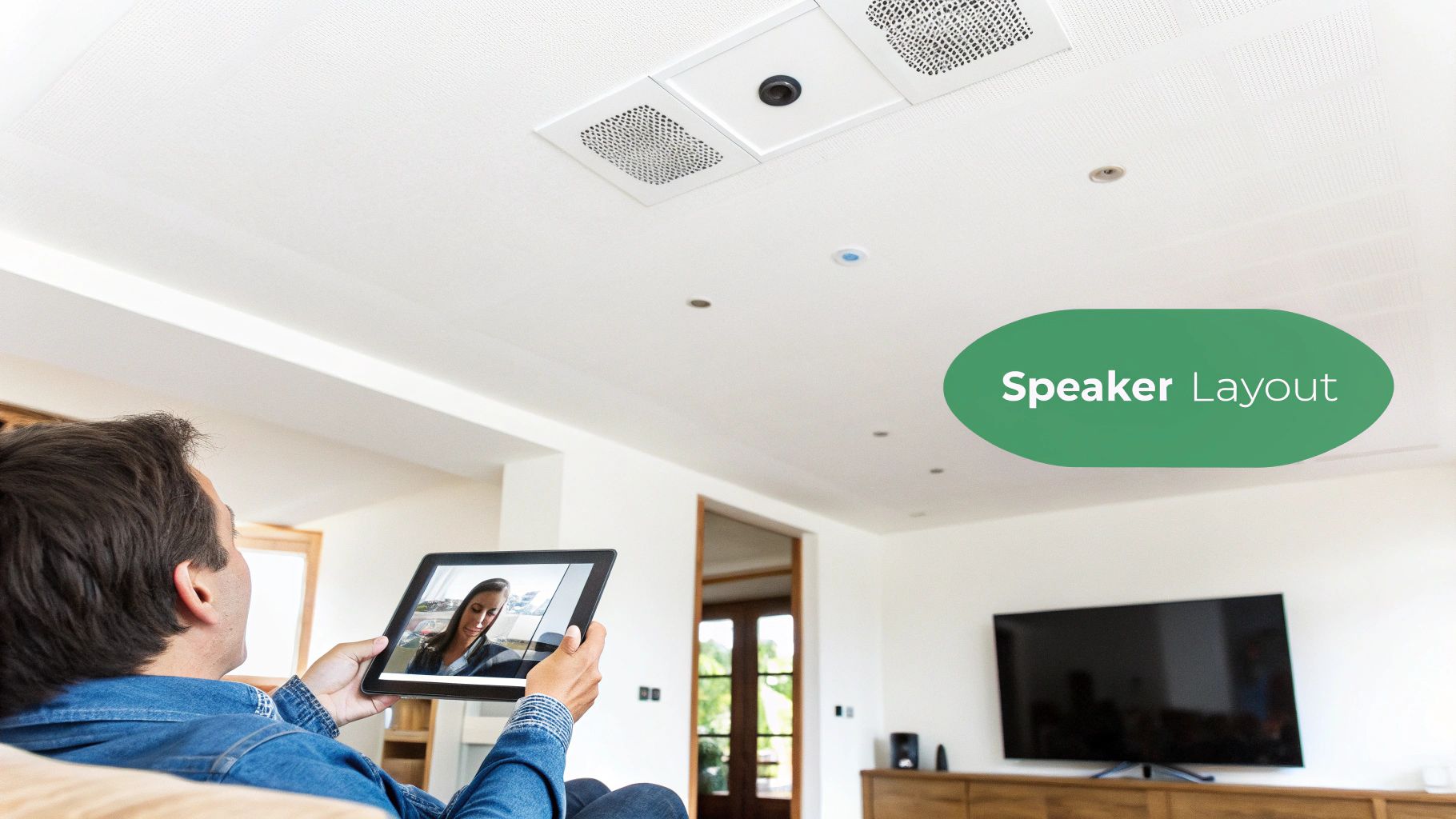
Before you even think about touching a tool, your plan is your most valuable asset. This phase is your blueprint for creating a soundscape that’s perfectly suited to your space, helping you sidestep costly mistakes and ensuring the final result is exactly what you envisioned. The right layout is what turns a simple speaker installation into a genuine audio experience.
The demand for integrated home audio is definitely on the rise. In the UK, the total speaker market was valued at £1.17 billion in 2023 and is projected to hit £1.63 billion by 2034, growing at a rate of 3.4% each year. This boom is being driven by the home cinema and multi-room audio sectors, where people are increasingly opting for ceiling-mounted speakers to keep their spaces clutter-free.
What’s Your Audio Goal?
First things first, what are you trying to achieve? Are you building a focused listening setup for a home cinema, or do you just want some ambient background music for the kitchen and dining area? Your answer will dictate the entire layout.
- Ambient Music: For general background sound in places like kitchens, hallways, or open-plan living areas, the aim is even, consistent coverage. You're not looking for a precise stereo image, just good clarity and volume everywhere.
- Focused Stereo Sound: In a living room or a dedicated listening space, you want to create a "sweet spot" where the stereo effect is at its best. This requires much more precise placement.
- Immersive Surround Sound: For a home cinema, ceiling speakers often play the role of height channels (for Dolby Atmos, for example) or even rear surrounds. Their placement is critical and has to work in perfect harmony with the rest of your speaker system.
My Pro Tip: Always think about the primary listening position. Whether that’s the sofa, the kitchen island, or your desk, the speaker layout should be optimised for where you'll actually be listening most of the time.
The Golden Rules of Placement
For a standard two-channel stereo setup, the ideal is to form an equilateral triangle between the two speakers and where you'll be sitting. A great starting point is to place the speakers at least 2 metres apart from each other and an equal distance from the side walls. This spacing is key to stopping the sound from becoming muddy or too narrowly focused.
You'll also want to avoid putting speakers too close to walls or corners. This can create an overly "boomy" bass response because of the sound reflections. As a rule of thumb, keeping them at least 50-60 cm away from any adjacent wall works well.
To make things a bit easier, here’s a quick reference table for some common scenarios.
Speaker Placement Guide for Common Room Layouts
| Room Type | Audio Goal | Recommended Placement Strategy |
|---|---|---|
| Living Room | Focused Stereo & Home Cinema | Place speakers to form an equilateral triangle with the main seating area. For surround sound, position them slightly behind the listening spot. |
| Kitchen/Dining Area | Ambient Background Music | Space speakers evenly across the ceiling for balanced sound coverage throughout the entire room. Avoid placing them directly over noisy appliances. |
| Bedroom | Relaxed Stereo Listening | Position a pair of speakers above the foot of the bed, aimed towards the headboard for a comfortable listening experience. |
| Bathroom | Ambient/Single-Point Stereo | Use a single-stereo speaker in the centre of the room or a pair of smaller moisture-resistant speakers if space allows. |
| Home Office | Focused Desktop Audio | Place speakers directly above the desk or slightly in front of the seating position to create a clear soundstage for work and calls. |
This table should give you a solid foundation for most projects, but remember to adapt the placement to the unique quirks of your own space.
Matching Speakers to Your Space
Not all ceiling speakers are created equal, and picking the right type for the job is essential.
- Mono Speakers: These are your standard single speakers, used in pairs for stereo or in larger groups for ambient audio. They're the most common choice for a reason.
- Single-Stereo Speakers: An absolutely brilliant solution for smaller spaces like bathrooms or narrow hallways where you just can't fit two separate speakers. These units have two tweeters and a dual voice coil woofer, delivering both left and right channels from one spot.
- Dual-Tweeter Speakers: These are designed to disperse sound over a wider area, making them perfect for large, open-plan rooms where you want broad coverage from fewer units.
Choosing the right speaker can simplify your layout and massively improve the final audio quality. For instance, newer models like the Sonora 3" install speakers have compact designs that are ideal for discreet multi-room audio projects. A little bit of careful planning at this stage ensures your journey into mounting ceiling speakers ends with a professional-sounding and deeply satisfying audio system.
Assembling Your Tools and Materials
A smooth installation all comes down to having everything you need within arm's reach before you even think about cutting a hole. Getting your tools and materials sorted upfront stops those frustrating mid-job dashes to the van and makes sure every step is done properly. Think of it as your pre-flight checklist for a professional ceiling speaker fit-out.
Having the right equipment doesn't just make the job quicker; it makes it a whole lot safer and more accurate. Trying to bodge it with the wrong tools is a recipe for messy cuts, a cracked ceiling, or dodgy wiring. Trust me, a bit of prep is half the battle won.
Essential Tools for the Job
This isn’t just a random list; it’s the core toolkit that’ll see you through a standard plasterboard ceiling job. Every installation has its own quirks, of course, but you won’t get far without these.
- Pencil & Tape Measure: Obvious, but crucial for marking out your speaker locations. A few millimetres out here can make the whole job look wonky.
- Electronic Stud Finder: Don't even start without one. A decent stud finder is your only way of knowing where the joists, pipes, and hidden cables are lurking, stopping you from cutting into something you really shouldn't.
- Jab Saw or Drywall Saw: This is your go-to for making clean, controlled circular cuts in plasterboard. It gives you the precision that a bigger, more aggressive tool just can't match.
- Cordless Drill/Driver: You'll need this for fixing any support brackets and maybe for screwing directly into joists, depending on the speaker design.
- Wire Strippers & Cutters: Absolutely essential for prepping your speaker cable. A proper set of strippers means you won't damage the delicate copper strands inside.
- Fish Tape or Cable Rods: Invaluable for pulling speaker wire through ceiling voids and down wall cavities, especially when you're covering a bit of distance.
One thing people always seem to forget is dust protection. Get dust sheets down over all the furniture and flooring, and wear goggles and a mask. Plasterboard dust is a nightmare – it gets everywhere. Best to contain it from the start.
Key Materials and Why They Matter
Once you've got your tools, picking the right materials is just as important for both performance and safety. Don't be tempted to cut corners here; the quality of these bits and pieces directly affects how good the system sounds and how safe the installation is.
Your speaker cable is the most important component – it's the lifeline between the amp and your speakers. For most in-ceiling setups, a good 16-gauge, 2-core speaker wire will do the job perfectly. If you're doing longer runs, say over 15-20 metres, it’s worth stepping up to a thicker 14-gauge wire to stop any signal loss and keep the audio quality crisp.
Crucially, you must always use cable that's properly certified for running inside walls and ceilings. You're looking for wire with an LSZH (Low Smoke Zero Halogen) jacket. This is a common requirement in UK building regulations for fire safety, as it emits very little smoke and no toxic halogen gases if it gets hot.
Finally, grab a tube of acoustic sealant. This is a flexible, non-hardening caulk you use to seal any small gaps around your speaker cutouts or back boxes. It's great for keeping the room's vapour barrier intact and can even help cut down on sound leaking into the room above. It’s a small detail, but it’s what separates a professional job from an amateur one.
Installing Speakers in Different Ceiling Types
The way you mount a ceiling speaker depends entirely on what your ceiling is actually made of. A modern home's plasterboard ceiling is a world away from the suspended grid of an office or the solid concrete you might find in an industrial conversion. Getting your head around these differences is the key to a secure, professional job that not only sounds fantastic but, crucially, stays put.
Each material calls for its own tools and techniques. While the end goal is always the same—a speaker sitting flush and secure—how you get there can vary quite a bit. Let's walk through the process for the three most common ceiling types you'll come across in the UK.
This gives you a quick visual on the core workflow.
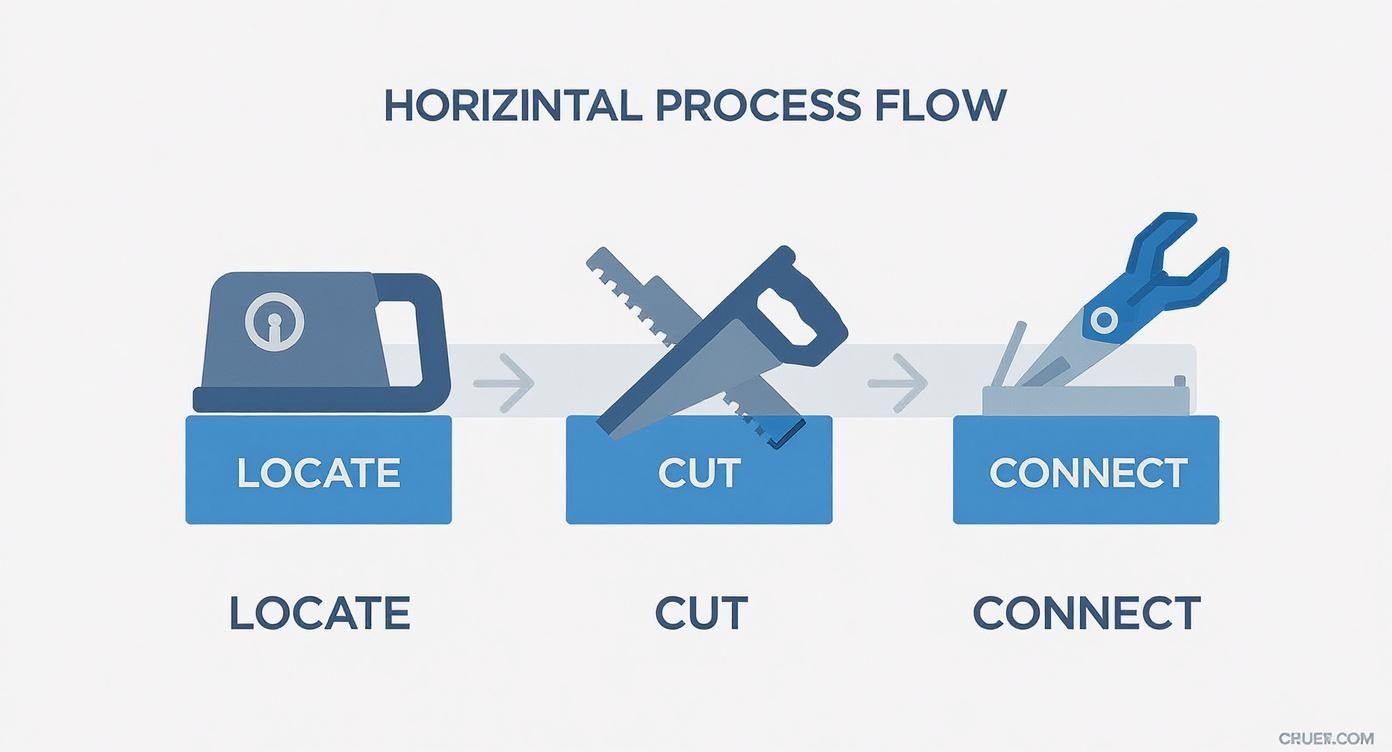
As you can see, it really boils down to three physical actions: finding the perfect spot, making a clean cut, and hooking up the wiring.
Working with Plasterboard Ceilings
Plasterboard is easily the most common ceiling material in UK homes, so this is the scenario you'll face most often. The good news is that most in-ceiling speakers are designed with exactly this in mind, using a clever fixing method known as dog-leg clamps.
These clamps are built into the speaker chassis. As you tighten the screws on the front, they swing out and grip the back of the plasterboard, effectively sandwiching the ceiling material for a really solid fit.
For a plasterboard install, your game plan looks like this:
- Find Your Joists: First thing's first, get your stud finder out and map the ceiling joists. You absolutely have to cut your hole in the empty space between two joists, leaving enough clearance for those dog-leg clamps to swing out and do their job.
- Mark and Cut: Grab the cardboard template that came in the speaker box and trace your circle. A jab saw is your best tool here; it gives you the control to make a precise, clean cut without chewing up the surrounding plasterboard.
- Mount the Speaker: Once the speaker cable is connected, gently push the speaker into the hole. Start tightening the screws on the front, and you'll feel the clamps bite and pull the speaker flush. Just be careful not to overdo it—you can easily crack the plasterboard if you get too aggressive.
The number one mistake I see is the hole being cut too big. The speaker's bezel gives you a tiny bit of wiggle room, but not much. Always trace the template accurately and cut just inside the line. You can always shave a bit more off, but you can't put it back.
The boom in smart home technology has really fuelled the demand for discreet audio like this. It's a huge market, with the global in-ceiling speaker sector projected to hit $8.71 billion by 2029. We're seeing this trend play out in UK homes everywhere. Although it means cutting into your ceiling, people love the clean, clutter-free look. You can find out more about this market growth and discover more insights about in-ceiling speakers from Research and Markets.
Tackling Suspended or Drop Ceilings
Often found in commercial spaces, dedicated home cinemas, or even basements, suspended ceilings are made of lightweight tiles resting in a metal grid. Cutting a hole in a tile is simple, but the tiles themselves have virtually no structural strength. They absolutely cannot support the weight of a speaker alone.
Mounting a speaker directly to a ceiling tile is just asking for trouble. It will sag over time, and could eventually fail completely, dropping the speaker.
The right way to do it is with a tile bridge or support bracket. This is a metal frame (either a large square or two long rails) that sits on top of the grid, spanning the T-bars. The speaker is then mounted through the tile and secured to the bridge. This transfers the entire weight onto the strong metal gridwork.
- Weight Distribution: The bridge takes the full load of the speaker off the flimsy tile.
- Vibration Damping: It's also great for cutting down on rattles and vibrations that would otherwise be very obvious.
- Secure Mounting: It provides a solid surface for the speaker's clamps to grip onto, something a soft tile could never do.
Installing in Concrete Ceilings
Concrete ceilings are by far the biggest challenge and are definitely not a typical DIY job. This kind of installation almost always needs to be planned during the construction or major renovation phase because you need to create a physical cavity within the concrete itself.
You can't just cut a hole in a concrete slab. Instead, a dedicated back box—a metal or plastic enclosure—has to be installed.
There are really only two ways this happens:
- New Builds: During the build, back boxes are positioned within the shuttering before the concrete is poured. This creates a perfect, purpose-built cavity for the speaker to be fitted into later.
- Retrofitting: In an existing building, the more common approach is to build a secondary false ceiling (usually plasterboard) below the concrete slab. This creates a new void for the speakers and all the wiring. Cutting directly into existing concrete is a specialist job requiring serious tools and structural approval.
The back box is non-negotiable here. It's not just a mounting point; it acts as an acoustic enclosure for the speaker, which is vital for defining its bass response. Without it, the sound will be thin and lack any real punch. This is a job for the pros, ensuring both structural integrity and safety are handled correctly.
Wiring Your System for Peak Performance
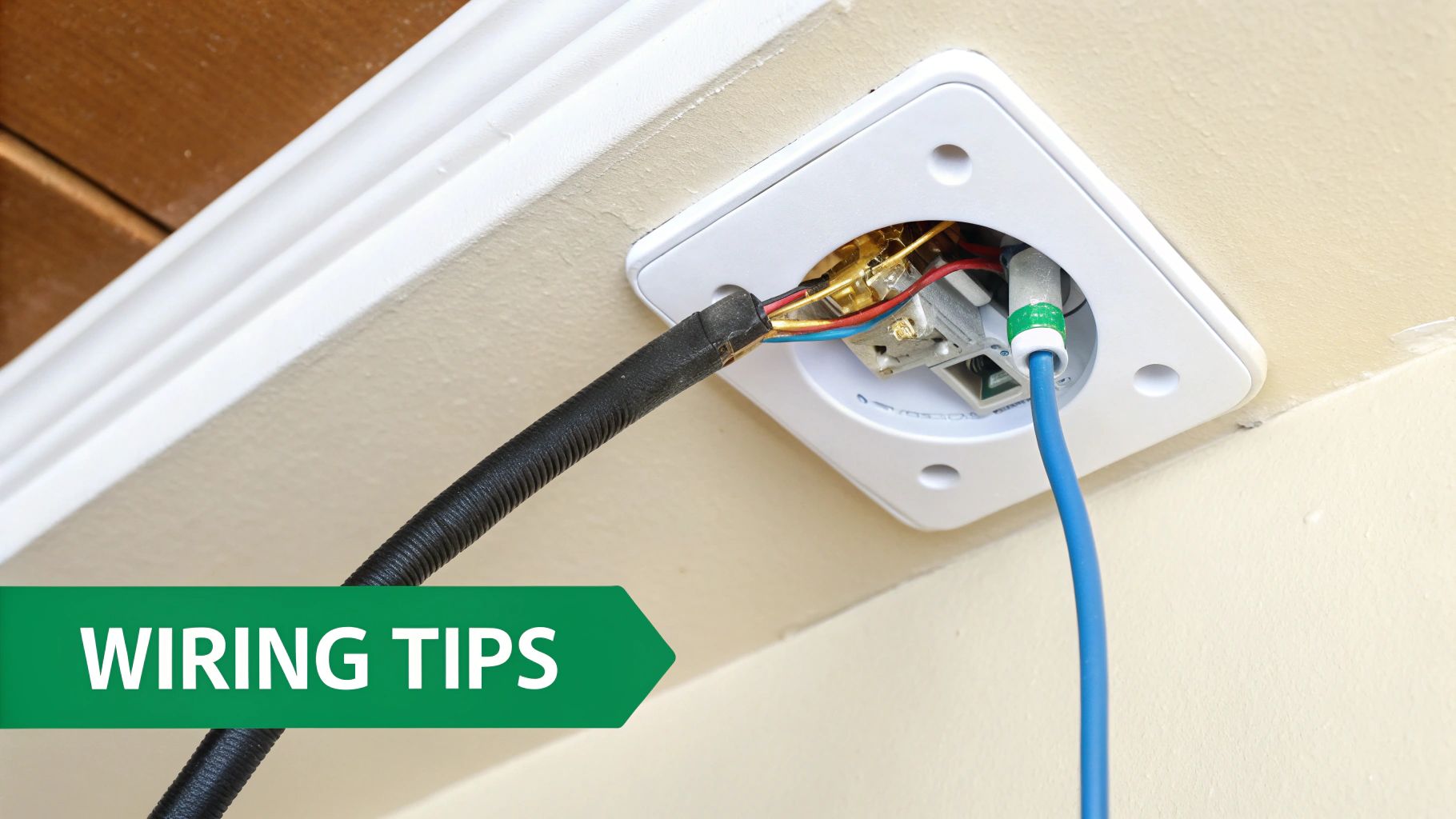
Getting the speakers physically mounted is only half the job. Honestly, the quality of your sound is just as dependent on the quality of your wiring. Think of it as the nervous system for your entire audio setup; get it right, and you're rewarded with reliable, high-fidelity sound. A truly professional, invisible installation is all about running cables discreetly and making solid connections that will last for years.
The trick is to plan the path for your speaker wire from the amplifier to each speaker. The goal is simple: make it completely disappear. This means running it through ceiling voids and down wall cavities where possible. Tools like fish tape or cable rods are absolute lifesavers here, letting you navigate those hidden spaces without tearing your walls and ceilings apart.
Low-Impedance Versus 100V Line Systems
Before you even think about pulling a single cable, you need to make a fundamental decision on the type of wiring you’ll be using. For most home projects, this boils down to a choice between a standard low-impedance setup and a 100V line system.
A low-impedance system, which is usually rated at 8 Ohms, is your go-to for home cinemas and high-quality stereo music systems. The concept is straightforward: you run a dedicated speaker cable from your amplifier directly to each speaker (or pair of speakers). This direct connection delivers the best possible audio fidelity, making it the perfect choice for dedicated listening rooms where sound quality is everything.
On the other hand, a 100V line system really comes into its own in larger spaces with lots of speakers—think big open-plan living areas, multi-room audio, or even garden sound systems. With this approach, speakers are 'daisy-chained' together on one single cable run from a special 100V amplifier. The massive advantage is the ability to run incredibly long cables and hook up many speakers without any signal degradation. The trade-off can sometimes be a subtle drop in absolute audio quality compared to an 8 Ohm system, but for background music, it’s fantastic.
Deciding between the two really depends on what you're trying to achieve. Here’s a quick comparison to help you figure out which system is the right fit for your project.
Low-Impedance (8 Ohm) vs 100V Line Systems
| Feature | Low-Impedance (8 Ohm) | 100V Line System |
|---|---|---|
| Best For | Home cinema, stereo music, high-fidelity setups. | Large areas, multi-room audio, long cable runs. |
| Wiring | One dedicated cable run per speaker (or pair). | Multiple speakers can be daisy-chained on one cable. |
| Audio Quality | Excellent, full-range frequency response. | Very good, but can have limitations at frequency extremes. |
| Complexity | Simple concept but can result in many cables at the amp. | Requires a 100V amplifier and speakers with transformers. |
| Scalability | Limited by the amplifier's channel count and impedance load. | Highly scalable; easy to add more speakers to the line. |
Ultimately, for most home cinema and living room setups, the 8 Ohm route is the one to take for pure audio performance. For anything bigger or more complex, 100V line offers a practical and scalable solution.
Making Secure and Correct Connections
Once your cables are patiently waiting in the ceiling, making the final connection is the critical last step. You need a solid, secure connection at both the speaker and the amplifier to guarantee a clean signal and avoid annoying problems later on.
Grab a good pair of wire strippers and carefully remove about 1cm of the outer insulation. The key is to do this without nicking the delicate copper strands inside.
The golden rule here is to maintain correct polarity. Your speaker cable has two cores, usually marked in some way—often red and black, or with a stripe on one side. You absolutely must ensure the positive (+) terminal on your amp connects to the positive (+) on your speaker, and the negative (-) goes to the negative (-).
Don't panic, getting the polarity wrong on one speaker won't damage your gear, but it will sound awful. The speakers become 'out of phase', which causes certain frequencies to cancel each other out. The result is a thin, weak sound with almost no bass. It's an easy mistake to make, but thankfully, it's also an easy one to fix.
Twist the exposed copper strands together tightly; this stops any stray wires from touching and causing a short circuit. Most ceiling speakers have simple spring-loaded terminals or binding posts. Just insert the wire and make sure the terminal clamps down firmly on the copper itself, not the plastic insulation. Give it a gentle tug to check it's secure.
For a more detailed walkthrough of the whole process, our complete ceiling speakers with amplifier setup guide has you covered from start to finish. Taking a few extra minutes to double-check every single connection now will save you a world of headaches later.
Meeting Safety and Acoustic Standards
A first-class installation is about more than just getting the sound right; it’s about safety and keeping unwanted noise where it belongs. When you’re cutting into a ceiling, especially here in the UK, you have to get your head around the building regulations on fire safety and sound transmission.
Honestly, getting these details spot-on is what separates a professional job from a risky shortcut. It ensures your system is not only safe and compliant but also performs exactly as it should.
The Role of Acoustic Fire Hoods
One of the most crucial bits of kit for this is the acoustic fire hood. This is an absolute must-have that you fit over the back of the speaker inside the ceiling void. Its main job is to maintain the fire integrity of your ceiling.
Think about it: UK building regulations state that if you cut a hole in a ceiling that doubles as a floor for the room above, you’ve got to restore its original fire rating. Most ceilings in UK homes are rated for 30 or 60 minutes of fire resistance. A fire hood is designed to expand when it gets hot, sealing the hole you’ve made and stopping fire from ripping through the void into the room above.
Are Fire Hoods Always Mandatory?
The rules are pretty clear-cut. If you’re installing speakers in a living room and there’s a bedroom directly above it, a fire hood is a legal requirement. It's not just 'best practice'—it's a matter of compliance and fundamental safety.
However, if you're working in a single-storey extension with just a roof loft above, the legal requirement might not apply in the same strict sense. Even so, I’d always recommend using one. They offer great acoustic benefits and stop dust and insulation fibres from getting into the back of your speaker.
Don't just see a fire hood as a box-ticking exercise. It's an integral part of the speaker system. Besides restoring the ceiling's fire and acoustic barrier, it also acts as a basic back box, which can noticeably improve the speaker's mid-bass performance by containing the sound waves.
The UK's approach to home audio is really shaped by these tough regulations and a strong luxury housing market. This is why we see such a preference for high-fidelity passive speakers, prized for their sound quality. Of course, easier-to-install active models are gaining ground in smart homes. This focus on compliance and quality is a real hallmark of the UK market, and you can discover more insights about the UK speaker market from 24 Market Reports.
Improving Performance with Acoustic Treatments
Beyond fire safety, you've got to think about sound leakage. A ceiling speaker can easily send unwanted noise and vibrations straight into the room above, which nobody wants. This is where dedicated back boxes and proper insulation come into their own.
- Back Boxes: These are purpose-built enclosures that the speaker sits in. They give the driver a controlled volume of air to work with, which really tightens up the bass response and delivers more predictable sound. Just as importantly, they act as an excellent acoustic barrier, cutting down sound leakage upstairs.
- Acoustic Insulation: If a full back box isn't an option, wrapping the rear of the speaker (and its fire hood) with some acoustic-grade mineral wool is a great alternative. It helps dampen vibrations and absorb stray sound.
Controlling sound levels is a huge part of professional audio design, especially in commercial venues. For bigger, more complex projects, you might need specialist gear; you can learn more about professional sound limiters in our article to see how volume is properly managed. For a home setup, though, a bit of quality insulation can make a world of difference.
Common Questions We Get Asked About Ceiling Speaker Installation
Even the most detailed plan can throw up a few curveballs once you're on site. Getting the right answers to these common questions can be the difference between a good job and a great one, making sure your setup is safe, compliant, and sounds fantastic.
Here are some of the most frequent queries that pop up when it's time to get speakers in the ceiling.
Do I Really Need Fire Hoods for Every Speaker?
This is a critical one, especially here in the UK. If you're cutting a hole into a ceiling that doubles as the floor for a habitable room above, then yes, an acoustically rated fire hood isn't just a good idea—it's a legal requirement. It's all about maintaining the ceiling's fire resistance rating, which is usually 30 or 60 minutes, as laid out in building regulations.
Now, if you're working in a single-storey extension with just a roof loft overhead, a fire hood might not be strictly mandatory by law. That said, we'd always recommend fitting one anyway. It's best practice for improving sound insulation (stopping noise from leaking into the loft) and it protects the back of your speaker from dust and debris.
Can I Put Ceiling Speakers in a Bathroom?
Absolutely. But you have to pick the right tool for the job, and that means choosing speakers with the correct IP (Ingress Protection) rating. Bathrooms are split into zones based on how close they are to water, and your speaker has to be rated for the zone it's going into.
- Zone 1: This is the area right above a shower or bath. You'll need a speaker with at least an IP45 rating here to handle direct splashes.
- Zone 2: For spots a bit further away from direct water, an IP44 rating is a safe bet. It'll protect the speaker from condensation and steam damage over the years.
Always, always check the speaker's IP rating before you buy it for a bathroom or any other humid space. It’s a non-negotiable for keeping things safe and making sure the speaker actually lasts.
A common mistake we see is people thinking "marine grade" is the same as being IP-rated for a bathroom. While they're related, the IP rating is the specific standard you need to look for. It's the only way to be sure the speaker is certified as safe for the zone you're installing it in.
How Far Apart Should I Space My Speakers?
The perfect spacing really comes down to what you're trying to achieve with the sound. For general background music where you want even coverage, a good rule of thumb is to place speakers at least 2 metres apart. This avoids any weird overlaps or dead spots in the room.
If you're setting up a more focused stereo sound field, maybe in a living room for watching films, you want to create an equilateral triangle between the two speakers and where you'll be sitting most of the time. As a starting point, try positioning each speaker the same distance from the side walls and about 2-3 metres apart from each other.
The one thing to avoid at all costs is placing them too close to corners. Shoving them into a corner will create a really boomy, muddy bass response that just doesn't sound good.
At Epic Audio Ltd, we provide the specialised hardware and expert advice needed for any audio installation, from a simple stereo pair to a complex multi-zone system. For trade pricing and project support on your next job, explore our full range of solutions.