

What Is a Hearing Loop and How Does It Work
At its heart, a hearing loop is a brilliantly simple idea: it acts like a personal, wireless speaker that sends sound directly to your hearing aid. It takes the audio from a specific source—like a microphone at a checkout, or the sound from a TV—and transmits it straight to a tiny receiver in your hearing aid, known as a telecoil (or T-coil). This direct link delivers incredibly clear audio, completely cutting out the distracting background noise that can make listening so difficult.
So, Why Does This Matter So Much?
Picture this: you're trying to hear an announcement at a busy train station, or maybe you're straining to follow the dialogue in a grand old theatre. For anyone with hearing loss, that combination of distance and surrounding noise can quickly turn speech into an indecipherable jumble. This is the exact problem a hearing loop is designed to solve. It creates a direct, private audio channel that slices right through the chaos.
Think of it as your own personal sound bubble. A discreet wire—the 'loop' itself—is installed around the perimeter of a space. This loop then broadcasts the sound you want to hear across a silent magnetic field. When someone with a T-coil enabled hearing aid steps inside this field and switches to the 'T' setting, their device instantly picks up this clean signal. The result? Pure, unaltered sound delivered right to their ear, already tailored to their own specific hearing needs.
A Game-Changer for Accessibility
This isn't some niche gadget; it's a vital accessibility tool. The sheer scale of hearing loss in the UK throws a spotlight on just how critical these systems are. According to the Royal National Institute for Deaf People (RNID), there are roughly 12 million people in the UK living with hearing loss—that’s about one in every five adults. And with an ageing population, that number is only set to grow, making clear communication in public spaces more important than ever. You can learn more about the latest UK hearing loss statistics to see just how widespread this issue is.
A hearing loop offers a seamless and dignified listening experience. Unlike other systems, it doesn't require users to borrow or wear conspicuous headphones or receivers. You simply activate a setting on your own hearing aid and instantly connect.
This discreet functionality is empowering. It allows people to take part in public life on their own terms, without having to announce their hearing loss to the world. From ticket counters and places of worship to lecture halls and even your own living room, hearing loops provide clarity and inclusion.
To put it simply, here’s a quick look at why hearing loops are so transformative for the user.
Key Benefits of Hearing Loops at a Glance
| Benefit | Impact for the User |
|---|---|
| Crystal-Clear Audio | Transmits sound directly, wiping out background noise and echo for exceptional clarity. |
| Discreet and Dignified | Uses your own hearing aid, so there’s no need for extra bulky hardware or headphones. |
| Improved Safety | Ensures crucial announcements in transport hubs and public venues are always heard clearly. |
| Increased Independence | Lets users participate fully and confidently in social, cultural, and professional situations. |
Ultimately, this technology gives people the freedom to engage with their surroundings effortlessly and with confidence.
How Hearing Loop Technology Works
Ever wondered how sound can travel silently across a room and land with perfect clarity inside a hearing aid? It sounds a bit like magic, but the technology behind a hearing loop is actually a beautifully simple process based on magnetism. At its heart, it’s a three-part journey that turns sound into a signal your hearing aid can understand directly.
The whole thing starts with a sound source. This could be anything from someone speaking into a microphone at a podium, the audio from a film in a cinema, or an announcement being made over a PA system at a train station. This initial sound is captured as a standard electrical audio signal.
From there, the signal is sent to the system's central component: the hearing loop driver, which is a highly specialised amplifier. This isn't your average amp; it's engineered specifically to power the loop. Its job is to boost the audio signal and convert it into a very specific type of current that then travels through the loop cable. Good quality drivers are absolutely essential for making sure the signal is strong and clear.
Creating the Magnetic Field
Once the audio signal is amplified, the loop driver sends it out into the loop cable. This is usually a thin, single-core copper wire that’s installed discreetly around the edge of a designated area—perhaps under a carpet, hidden in the ceiling, or even chased into the walls.
As the electrical current from the amplifier flows through this wire, it generates a magnetic field. This field is completely silent and harmless, but it carries the exact same audio information as the original sound. Think of it as a mini, self-contained radio broadcast, but using a magnetic signal instead of radio waves.
This magnetic field fills the entire looped area, creating a consistent listening zone. Anyone sitting inside this zone can access the sound, whether they're in the front row or right at the back. It’s this precise containment that makes the system so effective.
This diagram shows the simple, direct journey of sound from its source straight to the listener's ear.
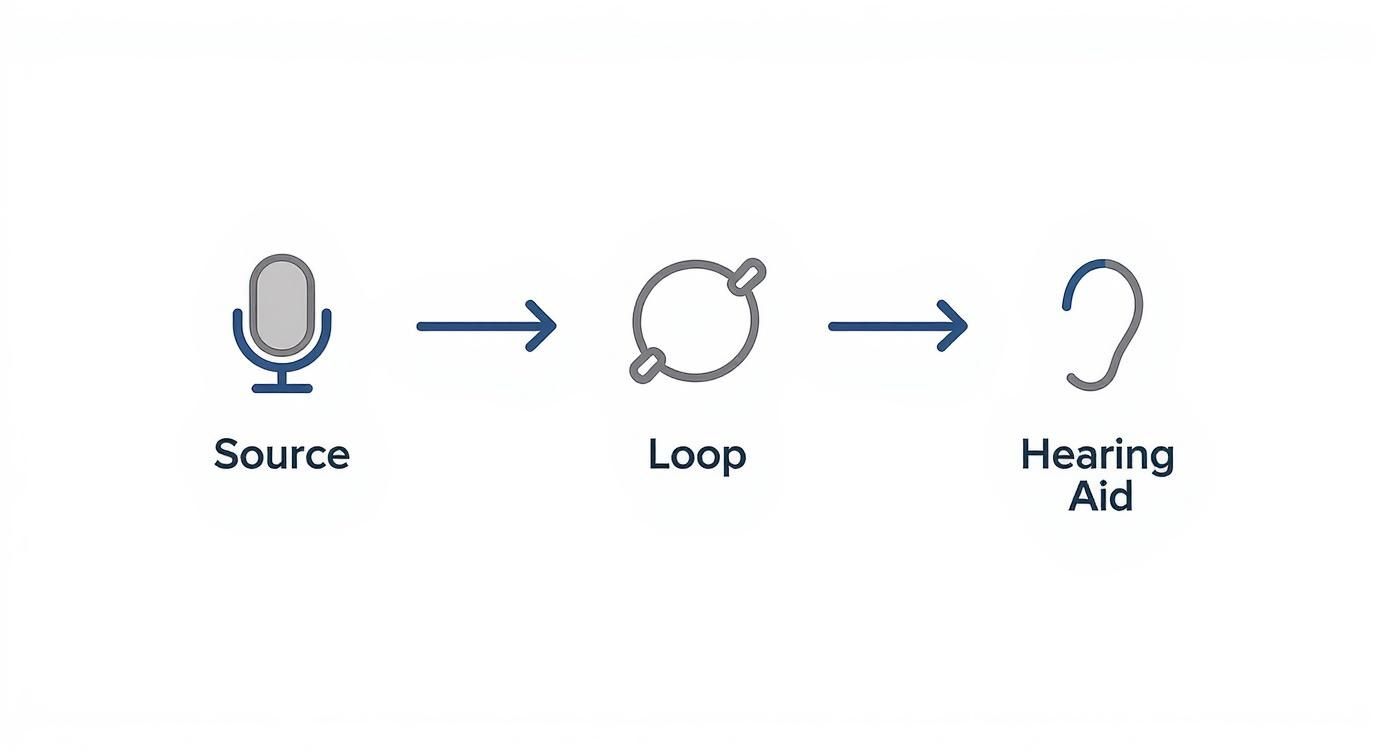
The image breaks down the three key stages: the audio source, the loop system's magnetic broadcast, and the direct reception by the hearing aid, which completely bypasses any background noise.
The Final Step: The Telecoil Receiver
The real connection happens right inside the listener's hearing aid or cochlear implant. Most modern hearing devices are fitted with a tiny, tightly-wrapped coil of copper wire called a telecoil, or T-coil. This little component acts as an antenna, specifically designed to pick up the magnetic signal being generated by the loop cable.
When a user switches their hearing aid to the 'T' setting, it deactivates the normal microphone and activates the telecoil. The T-coil then picks up the magnetic signal from the loop and converts it straight back into an electrical signal. This signal is then processed and amplified by the hearing aid, tailored perfectly to the individual’s specific hearing loss.
The result is pure, clear audio delivered directly to the ear, totally free from the echo, reverb, and background noise that can make listening in public spaces so difficult.
The key stages are:
- Sound Capture: A microphone or another audio system picks up the sound.
- Amplification: A loop driver amplifies and processes the signal. You can learn more about how a professional-grade 4-zone multifunctional mixing amplifier can manage audio sources for these systems.
- Transmission: The driver sends the current through the loop cable, creating a magnetic field.
- Reception: The T-coil in a hearing aid detects the magnetic signal.
- Conversion: The hearing aid turns the signal back into crystal-clear sound for the user.
This elegant process is what makes hearing loop technology so powerful. It’s a direct link from the sound source to the listener, creating an accessible and inclusive experience without any need for extra receivers or clunky headphones. It's a truly personal sound system.
A Surprisingly Long History
You might think hearing loops are a relatively new bit of tech, but the story actually starts nearly a century ago. This isn’t some flash-in-the-pan idea; it's a proven, powerful standard for accessibility that's been tweaked and perfected over decades. Its journey began long before digital audio, rooted in a simple but brilliant understanding of magnetism and sound.
The core concept behind the audio induction loop was first patented right here in the UK by Joseph Poliakoff way back in 1937. This was the very first step towards a new kind of assistive listening—one that could send audio straight to a listener without blasting it through loudspeakers. You can dive deeper into the early days of hearing loop technology to see how those initial ideas took shape.
For a long time, though, the technology’s true potential was locked away. The missing piece of the puzzle was a receiver small enough to be practical for everyday, personal use.
The Telecoil: A Game-Changer
The real breakthrough came in the 1970s with the refinement of the telecoil (or T-coil). This tiny component, just a small coil of copper wire, was compact enough to be built directly into behind-the-ear hearing aids. It effectively acted as a miniature antenna, perfectly tuned to pick up the magnetic signals a hearing loop system was putting out.
This one innovation changed everything. For the first time, a hearing aid could do more than just make every sound in a room louder. It could now receive a clean, direct audio feed from a specific source, cutting through all the distracting background noise.
The UK is where this development really took off.
In a landmark move in 1974, the UK's National Health Service (NHS) began prescribing these new T-coil equipped hearing aids, often free of charge. This single decision put powerful assistive listening technology into the hands of thousands.
Almost overnight, a huge user base was created, cementing the UK as a world leader in hearing accessibility and sparking demand for public spaces to install compatible loop systems.
From Simple Wires to Complex Venues
With T-coil hearing aids becoming commonplace, the technology behind the loop systems had to evolve alongside them. Early installations were pretty basic, often just a single wire running around the edge of a room. But as demand grew, so did the ambition for what a hearing loop could do.
Engineers had to get creative, developing more advanced loop drivers and clever installation techniques to tackle new challenges:
- Metal Structures: Modern buildings are full of metal—structural steel, reinforced concrete—which can absorb or distort the magnetic field.
- Uneven Coverage: A simple loop in a large or oddly shaped room could create 'dead spots' where the signal was weak or non-existent.
- Signal Spill: The magnetic field could sometimes leak into adjacent rooms, which is a big problem for privacy or interference.
To solve these issues, innovations like phased-array loop designs were developed. These use complex, interlocking patterns of wires to precisely shape and control the magnetic field. These advancements mean we can now install high-performance hearing loops in the most challenging environments imaginable—from historic cathedrals and sprawling airport terminals to state-of-the-art theatres and conference centres. It’s been quite a journey from that 1937 patent to today’s sophisticated systems, all driven by a relentless push for genuine inclusion.
Installing a Hearing Loop System the Right Way
A poorly installed hearing loop isn't just a waste of money; it's a broken promise of accessibility. For any venue manager or business owner, understanding what a proper installation involves is absolutely vital. It’s the difference between delivering a genuinely inclusive experience and creating a frustrating one plagued by dead spots and interference.
Getting it right means moving well beyond a one-size-fits-all approach. The system's design must be meticulously planned to match the unique characteristics of the space it will serve. A simple design that works perfectly in a small, quiet meeting room will likely fail spectacularly in a large, modern auditorium with a metal frame.
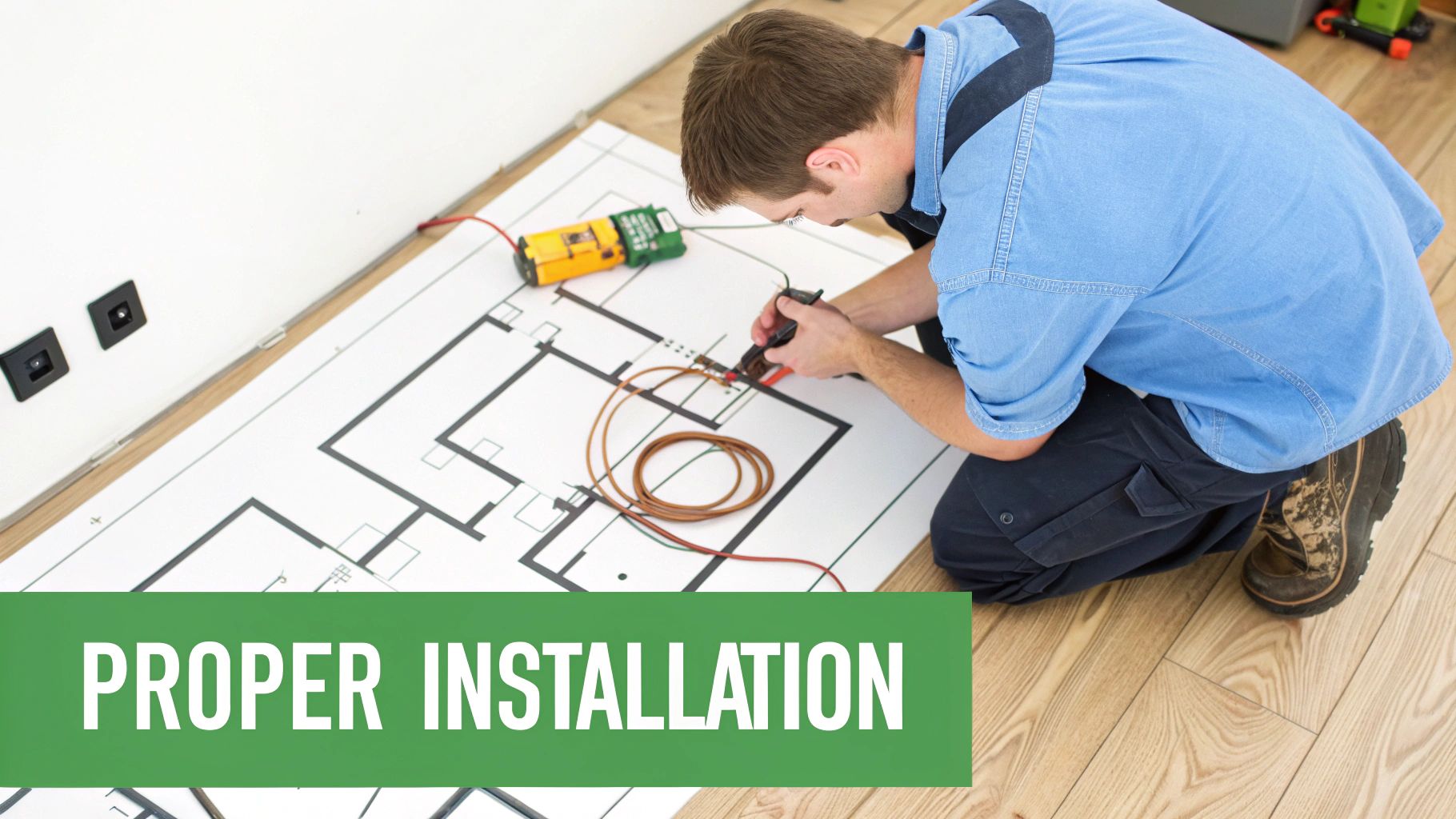
This process is definitely not a DIY job. It demands a deep understanding of audio engineering, building construction, and electromagnetics to guarantee clear, consistent coverage for every single user, no matter where they are seated.
Choosing the Right Loop Design
The first and most critical step is selecting the appropriate loop layout. The physical properties of the building heavily influence this decision, as different designs are needed to overcome specific architectural challenges. A professional installer will always conduct a site survey to assess these factors before recommending a solution.
A simple perimeter loop, where a single wire is run around the edge of a room, is often sufficient for smaller spaces with minimal metal in their construction. It's straightforward and cost-effective but can suffer from signal spill-over into adjacent rooms and a weaker signal right in the centre.
In contrast, buildings with significant metal structures, like reinforced concrete floors or steel frames, demand a far more advanced approach. Metal can absorb and distort the magnetic field, creating patchy, unreliable coverage. This is where complex designs like a phased array become essential.
A phased array loop uses multiple, interlocking patterns of wires. By carefully controlling the current flowing through each segment, an installer can shape the magnetic field with precision, steering it around metallic obstacles and ensuring a strong, even signal throughout the entire space.
This advanced technique also helps to minimise "spill," preventing the signal from leaking into nearby rooms and maintaining confidentiality where needed. Complex layouts like this are also a must for large venues where signal strength needs to be consistent from the front row to the very back.
To make sense of the options, let's look at a few common designs and where they shine.
Comparison of Common Hearing Loop Designs
| Loop Design Type | Best Use Case | Key Advantage |
|---|---|---|
| Perimeter Loop | Small, simple rooms with no metal interference. | Simple, fast, and cost-effective to install. |
| Figure-8 Loop | Adjacent rooms where signal spill must be prevented. | Naturally cancels the signal outside the looped area. |
| Phased Array | Large venues or rooms with heavy metal structures. | Provides even coverage and overcomes signal loss. |
Each design serves a purpose, and a professional assessment is the only way to determine the right fit for your unique space.
Critical Factors Beyond the Loop Layout
A successful installation involves much more than just laying wires correctly. A professional survey will identify and account for several other critical factors that can make or break the system's performance.
One major consideration is background magnetic interference. Electrical systems, lighting dimmers, and even certain building materials can generate their own magnetic fields. These can create an audible buzz or hum for hearing aid users, rendering the loop completely unusable. An installer will use specialised equipment to measure this interference and design the system to overcome it.
The building materials themselves are also a key factor.
- Reinforced Concrete: The steel rebar within concrete can block or distort the magnetic signal.
- Structural Steel Beams: These act like magnetic shields, creating dead zones if the loop design doesn't account for them.
- Metal Roof Decking or Panelling: Can significantly reduce the vertical reach of the signal, a huge problem for multi-level venues.
Understanding these elements is non-negotiable for a successful outcome. The goal is to provide a seamless audio experience, and just as you'd plan carefully when figuring out how to install ceiling speakers for perfect sound, a hearing loop requires the same level of professional attention to detail.
Meeting the Performance Standard
Ultimately, the measure of a good installation is its performance. The internationally recognised standard for hearing loops is IEC 60118-4. This standard defines the required signal strength, frequency response, and acceptable levels of background noise.
A reputable installer will not only design a system to meet this standard but will also perform rigorous testing and commissioning after installation. This involves using specialised field strength meters to map the signal across the entire looped area, ensuring there are no dead spots and that the audio quality is superb. They will then provide a certificate of conformity, giving you total peace of mind that your venue is truly accessible and compliant.
A system that meets the IEC 60118-4 standard guarantees that anyone with a T-coil equipped hearing aid can walk into your venue, switch to the 'T' setting, and receive crystal-clear sound. This commitment to quality is what turns a simple installation into a truly transformative tool for inclusion.
Meeting UK Accessibility and Legal Standards
For any business or public service in the UK, making your space accessible isn't just a nice-to-have—it's a legal and ethical duty. Understanding the rules is crucial, as they draw a straight line between a properly working hearing loop and your responsibilities as a service provider. The law is clear, and falling short isn't an option.
The bedrock of UK accessibility law is the Equality Act 2010. This act brought together a patchwork of older anti-discrimination laws into one powerful piece of legislation. For anyone providing a service, the key concept is the duty to make "reasonable adjustments" to ensure disabled people aren’t put at a 'substantial disadvantage'.
This duty is proactive. That means you should be thinking ahead about the needs of disabled visitors and customers, not waiting for a complaint to land on your desk. For the estimated 12 million people in the UK with hearing loss, a busy, noisy environment without any assistive listening tech is a massive barrier. Installing a functional hearing loop is widely seen as a perfect example of a reasonable adjustment.

Following the Code of Practice BS 8300
While the Equality Act lays down the law, it doesn't get into the nitty-gritty of how to be accessible. That's where British Standards come in. BS 8300 is the go-to code of practice for designing inclusive buildings, offering detailed guidance on meeting the needs of disabled people.
BS 8300 gets specific, recommending audio-frequency induction loop systems (AFILS) in all sorts of places where clear communication is vital. Think of places like:
- Service Counters: Reception desks, ticket windows, and shop checkouts.
- Meeting Rooms and Theatres: Anywhere with presentations, performances, or public speakers.
- Waiting Areas: Transport hubs, hospitals, and council service centres.
Following BS 8300 is considered best practice, and it can be your best evidence that you’ve made the necessary reasonable adjustments the law demands. It’s essentially an expert-endorsed roadmap for creating a genuinely welcoming space.
"To be able to go somewhere new and easily hear through a hearing loop is so reassuring and helpful. It’s wonderful because you don’t have to put on big headphones, you don’t have to self-identify as hard of hearing. You just click to turn it on, and suddenly you can hear."
This really gets to the heart of what compliance achieves. It’s not about ticking a box on a form; it’s about giving people a dignified, independent way to access your services. Sticking to the standards ensures the system you install actually delivers on its promise of crystal-clear sound.
The Critical Role of Signage
A perfectly installed hearing loop is completely useless if nobody knows it exists. Clear, consistent signage isn't just a courtesy; it's a fundamental part of your legal and practical duties. Without it, you’re failing to let people know that an adjustment is there for them to use.
The internationally recognised symbol is a square sign, usually blue, with a white ear graphic and the letter 'T' next to it. This tells someone that a system is in place that works with the 'T-coil' setting on their hearing aid.
To be effective, signage needs to be placed at key points:
- At the Main Entrance: Let visitors know your building is accessible the moment they walk in.
- At Specific Service Points: Put signs at every till, information desk, or meeting room where a loop is active.
- Within the Looped Area: For bigger spaces like auditoriums or churches, a sign inside the room reminds people the facility is there for them.
Forgetting the signs is a common mistake, but a serious one. It creates a barrier to access just as effectively as a broken system. When you invest in a hearing loop, you're making a commitment to inclusion—proper signage is the final, vital step in seeing that commitment through.
Your Questions About Hearing Loops Answered
Even when you get the basic idea behind a hearing loop, the practical questions always follow. It’s a beautifully simple technology for the person using it, but getting it right depends on the proper equipment and a bit of know-how. Let's clear up some of the most common queries we hear.
People often first ask if they need some sort of special gadget to use one. The answer is yes, but there's a good chance you already have it.
Do I Need a Special Hearing Aid to Use a Hearing Loop?
You do. Your hearing aid or cochlear implant needs to have a small component called a telecoil, or 'T-coil' for short. Think of it as a tiny wireless antenna built right into your device, ready to pick up the magnetic signal from the loop system.
The great news is that most modern hearing aids come with a T-coil fitted as standard. Sometimes, though, it needs to be switched on by your audiologist, so it’s always worth a quick chat with them to make sure it's activated and programmed correctly.
Connecting is as simple as flicking your hearing aid to its 'T' setting. And if your device happens to be one of the few without a T-coil, you’re not left out. You can use a portable loop receiver with a pair of headphones to tap into the same crystal-clear audio.
How Can I Tell if a Building Has a Hearing Loop?
Spotting a hearing loop-equipped venue is pretty straightforward once you know the symbol to look for. Public spaces are required to clearly signpost their accessibility features.
Keep an eye out for the internationally recognised symbol: a blue square sign showing a white ear graphic, with a capital 'T' in the bottom-right corner. You should see this displayed clearly at entrances, reception desks, ticket counters, and any service points.
If you can’t see the sign, don’t hesitate to ask a staff member. Many places also list their accessibility information on their website, which is a great way to check before you even leave the house.
Can You Install a Hearing Loop in Any Building?
Pretty much any building can be fitted with a hearing loop, but the job's complexity can vary hugely. This is definitely not a DIY project; you need professional expertise to get a result that works flawlessly.
The biggest hurdle is modern construction. Buildings with a lot of metal, like reinforced concrete floors or steel frames, can play havoc with the magnetic signal, causing 'dead spots' or weakening the audio.
A professional installer will always start with a site survey. They’ll assess the building’s construction, measure for any background magnetic interference, and design a system that works around these obstacles to give you perfect coverage.
In a tricky space, for example, they might need to install a complex phased array loop to steer the signal around metal obstructions. This ensures the system meets the strict IEC 60118-4 performance standard and gives every single user a brilliant experience, no matter where they're sitting.
How is a Hearing Loop Different From Other Systems?
While all assistive listening systems share the same goal of improving sound clarity, hearing loops offer an experience that’s in a class of its own. The main alternatives you'll come across are FM (Frequency Modulation) and IR (Infrared) systems. Here’s how they stack up.
- Hearing Loop: Beams sound directly into your T-coil hearing aid. No extra hardware, no fuss—just a discreet and dignified connection. The sound is processed by your own hearing aid, which is already fine-tuned for your specific hearing needs.
- FM Systems: These use radio waves to send sound to a receiver pack. Users have to borrow this pack and wear it, usually with headphones or a neck loop. It works, but it's extra kit to carry and can feel a bit cumbersome.
- IR Systems: Using invisible light, these also require a receiver and headphones. The catch here is that they need a direct line of sight. If someone walks in front of you, the signal can be blocked.
The standout advantage of the hearing loop is that direct-to-hearing-aid link. With nothing extra to carry or wear, it’s easily the most convenient and user-friendly option out there. This direct connection is also key when a hearing loop is part of a larger sound setup. For a deeper dive into professional audio, check out our guide to pro PA speaker systems. At the end of the day, a hearing loop simply empowers people to connect without a second thought.
At Epic Audio Ltd, we specialise in providing the high-quality amplifiers and audio components needed for professional, compliant hearing loop installations. Contact us today to discuss your project needs.
Article created using Outrank