

Speaker Stands for Surround Sound Placement Guide
Ever felt that disconnect between an explosive on-screen moment and the sound coming from your speakers? It’s the difference between a muffled, chaotic mess and a soundtrack where every detail is sharp, clear, and perfectly placed. Speaker stands for surround sound aren't just a bit of furniture; they are the key to unlocking that truly immersive audio experience, taking your system’s sound from simply loud to precisely located.
Why Speaker Stands Are Essential for Surround Sound
Think of your surround sound speakers like a band on stage. Without a proper stage, their performance is going to feel flat, disjointed, and lost in the room. Just plonking them on the floor, a bookshelf, or the corner of your media unit is a surefire way to stifle their potential and create a sonic muddle. This is exactly where dedicated speaker stands come in – they provide the perfect stage for each speaker to perform at its best.
Properly engineered stands are designed to solve three critical problems that kill audio quality: incorrect height, unwanted vibration, and poor positioning. By getting these fundamentals right, they transform a random collection of speakers into a cohesive system that wraps you in that 'bubble of sound' the film and music producers always intended.
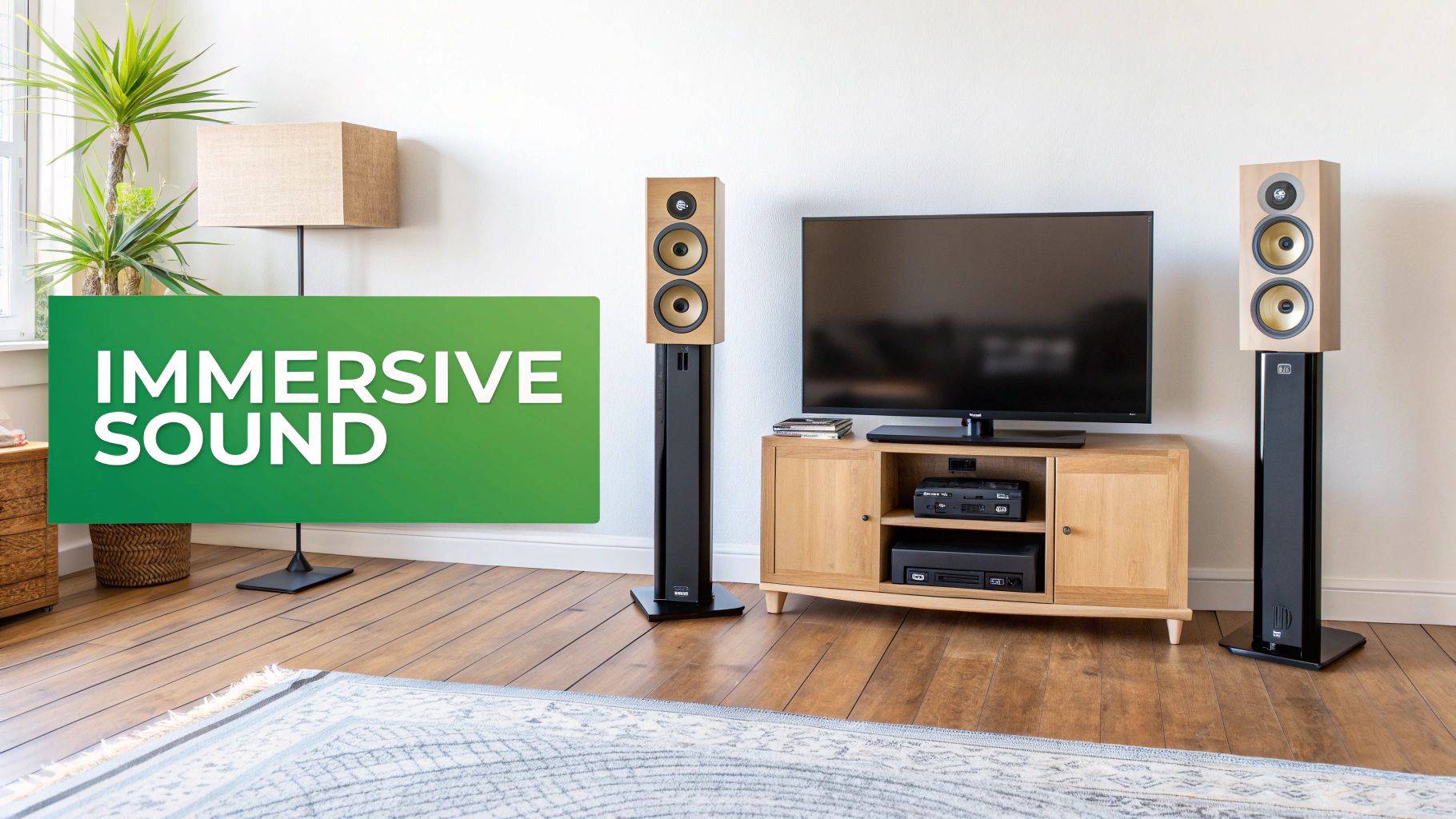
Unlocking True Audio Fidelity
The biggest win you get from proper stands is achieving the correct tweeter height. For a surround setup, you want the tweeters on your front channels aimed directly at ear level when you're seated. For the rear channels, a position slightly above ear level is ideal. This alignment is crucial because high-frequency sounds—the ones that give audio its detail and direction—travel in a straight line.
When a speaker is dumped on the floor, those vital frequencies are fired at your shins, resulting in a muddy, undefined sound. On the other hand, putting them on a tall bookshelf can make the audio feel strangely disconnected from the action you're watching.
After the speakers themselves, a good set of stands is the single most effective upgrade you can make to a surround sound system. They deliver the foundational stability and positioning needed to hear your audio exactly as it was mixed in the studio.
The Foundation of Immersive Sound
Beyond just height, stability is everything. A good stand is heavy and rigid, giving the speaker a rock-solid platform that stops the cabinet from vibrating or wobbling about. This is a game-changer for two main reasons:
- Improved Clarity: It prevents the speaker's energy from being wasted shaking the stand itself. The result? Tighter, punchier bass and much clearer midrange frequencies.
- Enhanced Safety: A stable base means your expensive speakers are far less likely to be knocked over by excited kids, pets, or even an enthusiastic guest.
The growing demand for high-quality audio setups really highlights how important this is. The global indoor surround sound system market was valued at around $4.8 billion and is on track to hit $7.9 billion by 2032. This boom shows a real consumer appetite for premium entertainment, particularly in markets like the United Kingdom where high-fidelity audio is seriously valued. You can learn more about the growth of the indoor surround sound market.
This guide will walk you through choosing the right stands and mastering their placement, ensuring your home cinema finally reaches its full potential.
How to Choose the Right Type of Speaker Stand
Choosing the right speaker stand is a bit like picking the right tyres for a car; the choice has a huge impact on performance, stability, and how the whole system handles its environment. It all boils down to matching the stand to your speakers, your room, and what you’re trying to achieve acoustically. Let's get into the common options so you can make a confident choice.
Getting your head around speaker stands for surround sound doesn't need to be a headache. Once you understand the main types, you'll quickly figure out what's right for your home cinema.
Solid Floor Stands: The Stable Foundation
Solid floor stands are the go-to for a good reason. Usually built from chunky wood or heavy-gauge steel, they offer a sturdy, fixed-height platform for bookshelf-style speakers. Their main benefit is sheer mass and rigidity, which properly grounds the speaker and stops unwanted vibrations from turning your sound to mud.
Think of them as the anchors for your audio system. Their weight and solid build make sure your speakers stay perfectly still, letting the drivers do their job without interference. That kind of stability is absolutely vital for crisp bass and a detailed midrange.
Many of the best metal stands are even designed to be fillable. You can pour materials like sand or lead shot into the hollow columns, which massively increases their weight. This simple trick makes the stand acoustically "dead"—stopping it from ringing along with the music and tightening up the audio even further.
Adjustable Pole Stands: Flexibility for Perfect Height
Adjustable pole stands have one massive advantage: versatility. Unlike fixed-height stands, you can tweak the speaker’s vertical position. This is a game-changer for surround sound channels, where getting the height spot-on relative to your ears is non-negotiable for that immersive feeling.
These stands are often lighter than their solid cousins, which makes them easier to shift around. If you’ve got a quirky room layout or your seating plan changes, that flexibility can be a real lifesaver. Many pro-grade options, like the dependable König & Meyer KM 12190 Laptop Stand, demonstrate the kind of solid adjustability that guarantees both stability and precise placement, even in tricky setups.
Isolation Mounts: The Audiophile's Choice
For anyone chasing the absolute best audio fidelity, isolation mounts are a more advanced solution. They aren't always full stands but are often specialist platforms or feet that sit between your speaker and the stand (or any other surface). Their job is to "decouple" the speaker from whatever it's sitting on.
Think of your speaker as a running engine. An isolation mount is like the engine mounts in a car—it absorbs the vibrations so they don't shake the entire vehicle. This stops the speaker's vibrations from travelling into your stand and, crucially, into your floor.
By cutting off this energy transfer, isolation mounts do two brilliant things:
- They stop the floor from vibrating and colouring the sound, which is a classic cause of boomy, undefined bass.
- They make sure the speaker cabinet's energy is only used to move air and create sound, giving you a purer, more accurate performance.
They are more of an investment, for sure. But the difference in clarity and bass definition can be stunning, especially in rooms with wooden floors that love to resonate.
Comparing Speaker Stand Types for Your Home Theatre
To help you decide, here’s a quick breakdown of how these different stand types stack up for a typical home cinema setup. Each has its place, and the best one for you depends entirely on your specific needs and room acoustics.
| Stand Type | Ideal Use Case | Acoustic Benefit | Key Consideration |
|---|---|---|---|
| Solid Floor Stands | Front and rear channels in a dedicated listening room. | Maximum stability and vibration dampening, especially when filled. | Fixed height requires careful matching to seating position. |
| Adjustable Pole Stands | Surround channels and rooms with varied seating heights. | Flexible height adjustment for precise tweeter alignment. | May offer less mass and rigidity than solid stands. |
| Isolation Mounts | High-performance systems on resonant floors (like hardwood). | Decouples speakers from surfaces, tightening bass and improving clarity. | An additional component that adds to the overall cost. |
Ultimately, choosing the best speaker stands for surround sound is all about creating the most stable and correctly positioned platform you can. Whether you need the unshakeable stability of a solid stand or the fine-tuning of an adjustable one, getting it right is a foundational step toward truly incredible sound.
Mastering Speaker Placement for Immersive Audio
This is where a pile of speakers and stands stops being a collection of gear and starts becoming a truly cohesive, immersive sound field. It’s not about guesswork. This is about following proven audio blueprints, laid out by the folks at Dolby and DTS, to create that seamless "bubble of sound" that puts you smack in the middle of the action.
Think of it as acoustic architecture. Just as a room's layout affects how you move through it, speaker placement dictates how sound travels around you. Getting this right is the difference between simply hearing a film and genuinely experiencing it. The aim is to make the technology completely disappear, leaving nothing but the audio experience behind.
The Golden Rule: Ear-Level Height
For any surround sound setup, the most critical starting point is ear-level height. Specifically, you want the tweeters—those small drivers that handle high-frequency sounds like dialogue, shattering glass, and rustling leaves—aimed directly at your ears from your front three speakers (left, centre, and right).
But for your surround channels, the rule changes slightly. Here, the ideal spot is generally 1 to 2 feet above ear level when you're seated. This elevation helps create a more diffuse, atmospheric soundscape, which makes it much harder for your brain to pinpoint exactly where the speaker is. The effect feels more natural and enveloping, as if the sound is just part of the room’s ambience.
Blueprint for a 5.1 Surround Sound Setup
The 5.1 configuration is the backbone of most home theatre layouts, using five speakers and a subwoofer. This is where using speaker stands for surround sound becomes essential to nail the correct height and angles for your side-surround channels.
Here’s a simple, actionable blueprint to follow:
- Front Left and Right Speakers: Position these at a 22-30 degree angle from the centre of your screen. They should form a perfect equilateral triangle with your main listening spot, with the tweeters at ear level.
- Centre Channel: Place this directly above or below your screen, making sure it’s aimed right at your ears. This is what anchors the dialogue to the action on-screen.
- Side Surround Speakers: This is where stands are indispensable. Place them directly to your left and right, at a 90-110 degree angle from the centre viewing position. The tweeters need to be 1-2 feet above ear level.
This setup ensures that sounds pan smoothly from the front to your sides, creating a convincing and continuous arc of audio that pulls you in.
The diagram below really breaks down how a stand's design, materials, and acoustic properties all work together.

It shows that a stand's performance isn't just about holding a speaker up; it's a careful balance of its physical type, the materials used, and how it interacts with sound.
Expanding to a 7.1 System
Stepping up to a 7.1 setup adds two rear surround channels into the mix, seriously enhancing that sense of immersion from behind you. The placement for these extra speakers is just as precise.
- Rear Surround Speakers: These should be positioned behind your listening spot at a 135-150 degree angle. Just like the side surrounds, they should be elevated 1-2 feet above ear level on stands to maintain that spacious, consistent sound field.
This addition closes the final gap in the soundscape, allowing for uncanny accuracy when effects like helicopters or spaceships fly overhead and behind you.
Handling Real-World Room Challenges
Let's be honest, very few of us have a perfectly symmetrical, acoustically treated room. We have to deal with furniture, doorways, and weird room shapes that often get in the way. Don’t panic—you can still get fantastic results with a few smart compromises.
The goal is always to preserve the intended audio imaging as closely as you can. Even if you can't hit the perfect angles, getting the height and relative distance right will still make a massive difference.
If a sofa is blocking the perfect spot for a side surround, try shifting the stand slightly forward or back, tweaking the angle so it still aims towards the main listening area. If one side of your room is open-plan, you might have to place one stand further away than the other. If that’s the case, just run your AV receiver's calibration system (like Audyssey or YPAO). It will automatically adjust the volume and delay for that speaker, ensuring the sound from every channel arrives at your ears at the exact same time.
The push for better home entertainment is clear in market trends. The United Kingdom speaker market hit approximately USD 1.17 billion and is projected to climb to around USD 1.63 billion over the next decade. This growth points to a huge consumer demand for better audio, and that all starts with fundamentals like proper speaker placement. You can dig into more data on UK consumer audio trends here.
Ultimately, mastering placement is about learning the established rules and then intelligently bending them to fit your own unique space.
Ensuring Stability, Safety, and the Right Load Capacity
A wobbly speaker stand isn't just an acoustic annoyance; it's a genuine safety hazard waiting to happen. Before you can even think about pitch-perfect audio, you need to be absolutely sure your setup is both sonically solid and physically secure for everyone at home. This all comes down to two things: load capacity and stability.
Getting to grips with load capacity is your first, most critical job. Think of it like a bridge's weight limit. Every stand is rated by the manufacturer to safely support a maximum weight, and frankly, ignoring this figure is a recipe for disaster.
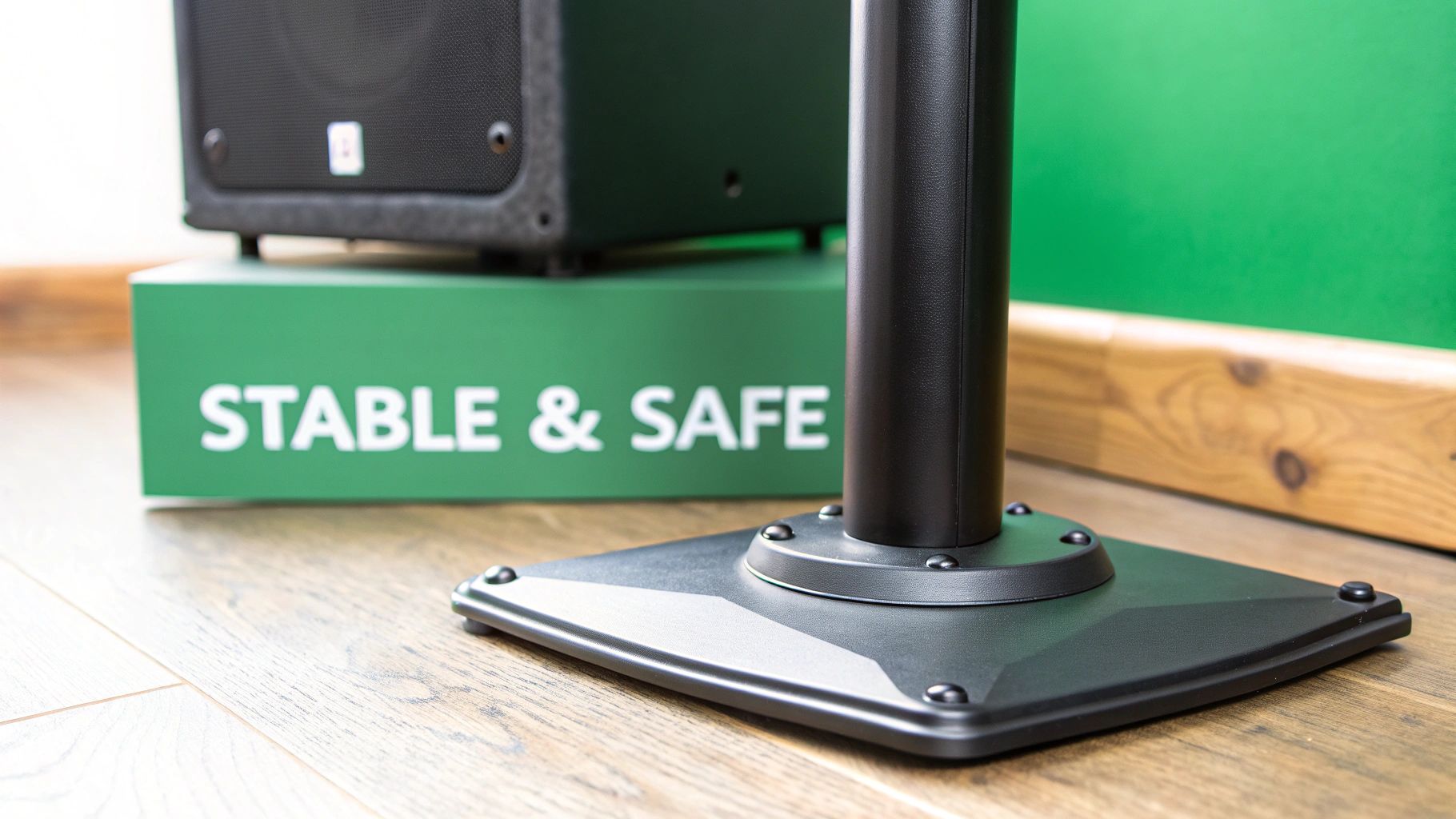
To get this right, you’ll need the exact weight of your speaker. Your goal is to find a stand with a load capacity that is significantly higher than the speaker's weight. This isn't about cutting it close; it's about building in a crucial safety margin. A stand that's only just strong enough can become unstable over time.
The Science of a Stable Foundation
With the load capacity sorted, the next piece of the puzzle is pure stability. This is all about the stand's design and what it’s made of. A wide, heavy base acts like the roots of a tree, anchoring the whole thing to the floor and making it incredibly difficult to knock over.
It all comes down to the centre of gravity. Stands built from heavy materials like steel or dense wood naturally have a low centre of gravity, which makes them inherently more stable. Lighter, flimsier stands can be easily toppled by an accidental bump from a pet, a child, or even an enthusiastic vacuum cleaner.
For hollow metal stands, there's a classic audiophile trick to seriously boost stability: filling them.
- Inert Filler: Materials like sand or specialised steel shot can be poured right into the stand's columns.
- Increased Mass: This added weight makes the stand far heavier and lowers its centre of gravity, effectively bolting it to the floor.
- Vibration Damping: The filler also makes the stand acoustically "dead," stopping the metal from ringing or vibrating along with the music, which gives you much cleaner audio.
This simple, low-cost upgrade gives you a boost in both safety and performance, making it one of the best tweaks for any surround sound setup.
Choosing the Right Feet for Your Floor
The final point of contact—where your stand meets the floor—is vital for both stability and protecting your surfaces. The type of flooring you have dictates the best approach. You wouldn't wear football boots on a dance floor, and the same logic applies here.
The interface between your stand and your floor is where acoustic energy can be either properly managed or disastrously mishandled. Choosing the correct feet—spikes or rubber pads—is not an aesthetic choice; it's a functional one that impacts both sound and safety.
For carpeted floors, metal spikes are your best bet. Their job is to pierce right through the carpet and underlay to make solid, firm contact with the subfloor beneath. This creates an unshakeable connection that drains vibrations away and prevents any wobble.
For hard surfaces like wood, tile, or laminate, spikes are a definite no-go; they'll cause damage and make the stand slide around. In this case, rubber or polymer feet are essential. These do two jobs: they protect your beautiful floor from scratches and provide the grip needed to stop the stand from moving. On a related note, for those needing to transport their gear safely, a durable option like the BoomToneDJ BOODJSTANDPROBAG is an excellent way to protect your equipment on the move.
By carefully considering load capacity, base stability, and the right floor interface, you build a foundation that not only protects your investment but also allows your speaker stands for surround sound to deliver the clear, immersive audio you’re after.
Fine-Tuning Your Setup with Coupling and Isolation
Once your speaker stands are stable and positioned just right, it’s time to wring every last drop of performance from your system. This is where we get into the nitty-gritty of audiophile fine-tuning, focusing on two crucial concepts: coupling and isolation.
Getting your head around how these principles manage unwanted vibrational energy is the final piece of the puzzle for optimising your speaker stands for surround sound. Nail this, and you can take your system from great to absolutely exceptional, with dramatically tighter bass and clearer midrange.
The Power of Coupling Your Speakers
Coupling is all about rigidly connecting your speaker to a large, stable mass – in most cases, the floor itself. The idea is to create one solid, unified structure that drains vibrations away from the speaker cabinet before they have a chance to muddy the sound.
Think of it like bolting a heavy piece of machinery to a solid concrete floor. That rigid connection transfers the machine's vibrations straight into the ground, stopping the machine from shaking itself to bits and losing efficiency. In the audio world, we achieve this with sharp metal spikes on the bottom of speaker stands.
By using spikes on a carpeted floor, you are effectively coupling the entire stand-and-speaker assembly to the subfloor. This creates an incredibly stable platform, allowing the speaker drivers to move with maximum precision and control.
This technique really shines on carpeted floors. The spikes punch right through the carpet and underlay to anchor directly to the solid structure beneath. The result? A tighter, more articulate bass response and a much clearer, more focused soundstage.
Understanding Acoustic Isolation
Isolation is the polar opposite of coupling. Instead of draining vibrations away, the goal here is to stop them from being transferred in the first place. It’s all about creating a buffer between the speaker and the surface it’s sitting on, effectively ‘floating’ the speaker.
The best analogy is a high-tech shock absorber on a performance car. Its job is to soak up all the bumps and vibrations from the road, preventing them from reaching the car's chassis and rattling the driver. For your audio setup, materials like dense foam, rubber, or specialist polymer pads act as these shock absorbers.
This approach is perfect for hard surfaces like wood, laminate, or tile. On these floors, vibrations can easily travel from the speaker, down the stand, and into the floor, causing the floor itself to resonate and colour the sound.
Coupling vs Isolation: Which Is Right for You?
Choosing between these two methods comes down almost entirely to your flooring. Neither is universally "better" than the other; they are simply different tools for different jobs.
- Coupling (Spikes): Your go-to for carpeted floors. The spikes pierce the carpet to make a solid connection with the subfloor, creating a single rigid unit that drains vibrations away.
- Isolation (Pads): Ideal for hard floors like wood, tile, or concrete. The pads absorb vibrations, stopping them from exciting the floor and creating unwanted resonance.
Getting this right is a big deal for audio purists and a growing market of discerning customers. The audio and video equipment retail industry in the United Kingdom, for instance, had a market size of £496.7 million recently. This sector is set to grow, driven by the demand for premium audio that relies on properly implemented infrastructure like speaker stands. You can discover more insights about the UK's audio retail market trends.
By mastering coupling and isolation, you’re taking control of the subtle physics of sound and vibration. This final tweak ensures that the only thing you hear is the pure, uncoloured audio coming directly from your speakers – just as the sound engineers intended.
Professional Installation and Cable Management Tips
Alright, let's get to the final, crucial step in setting up your speaker stands for surround sound: bringing it all together with a clean, professional finish. It’s not just about making things look good. A secure assembly and tidy wiring are essential for safety, performance, and keeping your system easy to manage down the road. Honestly, a chaotic mess of cables is just asking for trouble—one accidental snag could damage your gear or even cause an injury.
Taking a bit of extra time to organise everything properly is what separates a good setup from a great one. It protects your investment and makes future troubleshooting or upgrades a breeze.
Secure Stand Assembly Checklist
Before you even think about plugging in a single cable, you need to be 100% sure your stands are assembled correctly and are rock-solid. A rushed build is nearly always where things go wrong.
Just run through this quick checklist to build a secure foundation:
- Read the Instructions: I know, it sounds obvious. But manufacturers often hide vital details in there, like specific torque requirements or little assembly tricks that make all the difference to stability.
- Tighten All Fixings: Go over every single bolt and screw. Make sure they’re all properly tightened. It’s even worth giving them another check after a day or two, as things can settle into place.
- Confirm Speaker Mounting: Whether you’re using adhesive pads, Blu-Tack, or bolts, the speaker needs to be firmly attached to the stand's top plate. Give it a gentle wiggle; it should feel like one solid unit with no play whatsoever.
- Perform a Stability Test: Gently push on the top of the speaker from a few different angles. Does it rock or feel unstable? If it moves at all, stop what you’re doing and re-check your assembly and floor placement immediately.
Smart Cable Management Solutions
With your stands firmly in place, it’s time to tame those wires. A clean setup doesn't just look infinitely better, it also eliminates trip hazards and makes it dead simple to figure out what’s what later on.
A classic mistake is pulling cables tight between the speaker and the amp. You should always leave what’s called a 'service loop'—just a small, neat coil of slack cable—at each end. This stops any strain on the terminals and lets you move components without having to rewire the whole lot.
For hiding those speaker wires, consider these elegant solutions:
- Stands with Built-In Channels: This is the easiest route. Many modern stands have hollow columns or integrated channels designed specifically for this job, giving you the cleanest possible look.
- Fabric Cable Sleeves: These braided sleeves are brilliant. They wrap around your cables, bundling them into a single, tidy-looking tube. They’re flexible and come in loads of colours to match your room.
- Adhesive Cable Raceways: If you need to run cables along skirting boards or walls, these plastic trunking channels are a godsend. They offer a discreet and protective route and can even be painted to blend in seamlessly.
For more ambitious projects that might involve running wires through walls or ceilings, it pays to know your options. Our detailed guide on how to install ceiling speakers for perfect sound has some great tips that can easily be adapted for any high-end surround sound installation.
And one final tip: always label your cables at both ends. A simple label maker or even some coloured tape to mark "Side L" or "Rear R" is all it takes. This five-minute job will save you hours of headaches during future upgrades or system checks, ensuring your setup stays as functional as it is impressive.
Your Speaker Stand Questions, Answered
Even the most carefully planned home cinema project can throw up a few last-minute questions. Getting those details right is often what separates a good setup from a truly great one. Here, we'll tackle some of the most common queries that pop up when installing speaker stands for surround sound.
Getting these fundamentals sorted ensures every part of your audio system is pulling in the same direction, creating that seamless, immersive experience you're aiming for.
Do All My Surround Speakers Need to Be at the Same Height?
In a word, yes. To create a cohesive and believable sound field, your side and rear surround speakers should all sit at the same height. The professional benchmark is to place them 1 to 2 feet above ear level when you’re in your main listening position.
This consistency is what allows audio effects to pan smoothly around the room without any distracting jumps or drops in elevation. While your front LCR speakers play by a different set of rules, keeping your surrounds perfectly aligned is a core principle of high-performance home theatre design.
Can I Just Use Any Stand for My Bookshelf Speakers?
That’s a risky move. You absolutely have to check two things: the stand's load capacity and the size of its top plate. First and foremost, the stand must be officially rated to handle more than your speaker's weight. It’s a simple safety check you can't afford to skip.
Just as critical is the top plate. Ideally, it should be a very close match to the footprint of your speaker. A plate that's too small creates a dangerously unstable perch, while one that's too big can actually harm performance by causing early sound reflections. Always compare the specs of your speakers and stands to guarantee a secure and sonically transparent fit.
Is filling speaker stands with sand actually worth it? Absolutely. While it's not a requirement, it's one of the best pound-for-pound upgrades you can make. Filling the columns dramatically increases stability, but more importantly, it damps unwanted resonance. An empty metal tube can 'ring' along with the music, colouring the sound. Filling it with sand makes the stand acoustically inert, which leads to noticeably tighter bass and clearer midrange.
This simple tweak delivers a real, audible improvement for very little cost or effort. It’s a classic audiophile trick that pays dividends in both sound quality and peace of mind.
At Epic Audio Ltd, we provide the foundational hardware and expert advice that AV integrators need to deliver exceptional audio projects. From high-performance speaker stands to complete 100V line systems, our portfolio is built to perform. Explore our exclusive trade offerings and project support services to build your next installation with confidence. Learn more about our solutions at https://epicaudio.co.uk.