

Speaker System for Multiple Rooms: Design & Setup Guide
Getting your head around a speaker system for multiple rooms really starts with one clear decision. The whole game boils down to choosing the right architecture from the get-go—are you going for a 100V line or a low-impedance system? Nailing this choice is hands-down the most critical step to designing a setup that just works, perfectly, from day one.
Designing Your Multi-Room Audio Strategy
I like to think of a multi-room audio system a bit like a building's plumbing. Your amplifiers are the pumps, the wires are the pipes, and the speakers are the taps delivering the sound right where you need it. For a huge, sprawling office or a massive retail space, you’ll need a system that can deliver consistent pressure over seriously long distances. But switch gears to a high-end restaurant where the vibe is everything, and you'll need a more direct, high-flow connection for that pristine, top-notch sound.
Your strategy is all about striking the right balance between four key things: sound quality, scalability, budget, and control. Get this mix right at the start, and you'll sidestep costly redesigns and guarantee the final installation hits the mark for everyone involved. Think of it as your blueprint; it guides every single decision you make from here on out, from the type of wire you run to the specific gear you choose.
Defining Your Audio Goals
Before you even think about touching any hardware, you've got to be crystal clear on what the system actually needs to do. A setup designed for a bit of background music in a café has totally different demands than one that also has to handle emergency voice alarms in a school. Take a moment to consider the main job of the audio in each separate area.
This kind of upfront planning is more crucial than ever. The United Kingdom's speaker market, currently valued at around USD 1.17 billion, is expected to climb to USD 1.63 billion in the next few years. That growth is being driven by a huge demand for high-quality, multi-room audio in both commercial spaces and homes. You can explore more data on the UK speaker market to see these trends for yourself.
A successful multi-room installation isn't just about playing music everywhere; it's about delivering the right sound to the right place at the right volume. Your strategy is the map that gets you there.
Key Decision Factors for Your Multi-Room System
To put together a really solid plan, you need to weigh up a few critical factors for your project. Each one will directly influence the kind of system architecture and hardware you end up picking. It’s all interconnected.
The table below breaks down the main things you need to think about.
| Factor | What to Consider | Why It Matters |
|---|---|---|
| Sound Quality | Is the goal just some background ambiance (BGM), or are we talking high-fidelity, foreground music? | High-fidelity systems often demand a low-impedance setup and better-quality speakers, which will definitely impact your budget and the overall complexity. |
| Scalability | Is there a chance you'll need to add more speakers or zones down the line? | 100V line systems are far easier and more cost-effective to expand compared to their low-impedance counterparts. |
| Budget | What’s the total pot for hardware, all the cabling, and the installation itself? | This is the bottom line. It dictates the quality of your components and whether a simple setup or a more advanced control system is actually feasible. |
| Control | Do you need individual volume control in each room, or is centralised management the way to go? | The answer here determines if you can get away with simple wall attenuators, or if you need to step up to a multi-zone amplifier or even a sophisticated audio matrix. |
Thinking through these points carefully ensures you're not just buying gear, but building a system that’s perfectly suited to the job at hand.
Choosing Between 100V and Low-Impedance Systems
When you're designing a speaker system that spans multiple rooms, you'll bump into two core technologies: 100V line and low-impedance. Getting this choice right is probably the single most important technical decision you’ll make. It sets the direction for everything that follows, from the type of cable you run to the audio quality you can achieve.
A good way to think about it is choosing the right vehicle for a job. A 100V line system is your rugged, reliable lorry. It's built to cover long distances and carry a heavy, distributed load with incredible efficiency. This makes it a perfect fit for big commercial spaces like warehouses, schools, or sprawling offices where you need to run dozens of speakers from one amplifier channel.
On the other hand, a low-impedance system is more like a high-performance sports car. It’s all about a direct, powerful, and high-fidelity connection over shorter distances. This approach is king when it comes to sound quality, making it the only real choice for places where audio is front and centre, like a premium bar, a recording studio, or a dedicated home cinema.
100V Line vs Low-Impedance Comparison
To see exactly where they differ, this side-by-side comparison breaks down the key features of each system.
| Feature | 100V Line System | Low-Impedance System |
|---|---|---|
| Best For | Background music, public address, large areas (offices, schools, warehouses) | High-quality foreground music, performance venues (bars, clubs, home cinemas) |
| Sound Quality | Good, but transformers can limit frequency response (especially bass) | Excellent, with full frequency response and better dynamics. Hi-fi standard. |
| Cable Runs | Very long runs possible with minimal power loss. Uses thinner, cheaper cable. | Shorter cable runs are necessary to avoid signal loss. Requires thicker, quality cable. |
| Wiring | Simple. Speakers are daisy-chained in parallel on a single cable run. | More complex. Requires careful impedance matching (series/parallel wiring). |
| Scalability | Highly scalable. Easy to add more speakers to a line (up to the amp's limit). | Limited. Adding speakers requires recalculating impedance to avoid overloading the amp. |
| Amplifier Load | Simple. Just add up the wattage 'taps' of all speakers. | Complex. Total impedance must be calculated and matched to the amplifier's stable load. |
| Typical Impedance | N/A (High voltage system) | 4 ohms or 8 ohms |
Ultimately, neither system is inherently "better"—they are simply different tools for different jobs. The right choice depends entirely on the project's priorities: scale and simplicity versus outright audio fidelity.
Understanding the 100V Line Approach
So what's the secret behind a 100V system? It all comes down to transformers. The amplifier has a transformer that steps the audio signal up to a high voltage (100V), and then each speaker has its own little transformer to step it back down. This is the exact same principle the national grid uses to send electricity across the country with minimal power loss.
This clever design gives you two massive wins for any multi-room install.
- Simple Wiring: You can just daisy-chain a whole string of speakers together on a single cable run, almost like wiring up a set of spotlights.
- Easy Load Calculation: Every speaker has adjustable power settings, known as 'taps'. You just add up the total wattage of all the speakers on a line and make sure it’s under the amplifier's total power output. No complex maths needed.
This visual helps break down the core decision-making process based on what matters most for your project.
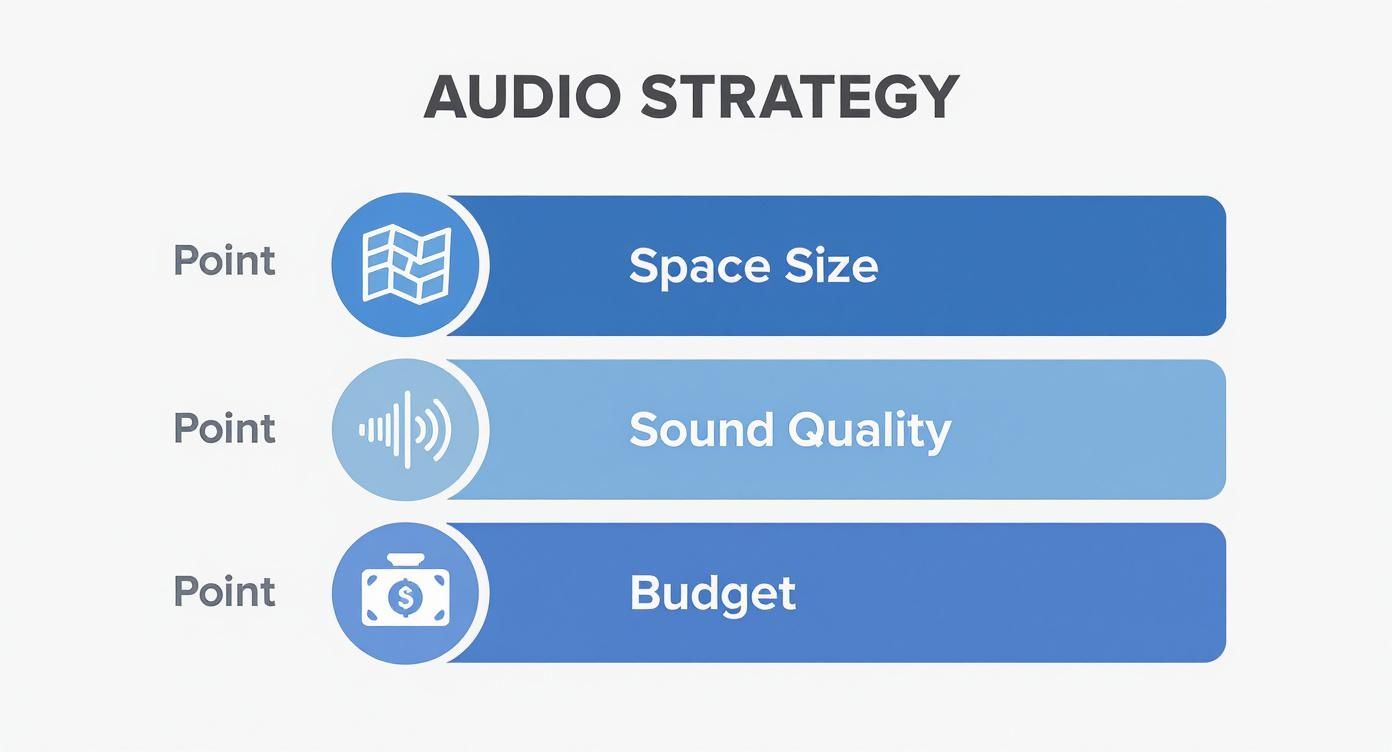
The main takeaway here is that the sheer scale of your space will often point you straight towards the best technology. For bigger, more complex jobs, 100V systems are almost always the way to go.
Exploring the Low-Impedance Option
Low-impedance systems, which you’ll often hear called 8-ohm or 4-ohm systems, work without any transformers getting in the way of the signal. This direct connection from amp to speaker is what your home hi-fi system uses, and it allows for a much wider frequency response and better dynamic range. The result? Richer, more detailed sound.
But this purity comes with a few trade-offs. Power gets lost much more quickly over distance, so your cable runs need to be kept fairly short, and you'll need to use thicker, higher-grade speaker cable. On top of that, matching the impedance is absolutely critical and much trickier. If you connect too many speakers, the total impedance can drop so low that it could seriously damage the amplifier.
For projects where sound quality is the top priority and speaker runs are manageable, low-impedance delivers an audio experience that 100V systems just can't touch. It’s the choice for foreground music, not just background ambience.
Making the Right Call for Your Project
So, which one do you pick? Let the practical needs of the space guide you. A 100V system is the undisputed champion for large public address systems and background music installations that stretch across multiple zones and over long distances. For these jobs, its scalability and simplicity are unbeatable.
But if your project is a smaller area where audio fidelity is everything—think a high-end retail boutique or a boardroom with serious AV needs—then the superior sound of a low-impedance system is the clear winner. Sometimes you might even use a hybrid approach, with low-impedance for a main bar area and 100V for background sound in the corridors and washrooms. In the end, matching the system’s strengths to your project's goals is the key to a successful, reliable install.
Mastering Audio Zoning for Total Control
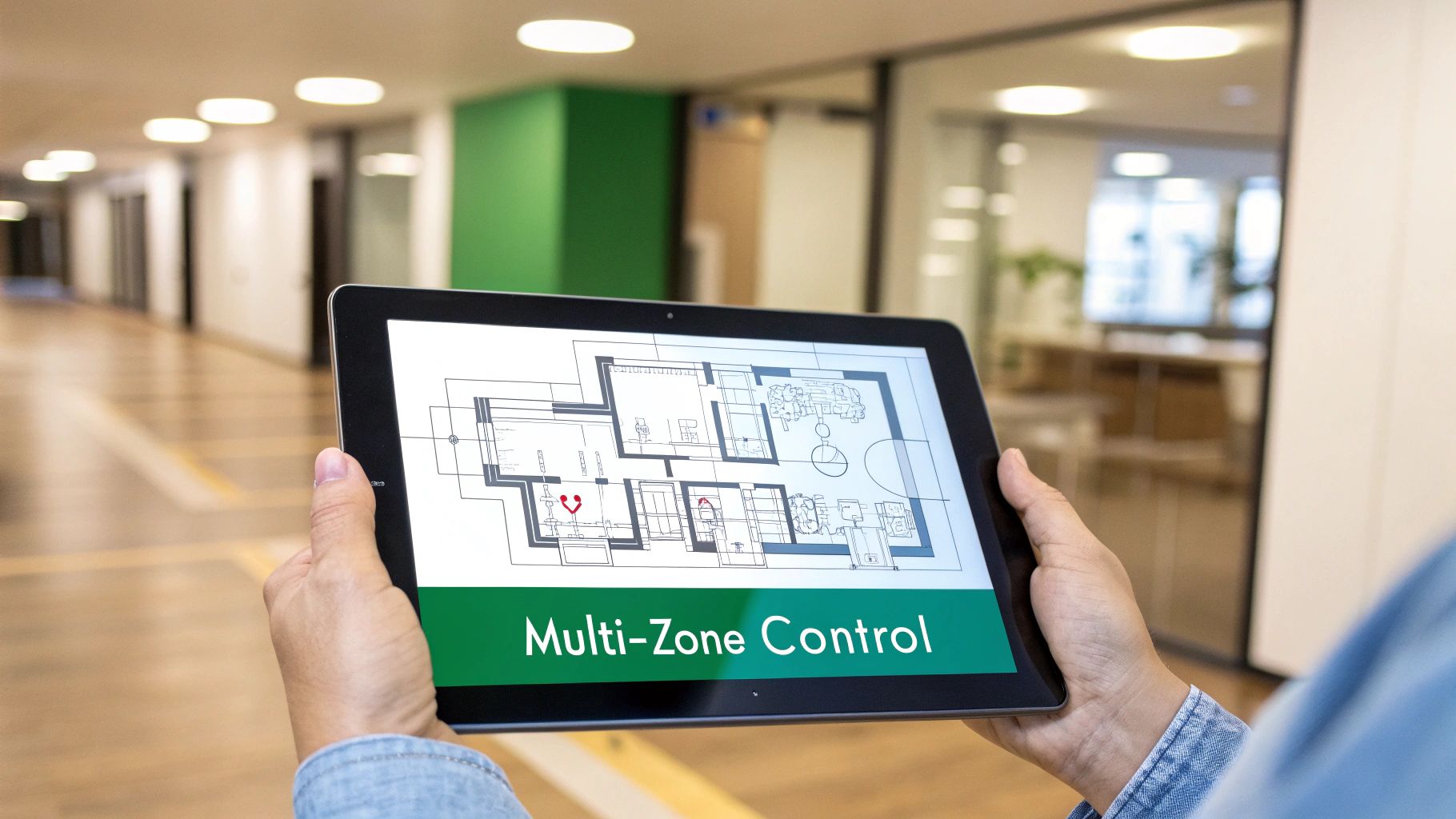 This is where a simple multi-room speaker setup transforms into a truly intelligent audio environment. Zoning is the brains behind the operation, giving you precise command over what plays, where it plays, and at what volume. For any commercial space, that level of control is non-negotiable for creating the right atmosphere.
Think about a modern hotel. The lobby needs some quiet, welcoming background music. Head to the gym, and you want high-energy tracks to get people moving. Meanwhile, the spa requires serene, calming sounds. With proper zoning, all of this can happen at the same time, from one unified system. That's the power of zoning in action.
Simple Zoning with Speaker Selectors
The most basic way to dip your toes into zoning is with a simple wall-plate speaker selector. Picture a pub with a main bar area and a quieter snug in the corner. An A/B selector switch lets the bartender easily turn the speakers in the snug on or off, or even tweak their volume, without affecting the main bar.
It's a really cost-effective way to manage two or three distinct areas. The catch? You’re limited to playing the same audio source across all zones, and the control is entirely manual and on-the-spot.
Advanced Control with Matrix Switchers
When you need to get more granular, you step up to an audio matrix switcher or a multi-zone mixing amplifier. A matrix is the central hub of your system, acting like a sophisticated telephone exchange but for your audio signals. It lets you route any input – a music streamer, a TV, a microphone – to any output zone you've created.
This unlocks a whole new level of control:
- Different Music Sources: Play rock music in the bar, jazz in the dining room, and the football commentary on the patio—all at once.
- Independent Volume Control: Set the perfect volume for each individual zone from one central point, whether that's a tablet, a dedicated wall panel, or a PC.
- Paging Overrides: Seamlessly integrate a microphone to make announcements that automatically duck the music in whichever zones you select.
An audio matrix switcher gives you complete command over the sonic landscape of your venue. It’s the difference between just having speakers everywhere and delivering a truly customised audio experience in every single room.
For installers kitting out small to medium-sized venues, a dedicated 4-zone multifunctional mixing amplifier is well worth a look, as it neatly combines the amplification and matrix control into a single, efficient unit.
The Digital Highway of Networked Audio
Today, the most flexible and scalable solution is networked audio, often running on a protocol called Dante (Digital Audio Network Through Ethernet). Think of it like your building’s IT network; a single Ethernet cable can carry data for dozens of different computers. Dante does the exact same thing, but with multiple channels of high-quality, uncompressed audio.
Instead of the old-school method of running a separate speaker cable from your amp room to every single zone, Dante sends all your audio channels down one standard network cable. A Dante-enabled amplifier or speaker can then simply "subscribe" to the specific channel it's supposed to play.
The benefits here are massive:
- Ultimate Flexibility: Rerouting audio is as simple as a few clicks in a software app. Need the meeting room audio to play in the reception for an overflow event? That takes seconds to configure.
- Scalability: Adding a new zone or audio source is as easy as plugging another device into the network switch.
- Pristine Quality: Because the audio stays digital until the very last stage, you get zero signal loss or degradation, even over seriously long cable runs.
This digital highway for sound is the gold standard for complex, evolving spaces like airports, university campuses, and large corporate headquarters, where the audio needs can change from one day to the next.
Practical Wiring and Amplifier Load Calculations
Okay, you've decided on the system architecture. Now it's time to get our hands dirty with the practical side of things. This is where theory hits the real world, and getting the wiring and load calculations spot-on is absolutely critical.
A single miscalculation here can lead to muffled sound, an overloaded amplifier, or worse, permanently damaged kit. It's that serious.
Think of your amplifier as having a fixed power budget. Ask it to do too much, and it’ll either shut itself down to protect itself (if you're lucky) or burn out completely. Both 100V and low-impedance systems have their own rules for managing this power, and knowing them inside-out is the key to a safe, reliable install that lasts.
Calculating Amplifier Load for 100V Systems
One of the best things about a 100V line system is just how simple the maths is. Your amplifier's total power output (in watts) is your budget, and you can't go over it. Every speaker you connect simply "spends" a little bit of that budget.
Every 100V speaker has a transformer with different power settings, known as taps. You might see options for 2.5W, 5W, 10W, and 20W. Your job is to select the tap that gives you the right volume for that particular spot.
To work out the total load, you just add up the wattage setting of every single speaker on the line. It's that easy.
Here’s a quick example:
- Your amplifier is rated at 240W.
- In a big open-plan office, you fit 10 ceiling speakers, each set to the 10W tap. (Total: 10 x 10W = 100W)
- For two smaller meeting rooms, you install 4 speakers, setting each to the 5W tap. (Total: 4 x 5W = 20W)
- At reception, you want a bit more punch, so you install 2 wall speakers on the 20W tap. (Total: 2 x 20W = 40W)
Add it all up: 100W + 20W + 40W = a total system load of 160W.
As a rule of thumb, you should never run an amplifier at 100% of its capacity. Always leave a safety margin of at least 20%. This 'headroom' stops the sound from distorting when the music gets loud and protects the amp from overheating on long jobs.
So, in our example, the 240W amp has a safe maximum load of 192W (240 x 0.8). Our total speaker load is only 160W, so we're well within the safe zone. We even have a bit of capacity left over if the client wants to add more speakers later.
Low-Impedance Wiring and Calculations
With low-impedance systems, we're playing a different game. The crucial number isn't watts, but impedance, which is measured in ohms (Ω). Most amplifiers are stable down to a certain impedance, usually 4Ω. If the total impedance of your speakers drops below that, you're asking for trouble.
You can hook up multiple low-impedance speakers to one amplifier channel in two main ways:
- Parallel Wiring: This is the most common method. When you wire speakers in parallel, the total impedance drops with every speaker you add.
- Series Wiring: Here, the total impedance goes up with each speaker. It's less common but can be a real lifesaver in certain situations.
The goal is always to combine your speakers so that the final impedance matches what your amplifier can handle. For example, wiring two 8Ω speakers in parallel gives you a total load of 4Ω – a perfect match for most amps. For a much more detailed walkthrough, our ceiling speakers with amplifier setup guide has wiring diagrams and extra tips.
Choosing the Right Speaker Cable
Don't let the cable be an afterthought. Using the wrong type can cause signal loss, ruin your sound quality, and even create a fire hazard.
- For 100V Systems: You need a certified, double-insulated speaker cable. The voltage is high, so safety is the number one priority. Cable thickness (gauge) isn't as critical as it is for low-impedance, but quality still matters for reliability.
- For Low-Impedance Systems: Here, signal loss over long runs is your biggest enemy. You have to use a thicker gauge cable (which means a lower AWG number) to keep resistance down and make sure all the amplifier's power actually gets to the speakers.
For any commercial job in the UK, especially if it includes a Voice Alarm (VA) system, you must use specific fire-resistant cabling to meet regulations like BS 5839-8. Always, always check the local building and safety codes before you start pulling any wire.
Selecting the Right Speakers and Amplifiers
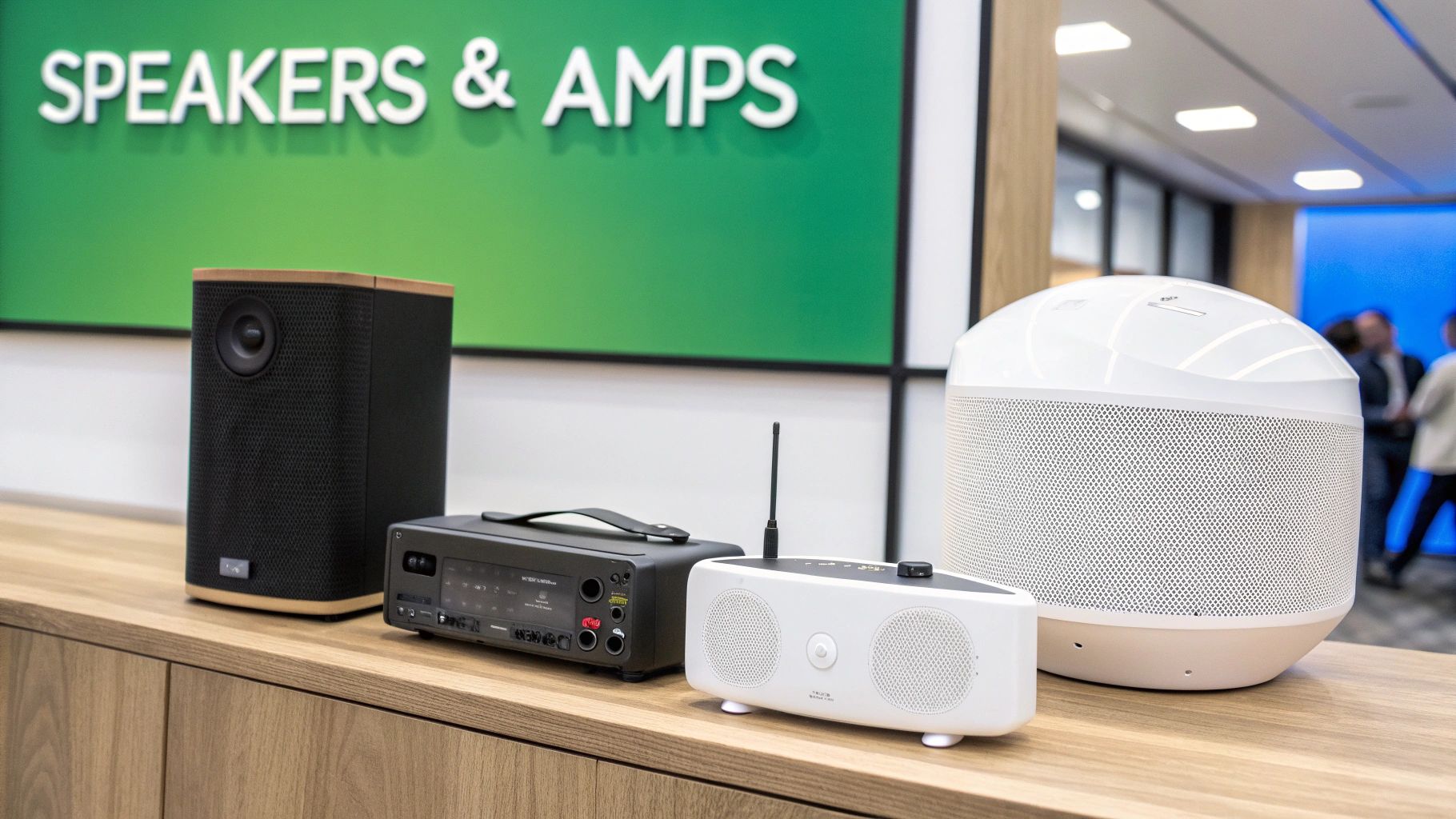
With a solid strategy, architecture, and zoning plan in place, it’s time to get hands-on with the hardware. A multi-room speaker system is only ever as strong as its weakest link, which makes picking the right speakers and amplifiers a make-or-break step. This is where you directly influence the final sound quality, long-term reliability, and even the look of the installation.
The goal isn't just to find components that work together; it's to find ones that meet the specific demands of each space. From discreet models that melt into the background to powerful units designed to be seen and heard, matching the kit to the environment is everything.
Choosing the Right Speaker for Each Space
Not all speakers are created equal, and every room has its own unique acoustic challenges. Taking a one-size-fits-all approach is a recipe for a poor-sounding, compromised system. You've got to think about the individual characteristics of each zone to pick the perfect tool for the job.
Here are the most common speaker types you’ll come across in commercial installs and where they shine:
- In-Ceiling Speakers: These are the bread-and-butter for offices, retail shops, and restaurants. They give you fantastic, even sound coverage while being almost invisible, disappearing into the ceiling for a clean, professional finish.
- Wall-Mount Speakers: The perfect solution when you can't get into the ceiling, or when you need to aim the sound more deliberately. Think bars, classrooms, or boardrooms where audio needs to be directed towards the listener.
- Pendant Speakers: Got a space with really high or open-truss ceilings like a warehouse, atrium, or a modern industrial-style shop? Pendant speakers hang down, bringing the sound source closer to ear level for much better clarity.
- Outdoor & IP-Rated Speakers: For any outside area—patios, beer gardens, poolside—you absolutely need speakers built to survive the British weather. An IP (Ingress Protection) rating is non-negotiable here, as it tells you how resistant the speaker is to dust and water.
One critical detail for ceiling speakers that often gets missed is the back can. This is a metal or plastic enclosure that sits behind the speaker in the ceiling void. It does two vital things: it ensures a consistent bass response no matter what's above the ceiling, and, crucially, it maintains the ceiling’s fire integrity rating.
By carefully selecting the right speaker for each zone, you can be sure that every area, from the main shop floor to the outdoor seating, gets audio that is both crystal clear and fit for purpose.
Selecting the Right Amplifier
Think of the amplifier as the engine of your entire sound system. It's what provides the power and, in many cases, the brains to drive all your speakers properly. Choosing the right one means matching its power output to your total speaker load and making sure its features line up with your zoning plan.
For a very simple, single-zone setup, a basic power amp might be all you need. But for most commercial multi-room jobs, you’ll need something a bit more capable.
Key Amplifier Types:
- Mixer Amplifiers: These are the true workhorses of commercial audio. They roll a mixer (for handling multiple inputs like music players and microphones) and a power amp into a single box. This makes them a brilliant, streamlined solution for pubs, shops, and small venues.
- Multi-Zone Amplifiers: As the name suggests, these units are designed to power several independent zones from one central amplifier. They often have matrix switching built-in, letting you send different music or announcements to different rooms, all controlled from one spot.
While traditional wired systems still dominate the commercial installation world due to their rock-solid reliability, the demand for wireless control is growing. The high-end home audio market in Europe, with the UK as a major player, is heavily invested in wireless systems. We're now seeing this trend cross over into luxury commercial spaces, where clients expect app-based control and easy integration with things like AirPlay. You can read more about the growth of high-end audio in Europe to see where the market is headed.
Ultimately, the right amplifier has to provide enough power for all your speakers (always add that 20% headroom for safety), offer the number of zones you need, and have the correct inputs for all your audio sources. By getting the pairing of speakers and amps right, you're building the foundation of a reliable, high-performing system.
Integrating Paging Mics and Voice Alarms
A commercial speaker system rarely just plays music. It often has to pull double duty as a public address (PA) system and, crucially, as a life-saving Voice Alarm (VA) system. Getting this integration right is fundamental for both daily operations and public safety.
The most common feature you’ll see is priority ducking. When someone speaks into a paging microphone, the system automatically dips the music volume so the announcement cuts through clearly. Once they're done, the music smoothly fades back up. This is essential for everything from calling for a price check in a supermarket to making boarding calls at a train station.
Understanding Voice Alarm Compliance
Here's where things get serious. While a basic PA system is handy, a certified Voice Alarm system is a legal necessity in many public buildings. The distinction is absolutely critical. A VA system isn't just a PA system with the volume turned up; it's a piece of life-safety equipment, rigorously designed and tested to work without fail in an emergency.
In the UK, these systems fall under the strict BS 5839-8 standard. This isn't just a suggestion—it’s a set of mandatory rules that demand features far beyond a standard audio setup:
- Continuous Fault Monitoring: The system is constantly checking itself. It will instantly report any faults with the wiring, amplifiers, or speakers.
- Battery Backup: If the mains power is cut during a fire, the VA system must keep running on a secondary power source, like a set of dedicated batteries.
- Fire Panel Integration: It has to link directly to the building's fire alarm panel. When the alarm is triggered, the VA system automatically plays pre-recorded evacuation messages.
From PA to Certified VA
The difference is non-negotiable. A simple PA might die in a fire, leaving people confused. A compliant VA system is built with the resilience and redundancy needed to guide them to safety when it matters most. It’s interesting to see how consumer trends are heading towards wireless, with a majority of UK urban households now preferring wire-free home audio. But in the commercial world, that hard-wired reliability is a legal and moral obligation for life safety systems. You can read more on how wireless preferences are shaping the UK home audio market to see just how different the two worlds are.
A Voice Alarm system is fundamentally different from a public address system. It is a piece of life-safety equipment first and an audio system second. Designing and installing one without adhering to legal standards carries significant legal and ethical risks.
For more complex paging needs, modern Audio-over-IP solutions like the EAM-17DT Dante Microphone Array System can be woven into these networked setups. They give you incredible flexibility for routing announcements across multiple zones, while still feeding the core audio into a fully compliant VA system for emergency use.
Common Questions About Multi-Room Speaker Systems
Even with a solid plan, a few questions always seem to pop up during a multi-room speaker installation. Here are some quick, straightforward answers to the queries we hear most often from installers and business owners.
Can I Mix Different Speaker Brands in a 100V Line System?
Yes, absolutely. This is one of the best things about working with 100V line systems – their sheer flexibility. As long as every speaker has its own 100V line transformer, you can mix and match different brands and even different types, like ceiling, wall-mount, and pendant speakers, all on the same cable run.
The crucial bit is to make sure you set the correct power tap on each speaker. After that, just do a quick calculation to ensure the total wattage of all the speakers added together doesn't go over 80% of your amplifier's total power output.
Do I Need Special Wiring for a Multi-Room Speaker System?
For any commercial 100V line project, we’d always recommend using a certified, double-insulated speaker cable for both performance and safety. But the rules get a lot more serious if your system needs to handle Voice Alarm (VA) duties.
In the UK, regulations like BS 5839-8 legally require the use of specific fire-resistant cabling for VA systems. This is non-negotiable, as it ensures the system keeps working during an emergency, which is a critical safety feature for public buildings. Always check your local building codes.
How Can I Control the Volume in Each Room Independently?
You've got a couple of great options here. The simplest approach is to fit in-wall volume controls, often called attenuators, in each room or zone. This gives people on-the-spot, local control.
For more powerful and centralised control, a multi-zone amplifier or a dedicated audio matrix switcher is the way to go. These bits of kit let you manage both the audio source and the volume for every single zone from one central point – whether that’s a wall panel, a PC, or a simple app on a tablet.
At Epic Audio Ltd, we've got the hardware and the know-how to help you deliver your commercial audio projects. From the first sketch to the final sign-off, our team is here to support installers with trade pricing, system design, and a massive portfolio of professional audio gear. Check out our range and see how we can help at https://epicaudio.co.uk.