

A passive bass speaker is essentially an unpowered, low-frequency loudspeaker that needs a separate, external amplifier to make any sound. This setup gives you maximum flexibility, letting you choose and pair your own amplifier and crossover components. You get complete control over how your sound system performs and how you can scale it up later.
Why Pros Still Choose Passive Bass Speakers

While active, or powered, subwoofers offer a neat all-in-one solution, you'll find that professional installers and serious audio enthusiasts often lean towards the modular nature of a passive bass speaker. The real advantage is separating the speaker from the amplification. This design philosophy opens up a world of customisation that integrated systems just can't touch.
When you go with a passive system, you’re not stuck with the manufacturer's built-in amp. Instead, you can hand-pick an amplifier that perfectly matches your speaker's power handling and impedance. This is how you guarantee optimal performance and longevity, which is absolutely critical in demanding commercial installations or high-end home cinemas.
The Power of Component Separation
Think of it like building a high-performance PC. If you need the absolute best performance for a specific job, you wouldn't buy an off-the-shelf machine. You’d carefully select the motherboard, processor, and graphics card yourself. The exact same logic applies to professional sound systems.
Breaking the system down into separate components provides some clear benefits:
- Ultimate Flexibility and Upgradability: You can upgrade your amplifier or speaker independently as new tech comes out or your needs change. This makes a passive system a proper long-term investment, not a disposable appliance.
- Precision System Matching: You can create a perfectly synergistic audio chain. This means pairing a high-current amplifier with a low-impedance speaker to deliver that dynamic, articulate bass you can really feel.
- Simplified Servicing: If an amplifier fails inside an active sub, the whole unit is out of action and often needs a specialist to fix it. With a passive setup, you just swap out the external amp. Downtime is minimised—a massive plus for any commercial venue.
This modular approach is a cornerstone of building robust and reliable audio solutions. You can learn more about how all these parts work together in our comprehensive guide to pro PA speaker systems.
Understanding the Key Differences
The real distinction between active and passive designs comes down to where the power and processing happen. An active subwoofer packs the driver, the enclosure, and a dedicated amplifier all into one box. A passive bass speaker is just the driver and its enclosure, waiting for you to bring the power.
A passive setup puts the system designer—you—in complete control. It demands a deeper understanding of specs like impedance and sensitivity, but the reward is a system tailored precisely to the acoustic goals of the space, whether it's a retail store, a live music venue, or a dedicated listening room.
This is exactly why the pros favour passive designs for complex or large-scale projects. They can run multiple speakers from a single, beefy amplifier rack tucked away in a central equipment room, which simplifies wiring and maintenance. This scalability also means a system can grow from a simple 2.1 setup to a full-blown multi-zone audio network without having to replace the core speaker components. Once you master the fundamentals, you unlock the potential for truly exceptional low-frequency performance.
Choosing the Right Passive Bass Speaker for Your Space

Picking the right passive bass speaker isn't about grabbing the biggest driver you can find. It’s a game of matching the speaker's technical capabilities to the acoustic reality of your space, whether that's a home cinema or a bustling bar.
Let's cut through the noise and focus on the specs that actually translate into clean, powerful, and reliable low-frequency performance. These numbers aren't just marketing fluff; they’re the blueprint for a system that delivers every single time.
Decoding Power Handling: RMS vs Peak
Power handling tells you how much juice a speaker can safely take from an amplifier. It’s probably the most misunderstood spec out there, often leading people to either blow their speakers or leave performance on the table. You'll see two key ratings:
- RMS (Root Mean Square): This is the one you really need to pay attention to. It represents the continuous power a speaker can handle day in, day out without breaking a sweat. Think of it as the speaker's marathon pace.
- Peak Power: This number shows the absolute maximum power the speaker can handle in tiny, split-second bursts—like a kick drum hit or an explosion in a film. It’s always a much higher figure and can be seriously misleading if you base your decision on it alone.
When you’re matching an amp, always, always go by the RMS rating. A solid rule of thumb in the pro world is to pick an amplifier that delivers around 1.5 to 2 times the speaker’s RMS power. This gives you plenty of "headroom," letting the amp handle those big dynamic peaks without 'clipping'—a nasty form of distortion that will fry a speaker’s voice coil in no time.
Understanding Speaker Impedance
Impedance, measured in ohms (Ω), is simply the electrical resistance the speaker presents to your amplifier. It dictates how much current the amp has to push, and the two most common ratings you'll encounter are 8 ohms and 4 ohms.
A lower impedance speaker (4 ohms) will draw more current from your amp than a higher impedance one (8 ohms). This isn't good or bad on its own, but it's vital for system stability. You must check that your amplifier is rated to handle the impedance load you're connecting.
For example, trying to run a 4-ohm speaker on an amp that's only happy with 8-ohm loads is a recipe for disaster. The amp will likely overheat, shut down, or worse, fail completely. It gets even trickier when you start wiring multiple speakers together, as this changes the total impedance the amp sees.
Choosing the right impedance is a strategic decision. An 8-ohm speaker is generally an easier load for most amplifiers, while a 4-ohm speaker can extract more power from a capable, high-current amplifier, making it a powerful choice for demanding applications.
Interpreting SPL and Sensitivity
So, how loud can the speaker actually get? This is where Sound Pressure Level (SPL) and sensitivity come into play. A speaker's sensitivity rating, which might look something like "98 dB (1W/1m)", tells you how efficiently it turns power into sound. In this example, the speaker produces 98 decibels of sound when measured from one metre away with just one watt of power.
A higher sensitivity rating means the speaker will go louder with less amplifier power. A mere 3 dB increase actually represents a doubling of acoustic energy. So, a 98 dB sensitive speaker will sound noticeably louder than a 95 dB one fed the same amount of power.
This efficiency is a huge deal in professional audio. In the UK, we're seeing steady growth in the mid-power passive bass speaker market (500-1,000W), which is expanding at a 4.1% CAGR. Why? Because a modern, efficient 700W cabinet can often match the real-world SPL of an older, less efficient 1kW model, potentially cutting setup costs by up to 15% for mid-sized venues. You can dive deeper into these professional speaker market trends for more insights.
Matching Enclosure Type to Your Sound Goal
The cabinet, or enclosure, has a massive impact on how a passive bass speaker sounds. The design dictates everything from its punch and accuracy to how deep it can go. Each type is engineered for a very specific job.
Here's a quick rundown of what to expect from the most common designs.
Matching Enclosure Type to Your Sound Goal
| Enclosure Type | Acoustic Profile | Best For | Pros | Cons |
|---|---|---|---|---|
| Sealed | Tight, accurate, punchy | Music studios, critical listening rooms, high-fidelity audio | Excellent transient response, very musical, predictable roll-off | Less efficient, limited deep bass extension compared to ported |
| Ported | Deep, powerful, high output | Home cinemas, live music venues, DJ setups | Higher SPL output, extended low-frequency response | Can sound "boomy" if poorly designed, less precise than sealed |
| Bandpass | Very high output, narrow frequency range | Clubs, large venues, car audio systems where pure volume is key | Extremely efficient and loud within its designed range | Limited frequency bandwidth, often a one-note bass character |
Ultimately, choosing between them comes down to what you're trying to achieve. If you're in a studio and need to hear every last detail of a bassline, a sealed box is your best bet. But if you're building a home cinema and want to feel the rumble of an action sequence, a ported design will deliver that visceral impact you're after.
Matching Your Speaker with the Right Amplifier and Crossover
A passive bass speaker is an incredible tool, but on its own, it’s just a silent box. The real magic happens when you pair it with the right amplifier and crossover. When you get this combination right, you create a system where each component elevates the others, transforming muddy, underwhelming bass into a tight, powerful low end that you can actually feel.
This isn’t about guesswork. It’s about making calculated decisions that protect your gear and deliver predictable, professional results every single time. Let's break down how to create that perfect match.
Calculating Your Amplifier Power Needs
One of the most common mistakes I see in the field is underpowering a speaker. It sounds counterintuitive, but a weak amplifier constantly pushed to its limits is far more dangerous to your speakers than one with power to spare. When an amp runs out of clean power, it starts to "clip," sending a distorted square wave signal that can quickly fry a speaker's voice coil.
To avoid this, you need headroom. A solid rule of thumb in the industry is to choose an amplifier that can deliver 1.5 to 2 times the speaker's continuous RMS power rating. So, for a passive bass speaker with a 500W RMS rating, you should be looking for an amp that provides between 750W and 1000W into the same impedance load. This ensures the amp can reproduce those loud, dynamic peaks in music or film without ever breaking a sweat.
Choosing an amplifier is about more than raw wattage. It’s about providing enough clean, undistorted power to let your passive bass speaker perform at its absolute best, ensuring both sonic excellence and long-term reliability.
Impedance Matching for Stability and Performance
Next up is impedance. You absolutely must match the amplifier's capabilities to your speaker's impedance load, which is measured in ohms (Ω). Every professional amplifier has a minimum impedance it can safely drive. Pushing it below this rating will cause it to overheat and, in the worst-case scenario, fail completely.
Most individual passive bass speakers are rated at 8 ohms or 4 ohms. A single 8-ohm speaker presents a straightforward load for almost any pro amp. But things get more interesting when you start wiring multiple speakers to a single amplifier channel, as this changes the total impedance.
- Wiring two 8-ohm speakers in parallel gives you a 4-ohm load.
- Wiring two 4-ohm speakers in parallel results in a 2-ohm load, which many amplifiers simply cannot handle.
Always, always check your amplifier's spec sheet to confirm it's stable at the final impedance load of your speaker setup. This step is non-negotiable for building a reliable system.
Interestingly, while these calculations are vital for big stage setups, the principles are just as important for home audio. Passive bass speakers are actually making a huge comeback in UK homes, mainly due to their customisability. Data even shows strong revenue growth for passive speakers in home theatre applications, where a well-matched system can be tuned to achieve deep bass extension right down to 25Hz—something many all-in-one active units struggle with. You can explore the full research on passive speaker trends to see just how much this market is growing.
Demystifying the Role of the Crossover
The final piece of this puzzle is the crossover. Think of it as a traffic controller for audio frequencies. Its job is to ensure that only the low-frequency signals get sent to your passive bass speaker, while the mid and high frequencies are routed to your main speakers. Without a crossover, all your speakers would be trying to reproduce the entire frequency spectrum, and the result would be a muddy, incoherent mess.
You have two main options here:
Internal Passive Crossovers
These are simple filter networks built directly into some full-range speakers. They're basic, require no external power, but offer very little control. You’ll rarely see them used for dedicated bass speaker setups.
External Active Crossovers
This is the professional standard, and for good reason. An active crossover is a separate electronic device that sits between your audio source (like a mixer) and your amplifiers. It lets you precisely set the crossover point—the exact frequency where the bass speaker takes over from the mains. A common starting point is around 80-100Hz.
If you're interested in how amplifiers process signals for different jobs, our guide on selecting an amplifier for voice applications offers some great related insights.
Using an active crossover gives you the complete control needed to fine-tune your system. It allows you to create a seamless blend between your bass and main speakers, delivering a truly cohesive and impactful sound.
Professional Wiring and Installation Techniques
You can meticulously select the perfect passive bass speaker and amplifier, but it all counts for nothing without professional-grade wiring and installation. This is where theory meets the real world. Getting the details right is what separates a clean, powerful system from one plagued by poor performance and safety headaches.
The absolute foundation of any solid install is the speaker cable itself. Using an undersized cable over a long distance is a classic mistake, and it will choke your amplifier's power before it even reaches the speaker. The result? Power loss, a reduced damping factor, and a noticeable drop in sound quality, often leaving the bass sounding loose and undefined.
As a rule of thumb, the longer the cable run and the lower the speaker's impedance, the thicker the cable you'll need. For most professional jobs involving a passive bass speaker, 12 AWG or 14 AWG (American Wire Gauge) is a robust choice that ensures minimal signal degradation.
Mastering Speaker Wiring Configurations
The way you connect multiple speakers to a single amplifier channel directly impacts the total impedance load. Understanding the two main methods—parallel and series wiring—is absolutely essential for system stability and getting the performance you need.
- Parallel Wiring: This is the go-to method in pro audio. You connect the positive terminals of all speakers together, and do the same for all the negative terminals. The key takeaway is that wiring speakers in parallel decreases the total impedance. For instance, two 8-ohm speakers wired in parallel will present a 4-ohm load to the amp.
- Series Wiring: With this setup, you daisy-chain the speakers, connecting the positive of one to the negative of the next. This method increases the total impedance. So, those same two 8-ohm speakers in series will result in a 16-ohm load.
Most professional applications favour parallel wiring because it lets the amplifier deliver more power. However, you must be absolutely certain your amplifier is stable and happy running at that resulting lower impedance.
This diagram illustrates the fundamental signal flow, from speaker selection right through to the final sound output.
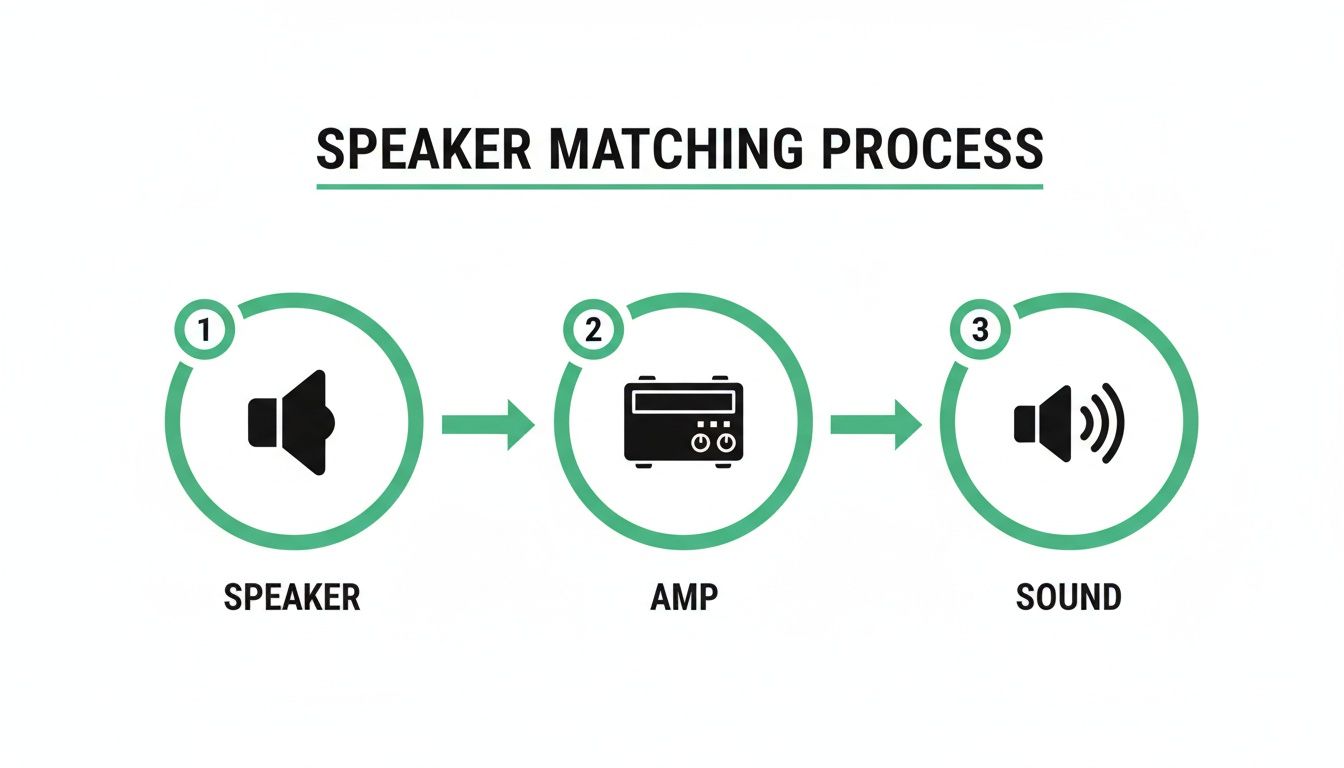
The visualisation really hammers home that the connection between the speaker and amplifier is the critical bridge to achieving high-quality sound.
Professional Connectors and Cable Management
While it might be tempting to just use bare wire connections, professional installs demand more secure and reliable solutions. Speakon plugs are the industry standard for a reason. They have a locking mechanism that prevents accidental disconnection—a lifesaver in live events or busy commercial venues.
They also provide a much larger contact area than banana plugs or bare wire, which means a better electrical connection and power transfer. For permanent installs, especially those with in-wall wiring, using wall plates with high-quality binding posts or Speakon sockets creates a clean, professional, and serviceable finish. You can pick up more practical tips from our detailed guide on how to install ceiling speakers for perfect sound, as many of the core principles apply.
Proper cable management isn't just about making things look tidy; it’s about signal integrity. Running speaker cables parallel to high-voltage power lines can introduce hum and noise into your audio system. Whenever possible, cross power and audio cables at a 90-degree angle to minimise any interference.
Finally, always put safety and compliance first. When you're running cables and making connections, you have to know and follow all local regulations. For commercial projects, this often means using specific cable types (like plenum-rated cables for air handling spaces) and following strict installation practices to maintain electrical code compliance. This doesn't just ensure the system is safe; it guarantees it will pass any required inspections, protecting both you and your client.
Strategic Speaker Placement and Room Tuning

So, you’ve picked the perfect passive bass speaker, paired it with a powerful amp, and wired it all up like a pro. Brilliant. But now comes the bit that truly separates good bass from great bass: getting it positioned and tuned just right for the room.
Believe me, where you place your speaker is just as crucial as the hardware itself. It’s all about how the speaker interacts with the room's acoustics.
Low-frequency sound waves are long and powerful. They bounce off walls, floors, and ceilings, creating spots where frequencies either cancel out (a "dead spot") or build up, resulting in a boomy, overwhelming mess. These are called room modes, and getting them under control is the secret to smooth, consistent bass throughout your space.
Finding the Sweet Spot with the Subwoofer Crawl
Before you even touch a dial, you need to find the best physical spot for your speaker. The most effective, time-tested trick in the book is the "subwoofer crawl." It might sound a bit daft, but the acoustic principle behind it is absolutely solid.
Here's how it works:
- Stick the passive bass speaker right where you'll be listening from – on the sofa, your favourite chair, wherever.
- Put on a track you know well, something with a steady, repeating bassline.
- Now, get down on your hands and knees and literally crawl around the edges of the room where you're thinking of putting the speaker.
- Listen closely. You’ll hear the bass change dramatically as you move. In some places, it'll sound thin and weak; in others, it'll be tight, deep, and perfectly clear.
That spot where the bass sounds best? That’s your sweet spot. Mark it with a bit of tape. This simple technique flips the speaker-listener relationship, letting you physically find where the room's acoustics deliver the most balanced low-end to your primary listening position.
Integrating Your Bass with System Tuning
Once your speaker is in its new home, the final job is to blend it seamlessly with your main speakers. This is all done using the controls on your amplifier or audio processor. The goal is to make everything sound like one cohesive system, not a collection of separate boxes.
The aim isn't just to have "loud bass." It's to create a unified soundstage where the low end perfectly supports everything else. The best bass performance is one you feel more than you can pinpoint, integrating flawlessly without drawing attention to itself.
The two most critical adjustments here are phase and level matching.
Phase Control
Your amp or crossover will have a phase switch or dial, usually running from 0 to 180 degrees. This tweak adjusts the timing of the bass speaker's driver compared to your main speakers. If they're out of phase, their sound waves can clash at the crossover point, creating a noticeable dip in the mid-bass.
To get it right, play some music and get a friend to flip the phase switch back and forth while you sit and listen. Go with the setting that sounds fullest and loudest in the bass region.
Level Matching
Finally, you need to balance the volume. The easiest way is with an SPL meter – even a decent smartphone app will get you close. Play some pink noise through your system and measure the volume from your main speakers at your listening spot. Then, disconnect the mains and adjust the bass speaker's amp channel until it hits the same level.
After that, it’s all about fine-tuning by ear to get it just how you like it. When you're trying to get the best performance, understanding sound barrier principles can also be incredibly useful for managing the acoustics of the wider environment.
The UK speaker market hit USD 1.17 billion in 2024, and it's set to grow by 3.40% annually through 2034. Passive bass speakers are a big driver of this, as their ability to be paired with high-wattage amps to reach SPL levels up to 120dB is perfect for the larger living spaces in many UK homes and for replicating the powerful, bass-heavy music popular in British club culture.
Getting to the Bottom of Bass Speaker Problems
Even the most carefully planned system can throw you a curveball. When the low end just isn’t performing, it's usually down to one of a few common culprits. Instead of randomly swapping gear, a structured approach will save you time, money, and a lot of frustration.
Let's walk through a diagnostic process, starting with the simple stuff and working our way up. This will help you pinpoint the issue and get your passive bass speaker delivering the performance it was designed for.
Dead Silence: When There's No Sound at All
Okay, the most worrying problem is when you get nothing from the speaker. It’s easy to assume the worst, but more often than not, it's a simple oversight rather than a catastrophic failure.
Before you start unplugging everything, check the absolute basics. Is the amplifier actually on and receiving a signal? Make sure your source is playing and the volume is up on your mixer or pre-amp. You wouldn't believe how often a muted channel is the root cause.
If the basics are covered, it's time to trace the signal path:
- Check Your Cables: Is the speaker cable properly locked in at both the amp and the speaker? A loose Speakon connector or a wire that’s popped out of a binding post is a very common offender.
- Look at the Amplifier: Most professional amps have status lights. If you see a red or amber "protect" light, the amp has shut down a channel to prevent damage. This could be due to a short circuit in the wiring or an impedance load it can't handle. Power everything down, disconnect the speaker, and see if the amp powers up cleanly without a load attached.
- Swap and Test: The quickest way to isolate a fault is by substitution. Try a speaker cable you know works. If that doesn't fix it, connect a different, working speaker to that same amplifier channel. This process of elimination will tell you very quickly if the problem lies with the original speaker, the cable, or the amp itself.
The Dreaded Hum and Buzz
There's nothing more irritating than a persistent hum or buzz. This kind of noise is almost always an electrical or signal chain issue, not a fault with the passive bass speaker. The number one cause? A ground loop.
A ground loop happens when different pieces of audio gear are plugged into separate mains sockets, creating more than one path to the earth ground. This can introduce a nasty 50Hz hum (in the UK) which is especially obvious through a bass speaker.
A ground loop is an electrical problem, not a speaker problem. The hum is just the symptom. Solving it means finding and fixing the source of the electrical interference in your system.
Here’s how to hunt it down and eliminate it:
- Use One Socket: The simplest fix is often to plug all your audio equipment—mixer, amp, source players—into a single high-quality power distribution unit or strip. This often gets rid of the problem immediately.
- Isolate the Source: Unplug all the input cables from your amplifier. If the hum goes away, the loop is coming from one of your source devices. Plug them back in one by one until the noise returns, and you’ve found your culprit.
- Break the Loop: For really stubborn ground loops, a DI (Direct Injection) box with a "ground lift" switch or a dedicated audio isolation transformer on the signal line is the professional solution. It safely breaks the electrical connection causing the loop.
Weak or Muddy Bass? It's All in the Setup
If your speaker is making noise but the bass is weak, lacks punch, or just sounds "muddy," the problem is almost certainly in your setup and tuning, not a hardware fault. This usually points to phase misalignment or incorrect crossover settings.
First, take another look at your crossover. If you set the crossover point too low, you'll leave a "hole" in the sound between your main speakers and the sub. Set it too high, and you get a boomy, undefined mess where both sets of speakers are fighting to reproduce the same mid-bass frequencies. A good starting point is usually between 80-100Hz, but you have to fine-tune this by ear to get a smooth transition.
Phase alignment is the other big one. If your bass speaker is pushing out while your main speakers are pulling in, their sound waves will literally cancel each other out around the crossover frequency. This creates a massive drop in bass right where you're listening.
- Actionable Tip: Get a friend to flip the phase switch (usually labelled 0/180 degrees) on your amp or crossover while you stand in the main listening spot. One setting will sound noticeably fuller and more powerful. That's the one you want.
At Epic Audio Ltd, we provide the hardware and the expertise to support your audio projects from concept to completion. Explore our extensive range of professional audio solutions for your next installation.
Find the right audio solution for your project at epicaudio.co.uk