

Imagine trying to have a conversation in a packed venue. The chatter, the music, the general hum—it all blends into a solid wall of noise. For someone with hearing loss, this isn't just a distraction; it's a barrier that makes it nearly impossible to pick out a single voice or announcement. It's like trying to find one specific radio station buried under layers of static.
This is the exact problem that hearing loop systems are designed to solve. They cut through all that background clutter.
Why Hearing Loops Are a Game Changer for Accessibility
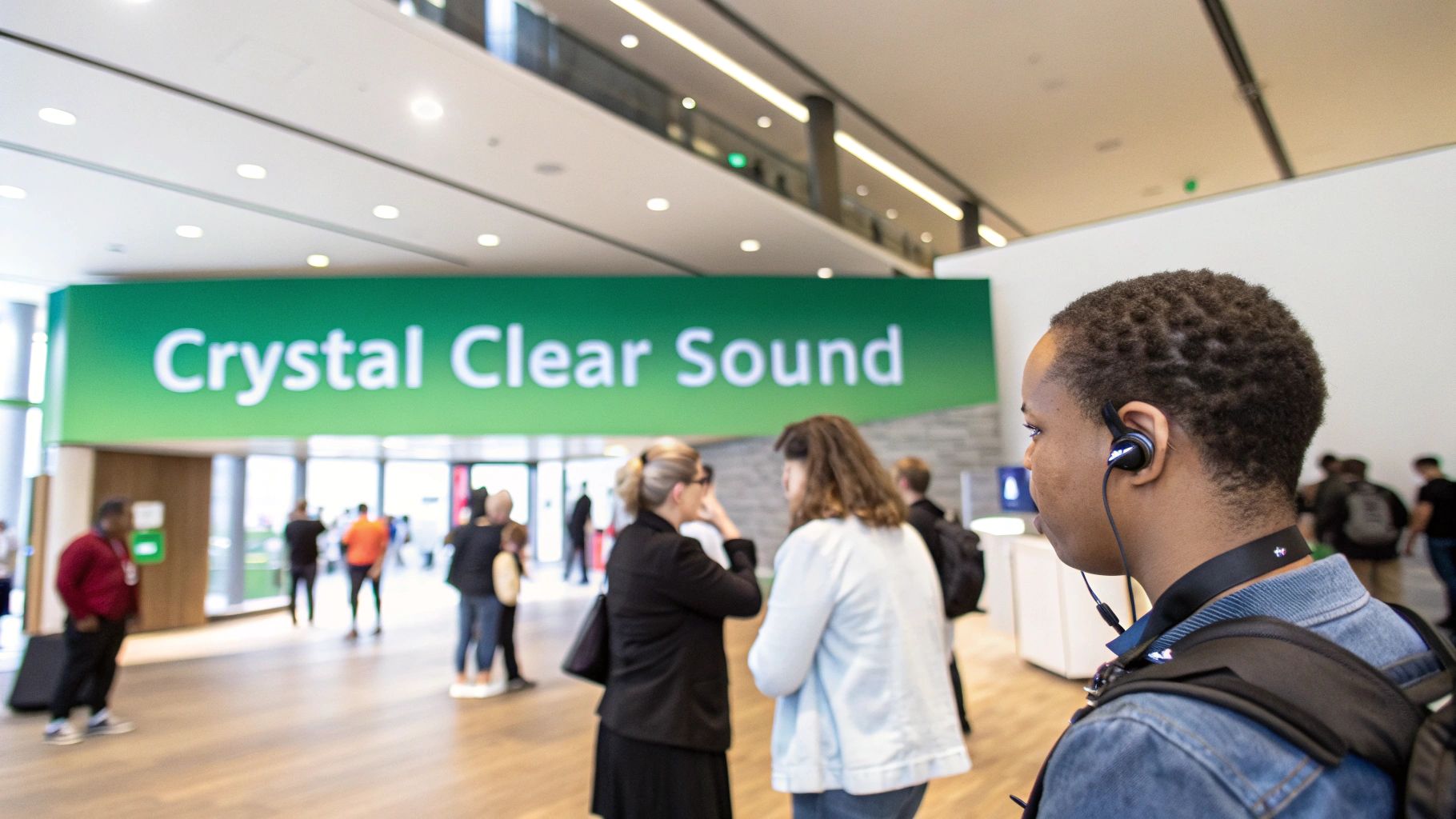
Unlike a standard PA system that just cranks up the volume—and all the unwanted noise with it—a hearing loop delivers a clean, direct audio feed straight into a person’s hearing aid. It's an elegant solution to a complex problem.
This guide is built for AV professionals like you. You’re the ones on the ground, with the power to turn a noisy, exclusive space into an accessible one.
The Installer's Role in True Accessibility
As an installer, you're not just running cables and connecting kit. You are genuinely crafting an inclusive experience. A properly installed hearing loop system isn’t about ticking a box; it's about fundamentally changing how people connect with a space.
We’ll walk through the whole process, from the science behind the tech to the nuts and bolts of installation and UK compliance. You'll quickly see how this expertise can make your business stand out, transforming a client's legal obligation into a real competitive edge for them—and you.
A well-executed loop system brings a host of benefits:
- Seamless User Experience: There are no clumsy receivers or headphones. Users simply flick their hearing aid to the 'T' (Telecoil) setting to tune in. It’s that easy.
- Dignified Access: It’s a discreet solution. People can participate fully without having to draw attention to their hearing loss.
- Legal Compliance: A correct installation ensures your clients are meeting their duties under the Equality Act 2010, which mandates 'reasonable adjustments' for accessibility.
- Superior Sound Quality: The direct magnetic transmission bypasses the room's acoustics entirely, eliminating echo, distance issues, and background noise.
A hearing loop cuts through the noise of a busy venue, delivering a clean, direct audio feed. It is not just an amenity but a fundamental tool for communication and inclusion, directly impacting the quality of life for millions.
Of course, creating a truly accessible environment goes beyond just audio. It’s also worth being aware of other assistive communication technologies like Speech Assistant AAC, which help people with speech impairments communicate clearly. Having a broad understanding of these solutions positions you as a true expert in the field.
How Hearing Loop Technology Actually Works
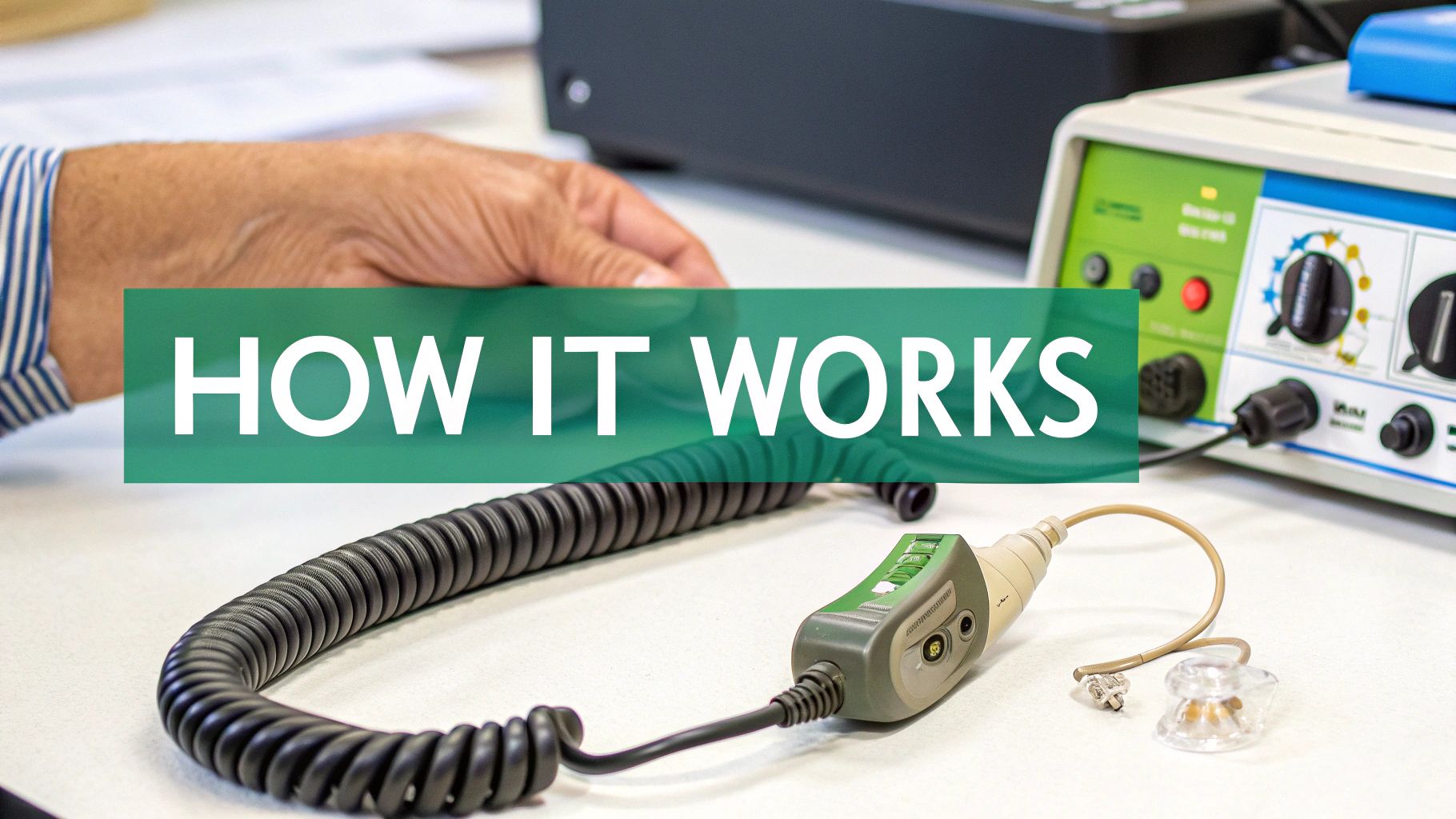
At its core, a hearing loop system is like a personal, hyper-localised radio broadcast. But instead of sending music across a city, it transmits a crystal-clear audio signal directly into a user's hearing aid, all confined within a specific room. It’s a clever bit of physics—electromagnetic induction—that makes it so incredibly effective.
This whole process is surprisingly straightforward but powerful. It neatly sidesteps all the usual acoustic problems that plague big or noisy venues. For any AV installer, getting your head around this signal path is the first real step to designing and deploying hearing loop systems that actually do the job right.
What you're really doing is creating a personal sound bubble for every user. You’re delivering the intended audio without any of the background chatter, echo, or distance issues, transforming a messy soundscape into a clean, understandable experience.
Tracing the Signal Path from Source to Ear
Let’s follow the journey of sound through a hearing loop. It all starts with capturing the audio and ends with it arriving flawlessly in the listener's ear. The real magic happens when sound energy gets converted into magnetic energy and then back again.
Picture a speaker at a podium in a big conference hall. Their voice is the audio source we need to deliver.
- Audio Capture: It all kicks off when a microphone picks up the speaker’s voice. This could just as easily be an audio feed from a mixing desk, a TV, or any other sound system.
- Amplification: From the mic, the signal heads to a specialised loop driver or amplifier. This is the brains of the operation.
- Current Conversion: The driver takes that audio signal and converts it into a very specific electrical current, meticulously controlled to meet performance standards.
- Magnetic Field Generation: This current is then pushed through a loop of thin cable. Often, it's a discreet flat copper tape tucked away under the flooring or in the ceiling, tracing the perimeter of the room. As the current flows, it radiates a magnetic field throughout the looped area—a field that is an exact replica of the original audio.
This magnetic field is the "broadcast." It silently and invisibly fills the room with the sound signal.
The Role of the Telecoil
Now for the final piece of the puzzle, and arguably the most important. It's a component you don't even install: the telecoil (or T-coil). This is a tiny, inexpensive coil of wire built into the vast majority of modern hearing aids and cochlear implants.
This small but mighty feature acts as a wireless receiver. When a hearing aid user switches their device to the "T" setting, the telecoil immediately picks up the magnetic field you've created with the loop.
The telecoil's job is simple: it converts the magnetic signal it picks up directly back into high-fidelity sound. This sound is then amplified by the hearing aid and delivered straight to the user's ear, perfectly tailored to their specific hearing loss profile.
This direct transmission is precisely why hearing loop systems are so transformative. All the usual acoustic barriers just vanish.
- No Background Noise: The chatter of the crowd, the hum of the air-con, and other ambient sounds simply aren't picked up by the magnetic field.
- No Reverberation: Sound bouncing off walls and ceilings (echo) is completely bypassed because the signal travels directly to the telecoil.
- No Distance Decay: It doesn’t matter if the user is sitting in the front row or right at the back. As long as they are inside the loop, the signal strength and clarity are rock solid.
Ultimately, the technology forges a direct link between the sound source and the listener's brain. It delivers an audio experience as clean and crisp as if the speaker were standing right beside them. This elegance is what makes it the superior choice for genuine accessibility.
Navigating UK Standards for Full Compliance
For any AV installer in the UK, putting in a hearing loop system isn't just about good service – it's a legal and technical minefield you have to get right. This isn’t optional. Nailing the compliance side of things protects your clients, gives users the experience they deserve, and cements your reputation as a pro who knows their stuff.
Your compliance journey starts with the law. The UK's regulatory landscape has firmly established hearing loops as essential, driven by key legislation that serves the UK's 12 million people with hearing loss. That's one in every five adults. The Equality Act 2010 is the big one; it outlaws discrimination and legally requires service providers to make 'reasonable adjustments' for people with disabilities, including hearing loss. You can see how this plays out in public spaces on the RNID website.
A properly specified and installed hearing loop is widely seen as the gold standard for a 'reasonable adjustment'. In short, your work directly helps your clients meet their legal duties.
The Technical Bible: BS EN 60118-4
While the Equality Act sets out the legal 'why', the technical 'how' is all down to BS EN 60118-4. This is the British Standard that details the performance requirements for audio-frequency induction loops. Think of it as the definitive rulebook for every single installation.
This standard isn't a vague set of guidelines; it's a blueprint for making sure the system actually works as intended. It sets out precise, measurable targets for performance to guarantee a consistent, high-quality experience for anyone using it.
- Magnetic Field Strength: The standard demands a very specific field strength of 400 mA/m (+/- 3dB). This ensures the signal is strong enough for a hearing aid's telecoil to latch onto clearly, but not so powerful that it distorts the audio.
- Frequency Response: It maps out the exact frequency range the system needs to cover. This is critical for making sure speech is not just audible, but perfectly intelligible.
- Background Magnetic Noise: The standard also puts a hard limit on acceptable levels of background magnetic interference from other electrical systems. This is what keeps the audio clean and free from that annoying buzzing or humming.
Meeting the BS EN 60118-4 standard is non-negotiable. It’s the only way to certify that a hearing loop is fit for purpose and genuinely helps the end-user. An uncertified system is, for all intents and purposes, an incomplete job.
Integrating with Accessible Building Design
Beyond the loop itself, compliance means thinking about the bigger picture of the building's design. This is where BS 8300-2:2018 comes in. This code of practice offers guidance on creating accessible and inclusive buildings from the ground up.
BS 8300-2 treats hearing loops as a fundamental part of an accessible environment, right alongside ramps and accessible toilets. It recommends exactly where systems should be fitted—think service counters, meeting rooms, and auditoriums—to ensure people have consistent access throughout a venue.
This standard reinforces a key idea: accessibility can't be an afterthought. By getting to grips with its recommendations, you can advise clients on a complete accessibility strategy, ensuring the loop system is seamlessly integrated with the building's layout and purpose. For a deeper look at the hardware involved, you might find our guide on selecting the right amplifier for voice applications useful.
Here's a quick rundown of the key standards and what they mean for you as an installer.
UK Hearing Loop Compliance Checklist
| Standard/Legislation | Key Requirement | Installer's Responsibility |
|---|---|---|
| Equality Act 2010 | Service providers must make "reasonable adjustments" for disabled people. | Install systems that provide effective access to audio for those with hearing loss, fulfilling the client's legal duty. |
| BS EN 60118-4 | Specifies technical performance for field strength, frequency response, and background noise. | Design, install, and test the system to meet these precise audio performance metrics. Provide a certificate of conformity. |
| BS 8300-2:2018 | Recommends locations for hearing loops within buildings to ensure comprehensive accessibility. | Advise clients on strategic placement in key areas (receptions, meeting rooms, theatres) as part of an inclusive design. |
| Building Regulations | Part M (Access to and use of buildings) requires aids to communication in certain public buildings. | Ensure installations in new builds or major refurbishments meet the requirements of Part M, which often points to BS 8300. |
Mastering these standards is what separates a basic installer from a true accessibility consultant.
Ultimately, getting to grips with these standards allows you to move beyond just fitting equipment. You become a trusted advisor, guiding clients through their legal and ethical duties to deliver a solution that is not only compliant but genuinely life-changing for the people who use it.
Designing for Success with Site Surveys and System Planning
A top-tier hearing loop system is never a one-size-fits-all, off-the-shelf solution. The whole thing hinges on meticulous planning, and the site survey is, without doubt, the most important step in that process. Trying to install a system without one is like navigating blindfolded; you are guaranteed to hit snags that wreck performance and break compliance rules.
Think of the survey as your diagnostic tool. It’s how you get to grips with the unique electromagnetic and structural personality of a space. Sure, a simple perimeter loop might do the job in a quaint village hall with wooden floors, but it will fail spectacularly in a modern conference centre built with reinforced concrete. This initial groundwork is what separates a compliant, effective system from an expensive white elephant.
Your main goal during a survey is to pin down and measure two key gremlins that can cripple a hearing loop's magnetic field: electromagnetic interference and structural metal loss.
Identifying Sources of Interference
Before you even begin to sketch out a loop design, you’ve got to map out the existing electromagnetic landscape. A surprising number of common building systems generate background magnetic noise, which for a hearing aid user translates into an infuriating hum or buzz, making the whole system useless.
During the survey, you’re basically on a hunt for the usual suspects:
- Lighting Systems: Dimmer racks, old-school fluorescent lights, and even some LED drivers are notorious culprits for interference.
- Power Infrastructure: Big mains cables, substations, and transformer rooms can radiate a powerful hum that’s hard to ignore.
- Other AV Equipment: We’ve seen certain amplifiers, projectors, and control systems create their own conflicting magnetic fields.
- Machinery: Lifts, motors, and hefty HVAC systems can also be significant sources of unwanted noise.
A Field Strength Meter (FSM) is your best friend here. It lets you measure this background noise and check it against the limits laid out in BS EN 60118-4. If the ambient noise is too high, you’ve either got to find a way to quieten it down or design your system to power through it.
Calculating the Impact of Metal Loss
The second massive challenge is structural metal loss. Steel and other conductive metals used in a building's construction act like a sponge, absorbing the magnetic energy from the loop cable. This starves the signal before it can reach the user, and it’s a huge headache in modern construction.
It’s a bit like trying to get a decent Wi-Fi signal through thick concrete walls—the strength just plummets. The most common sources of metal loss are:
- Reinforced concrete floors (rebar is the enemy)
- Suspended ceiling grids
- Steel-framed buildings and raised access flooring
- Metal-backed plasterboard
Once again, your FSM is essential. By running a test signal, you can measure exactly how much of it is being gobbled up by the building itself. A loss of just 3dB means you need a loop driver with double the power to get the same result. A loss of 9-12dB, which is pretty common in new builds, could make a simple perimeter loop completely unworkable.
The site survey isn't just about spotting problems; it's about gathering the precise data needed to engineer a solution. The measurements you take for interference and metal loss directly inform your choice of amplifier and loop layout.
The infographic below shows the key regulations that a successful hearing loop system must meet. These are the standards we verify against during the design and final commissioning.
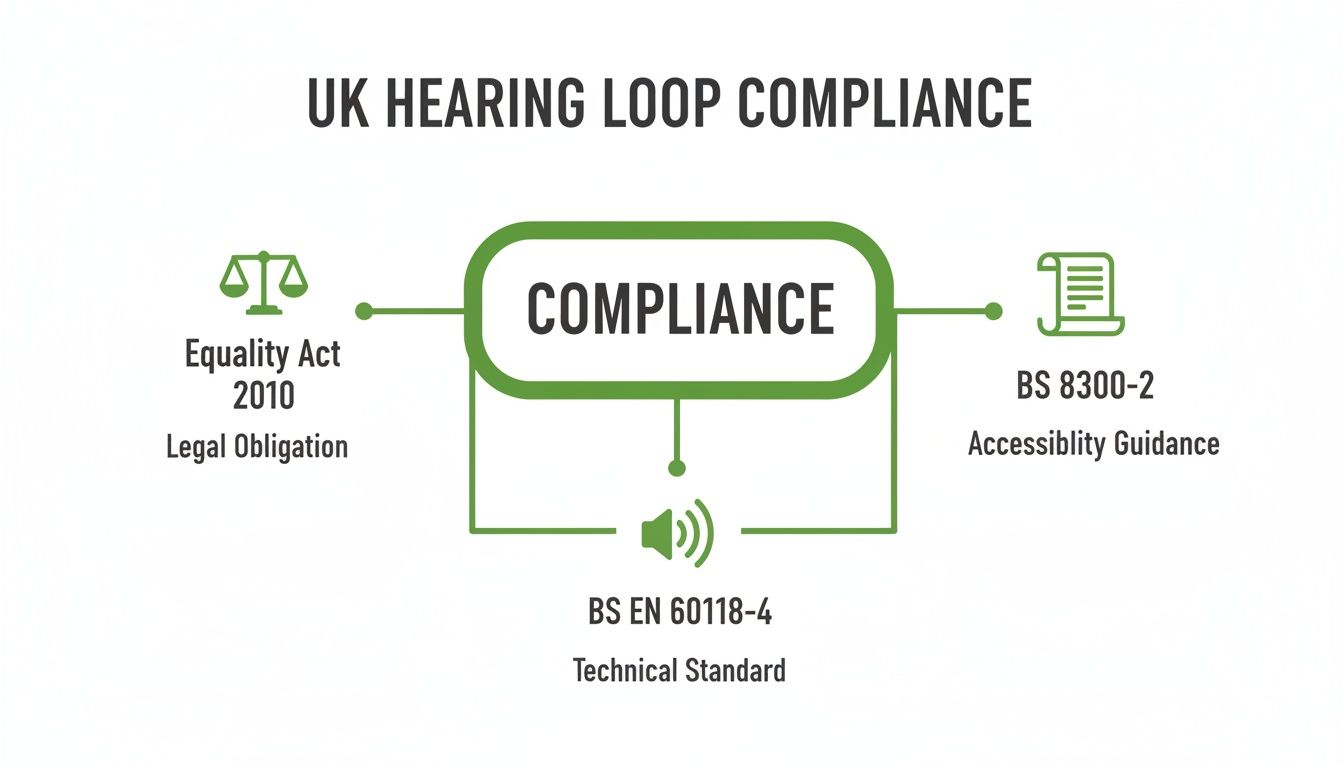
This visual really clarifies how legal duties like the Equality Act 2010 are backed up by the hard technical performance standards of BS EN 60118-4, giving us a solid framework for compliant design.
Choosing the Right Loop Layout
Once you’ve got your data, you can get down to the system design. The layout of the loop cable is absolutely crucial for ensuring even coverage and keeping the signal where you want it. A simple perimeter loop is fine for small rooms with low metal loss, but more complex spaces demand smarter solutions. For really complex jobs, like those needing extensive external coverage, you might also find our guide to designing an outdoor loudspeaker system useful.
- Perimeter Loop: The most basic design, with a single cable running around the edge of the room. It’s best for areas with minimal metal loss where you’re not worried about the signal spilling into adjacent rooms.
- Figure-of-Eight Loop: This layout uses two interconnected loops with currents flowing in opposite directions. The magnetic fields cancel each other out where they cross, which dramatically cuts down on signal spill. It’s perfect for confidential spaces like adjacent meeting rooms or cinema screens.
- Phased Array Loop: This is the most advanced option, reserved for large venues with high metal loss. It uses two overlapping loop systems powered by a two-channel amplifier with a 90-degree phase shift. This creates a much more consistent vertical field, overpowering the signal-sapping effects of rebar and ensuring smooth, even coverage across the entire space.
At the end of the day, the survey and planning stage dictates the success of the entire project. By methodically sniffing out interference, quantifying metal loss, and picking the right loop layout, you can design a bespoke hearing loop system that is guaranteed to be compliant, effective, and built to last.
An Installer's Toolkit for Equipment and Best Practices
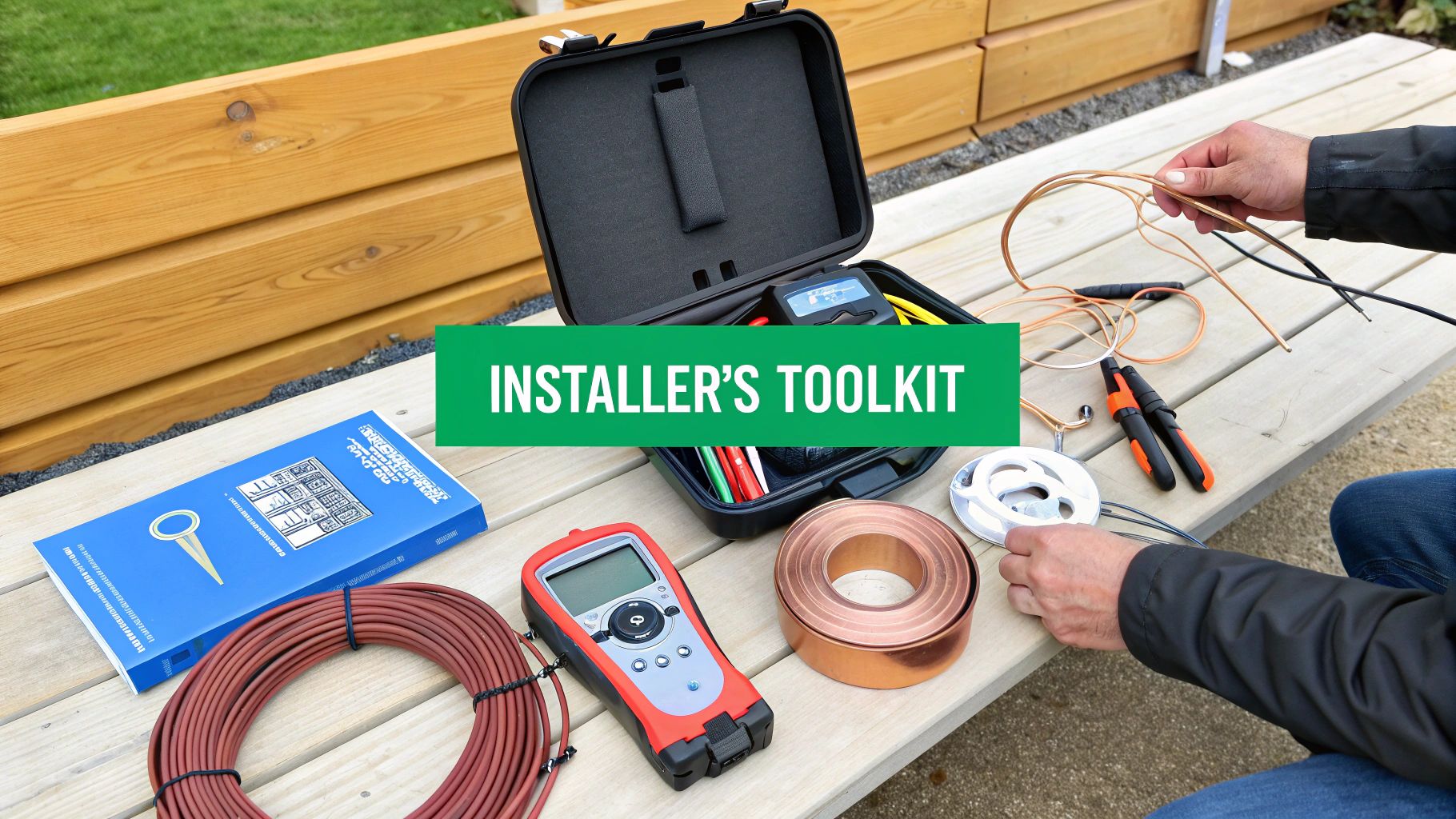
With a solid design plan in hand, it’s time to shift focus to the hardware and the hands-on job of bringing a hearing loop system to life. A truly professional installation is defined by two things: the quality of the components you use and the precision of your work. This is where your technical skill turns a blueprint into a reliable, compliant accessibility solution.
At the heart of any system is the loop driver, or amplifier. And no, this isn't just any old amp. It's a specialist piece of kit engineered to convert audio signals into the specific current needed to generate a clean, powerful magnetic field. Choosing the right one comes directly from your site survey. The driver needs enough grunt to energise the entire loop cable, compensate for any metal loss you measured, and consistently produce the required field strength across the whole space.
The technology has a long history here in the UK. It all started with a patent from Joseph Poliakoff back in 1937 for a magnetic induction system. But it was Ampetronic, founded in 1987, that really pushed things forward. They brought out groundbreaking phased array systems in 1991 to cover huge, metal-heavy buildings and followed up with metal loss control systems by 1995—tackling the very signal distortions we now plan for so meticulously. If you’re curious, you can explore the history of hearing loops to see the full story.
Choosing the Right Components
Beyond the driver, every piece of kit has a crucial part to play. Take the cable, for instance. Your choice depends entirely on where it’s being installed. For most projects in finished spaces, flat copper tape is the way to go. It’s designed to be laid discreetly under carpets, laminate, or other floor coverings, which makes the whole installation practically invisible.
But the most essential tool in your kit, without question, is the Field Strength Meter (FSM). You simply cannot professionally install or commission a hearing loop without one. An FSM is the only way to accurately measure magnetic field strength, frequency response, and background noise. It's how you verify that the system meets every single performance standard of BS EN 60118-4.
An installer without a Field Strength Meter is working blind. It's the difference between guessing and knowing. Crucially, it's the only way you can provide the client with a certificate of conformity—the ultimate proof of a successful, compliant installation.
A Best-Practice Installation Workflow
A methodical approach is everything for an efficient and effective install. Following a clear workflow cuts down on mistakes and ensures every critical step is done to the highest standard.
- Cable Installation: Start by carefully laying the loop cable or copper tape exactly as planned in your design (perimeter, figure-of-eight, etc.). Make sure it's fixed down securely to stop it from moving or getting damaged, especially in high-traffic areas.
- Driver Connection: Mount the loop driver somewhere suitable, usually in an AV rack or comms room. Connect the ends of the loop cable to the driver's output terminals, making sure you have a solid, reliable connection.
- Audio Source Integration: This is a vital step. The driver needs a clean, high-quality audio feed. This usually means taking a line-level output from the venue’s main PA mixer so the loop broadcasts the same audio as the main sound system. Getting the gain structure right is key to avoiding distortion. Many modern drivers also have network connectivity, which can make integration a lot simpler. If you're interested, you can learn more about the benefits of Power over Ethernet in AV systems.
Commissioning and Certification
With everything connected, you’re onto the final and most critical phase: commissioning. This is where you grab your FSM to test, measure, and fine-tune the system's performance. You’ll need to methodically walk the entire looped area, taking readings at various points to confirm the field strength is a consistent 400mA/m (+/- 3dB).
During this process, you'll be tweaking the driver's output current and frequency response settings until your FSM readings prove full compliance with BS EN 60118-4 across the whole space. Once that's verified, you can issue a certificate of conformity. This gives the client formal proof that their system is fit for purpose and meets all legal and technical standards. It’s this final step that marks you out as a true professional.
It’s Not Over When the Certificate is Signed: Maintenance and Education
Your job isn't done when you hand over the commissioning certificate. Far from it. The real test of a hearing loop system is how it performs day in, day out, for years to come. This is where a simple technical install becomes a genuine accessibility asset, protecting your client's investment and making sure the system actually does its job.
Think about it: even the best-laid plans can go awry. Without a proper upkeep schedule, the finest installation will degrade. A stray chair leg can damage a cable, a room reshuffle can create dead spots, or components can simply wear out. Before you know it, the system is non-compliant and, worse, useless. A proactive approach is non-negotiable.
Putting a Practical Maintenance Schedule in Place
Regular health checks are the lifeblood of a compliant and effective hearing loop. A straightforward, scheduled maintenance plan stops small hitches from turning into catastrophic failures and gives your client total peace of mind.
A solid annual check-up should cover:
- Amplifier Inspection: Give the driver a once-over for any visible faults, make sure its ventilation isn't blocked, and double-check that the settings haven't been fiddled with.
- Connection Integrity: Get hands-on and physically inspect every connection—from the audio source right through to the loop cable itself.
- Field Strength Re-verification: Pull out the Field Strength Meter (FSM) and run some spot checks. You need to be certain the system is still hitting the BS EN 60118-4 standard for signal strength across the entire coverage area.
This isn't just box-ticking; it’s about making sure the system keeps delivering that crystal-clear audio experience it was designed for.
From Installer to Educator: The Final, Crucial Step
Beyond the nuts and bolts, your most important job is to educate. You have to empower the venue's staff to get what the system is, why it’s there, and how to look after it. This is the bridge between a piece of kit and true accessibility.
This means leaving them with simple, clear instructions on how it all works. Staff need to know how to see if it’s switched on and actually getting an audio signal. And crucially, they need to understand just how important that little blue sign with the 'T' symbol is. If that sign isn't displayed prominently, no one will even know the loop is there to be used.
Taking the time to properly brief clients and their staff is what makes all the difference. It turns the hearing loop from a passive box on the wall into an active tool for inclusion, maximising its impact and delivering a proper return on their investment.
This has never been more vital. In the UK, around 12 million people—that’s one in five adults—live with some form of hearing loss. Hearing loops are a frontline defence against the isolation this can create, particularly in public spaces. Take churches, for example. Many have loops installed, but their performance is often a complete mystery, despite serving communities where hearing issues can genuinely stop people from participating. You can read more about the importance of hearing loops in community spaces on oxford.anglican.org. By making sure these systems are properly maintained and understood, you’re not just an installer—you’re actively building more inclusive communities.
Your Hearing Loop Questions, Answered
This is where we tackle the questions that come up time and time again from AV integrators and their clients. The aim here is to give you straight, clear answers so you can walk into any project discussion with complete confidence.
Can Any Electrician Install a Hearing Loop System?
While an electrician can certainly run the cable, the design, commissioning, and final certification absolutely demand a specialist AV installer. Getting a hearing loop right is a real craft, blending a deep understanding of audio systems, the physics of magnetic fields, and the strict performance standards laid out in BS EN 60118-4.
A certified installer doesn't just guess; they use a dedicated Field Strength Meter (FSM) to meticulously measure and prove the system delivers correct, even coverage. This isn't just about giving the user a good experience—it’s about making sure your client meets their legal obligations under the Equality Act 2010.
How Does Structural Metal Affect a Hearing Loop?
Think of it like this: structural metal, whether it's rebar in a concrete floor or steel beams in the ceiling, literally soaks up the magnetic signal from the loop cable. This phenomenon, known as 'metal loss', can create frustrating dead spots or weaken the signal so much that it becomes completely useless.
This is why a proper site survey is non-negotiable. It allows us to measure this loss precisely. To fight back against it, we might need to specify a more powerful amplifier or design a more complex loop layout, like a phased array, to punch through and guarantee a strong, compliant magnetic field across the entire space.
The key difference is the user experience. A hearing loop offers a completely discreet, hygienic, and seamless solution. It allows users to connect effortlessly using their own hearing aid.
What Is the Difference Between a Hearing Loop and an FM or IR System?
It all comes down to the user's experience. A hearing loop sends sound directly to a person's hearing aid using its built-in telecoil (T-coil). It's an integrated, dignified solution with zero extra hardware for them to worry about.
On the other hand, FM and Infrared (IR) systems mean the user has to ask for, borrow, and then wear a separate receiver pack with headphones or a neckloop. While they work, it can feel clumsy and frankly, it draws attention to their hearing loss. Hearing loops offer a far more seamless and inclusive experience.
At Epic Audio Ltd, we provide the specialist equipment and free project design support you need to deliver compliant, high-performance hearing loop systems. Explore our complete range of installation audio solutions.