

When you get serious about professional audio, passive bass speakers are where you find the ultimate level of control and scalability. In essence, they are powerful low-frequency drivers inside an enclosure that needs an external amplifier to work. This simple fact is what gives system designers total command over the power, processing, and overall performance in the most demanding environments.
Understanding Passive Bass Speakers in Pro AV

Think of a passive bass speaker—or subwoofer—as a high-performance engine. It has immense potential to create that deep, chest-thumping bass, but it can’t do anything without a separate, perfectly matched power plant: the amplifier. That separation is the fundamental difference between them and active subwoofers, which have the amp built right into the speaker cabinet.
This modular design is exactly why experienced AV installers and sound engineers lean towards passive setups for big or bespoke projects. Being able to hand-pick specific amplifiers, crossovers, and processing gear means you can build a system that is perfectly dialled-in to a venue's unique acoustic fingerprint. To see how all these pieces slot together, our guide to pro PA speaker systems is a great place to start.
Why Choose a Passive System?
For the pros, the choice usually boils down to a handful of critical advantages, especially for fixed installations and complex live sound setups.
- Ultimate System Control: With the amplifier on the outside, you get granular control over every aspect of power delivery and signal processing. This allows for incredibly precise tuning.
- Scalability and Flexibility: Expanding a passive system is far easier. You can hook up more speakers to your existing amp rack or upgrade the amps without having to replace every single speaker.
- Simplified Maintenance: Keeping all your amplifiers in one central, climate-controlled rack makes servicing and troubleshooting a breeze. That’s a massive plus in busy venues like theatres, concert halls, and churches.
- No Power at the Speaker: You’re only running speaker cable—not mains power—to each subwoofer. In many situations, this can simplify the installation and make electrical safety compliance much more straightforward.
The real beauty of a passive design is its dedication to specialisation. Each part—the driver, the cabinet, and the amplifier—is chosen to do one job and do it exceptionally well. The result is a rock-solid and powerful audio foundation.
To get a full picture of the audio gear that makes an event a success, it's worth checking out guides on the best karaoke system, which often underscore just how vital good quality low-end is. It’s another great resource for navigating the technical side of things to ensure you can deliver a truly outstanding audio experience.
Decoding the Core Specs of Passive Bass Speakers
When you step into the world of professional passive bass speakers, you need to look past the marketing fluff and learn to speak the language of performance: the spec sheet. These aren't just numbers on a page; they're the DNA of a subwoofer, telling you exactly how it will behave in a real-world install. For any AV pro, getting a grip on these specs is the secret to designing systems that are not only powerful but also reliable and precisely controlled.
Think of a spec sheet as the blueprint for sound. It reveals everything from how much of a beating a speaker can take to the actual character of the bass it will kick out. Understanding this blueprint lets you match components with confidence, predict how a system will perform, and sidestep those costly mismatches that can tank an entire project. Let’s translate the tech-speak into practical, on-the-job knowledge.
Understanding Power Handling
One of the first things you'll see is power handling. This tells you how much juice you can feed the speaker from an amplifier before you start doing damage. It’s usually broken down into two key ratings:
- Continuous (RMS) Power: This is the number that really matters. It’s the amount of power the speaker can handle day in, day out, without overheating or giving up the ghost. Always, always use this figure when matching your amps.
- Peak Power: This number shows the absolute maximum power the speaker can handle in a tiny burst, like the smack of a kick drum. It looks impressive, but trying to run a system at peak power is the fastest way to fry a voice coil.
Getting these two mixed up is a classic, and expensive, mistake. A bulletproof system is always built around the continuous RMS rating. It’s the key to longevity and consistent performance, night after night.
Navigating Speaker Impedance
Next up is impedance, measured in ohms (Ω). In simple terms, this is the speaker's electrical resistance, and it tells the amplifier what kind of load it’s dealing with. Most pro-level passive bass speakers come in at a nominal impedance of 4Ω or 8Ω.
This spec becomes absolutely critical when you start daisy-chaining multiple subs to one amplifier channel. Wiring speakers in parallel drops the total impedance, while wiring them in series raises it. For instance, two 8Ω speakers wired in parallel will present a 4Ω load to the amp.
An amplifier must be rated to handle the final impedance load you throw at it. Pushing an amp below its minimum stable impedance rating will cause it to overheat and shut down—or worse, fail completely. Always do the maths on your final load before you plug anything in.
Sensitivity: The True Measure of Efficiency
Sensitivity is a spec that’s often misunderstood but is a pure measure of efficiency. It tells you how loud a speaker will be (in decibels, dB) when you feed it 1 watt of power, measured from a metre away. A speaker with a higher sensitivity rating will give you more volume for less amp power. Simple as that.
For example, a speaker rated at 98 dB (1W/1m) is a whole lot more efficient than one rated at 95 dB. That 3 dB difference means the more sensitive speaker needs only half the amplifier power to hit the same volume. In big installs, choosing high-sensitivity speakers can mean serious savings on amp costs and electricity bills.
Frequency Response: Defining the Low End
The frequency response tells you the range of tones the speaker can actually produce, measured in Hertz (Hz). For a bass speaker, you’re looking at the low end, so that first number is key (e.g., 35Hz – 250Hz). The lower that number, the deeper and more gut-rumbling the bass.
But don’t just glance at the range. Look for the tolerance, often written as "+/- 3 dB". This tells you the window where the output is relatively flat and predictable. A sub with a response of 35Hz - 250Hz at +/- 3 dB will give you far more accurate and reliable low-end than one measured at a sloppy +/- 10 dB. When decoding core specs, it’s worth thinking about how different designs contribute to achieving a 'phatt' bass tone that so many live events crave.
To make sense of it all at a glance, here’s a quick-reference table.
Key Passive Bass Speaker Specifications Explained
A quick-reference guide translating technical specifications into practical implications for system design and performance.
| Specification | What It Measures | Why It Matters for Installers |
|---|---|---|
| Power Handling (RMS) | The continuous power a speaker can safely handle without damage. | The most critical number for matching amplifiers. Ensures system reliability and prevents component failure. |
| Impedance (Ω) | The speaker's electrical resistance, which dictates the load on the amplifier. | Essential for calculating total load when wiring multiple speakers. Mismatched impedance can destroy an amplifier. |
| Sensitivity (dB 1W/1m) | How efficiently a speaker converts power into sound (volume). | Higher sensitivity means less amplifier power is needed to achieve the same volume, saving costs on larger installs. |
| Frequency Response (Hz) | The range of frequencies the speaker can reproduce accurately. | Determines how deep the bass will go. The +/- dB tolerance indicates the accuracy and consistency of the sound. |
| Enclosure Type | The design of the speaker cabinet (e.g., ported, sealed, bandpass). | Fundamentally shapes the character of the bass—from tight and punchy to deep and booming. |
Understanding these specs moves you from just plugging things in to truly designing a sound system.
Enclosure Types: Shaping the Sound
Finally, the enclosure type plays a huge role in shaping the sonic character of the bass. The three most common designs each have their own strengths:
- Ported (or Reflex) Enclosures: These are the workhorses of live sound. A tuned port or vent boosts output around a specific frequency, giving you that deep, powerful sound that fills a room.
- Sealed Enclosures: With no port, these cabinets deliver a tighter, more precise, and articulate bass. They're often the top choice for studios or high-fidelity setups where accuracy is everything.
- Bandpass Enclosures: These are more complex designs where the driver is hidden inside the box, and the sound only comes out of one or more ports. They're incredibly efficient but only in a narrow frequency range, making them perfect for nightclubs and cinemas where you want maximum impact.
In the professional audio market, these design choices are a big deal. As of 2024, the global pro speakers market hit around USD 2.54 billion, and the UK’s booming live music scene is a major part of that. Sound engineers often lean towards passive bass speakers for their flexibility and control in large systems—a choice that’s also influenced by UK noise regulations demanding smarter, more directional sound solutions.
Mastering Amplifier and Crossover Matching
Getting the pairing right between your passive bass speakers, amplifier, and crossover isn't just a box-ticking exercise; it’s the secret to unlocking your system’s real power. This relationship governs everything from raw grunt and sonic clarity to the long-term health of your gear. Get it wrong, and you’re looking at more than just bad sound—you risk catastrophic failure.
The fundamental goal is simple: give your speakers enough clean power to do their job without breaking a sweat. It's like putting the right fuel in a high-performance engine. Too little, and it’ll splutter and choke. Too much, and you’ll blow the whole thing apart.
The rule of thumb in the pro world is to pick an amplifier that can deliver 1.5 to 2 times the speaker's continuous RMS power rating. This extra oomph is called headroom, and it's the most important safety net you can give your system. It allows the amp to handle massive, sudden bass hits—like a kick drum smack—without being pushed to its breaking point.
The Dangers of a Power Mismatch
It’s a common myth that underpowering a speaker is somehow safer than overpowering it. The truth is, a weak amplifier is often far more dangerous. When you crank a weedy amp to get the volume you want, it starts producing a distorted, squared-off signal called clipping.
Clipping is the number one speaker killer. It sends a nasty form of direct current (DC) straight to the speaker's voice coil, causing it to overheat and burn out in seconds. It sounds awful too—a harsh, fuzzy mess that completely wrecks your low-end punch.
Overpowering, while less frequent, is just as straightforward: you’re simply feeding the speaker more continuous power than its parts can physically take, leading to mechanical failure. Both are easily avoided with a bit of careful planning. For a deeper look into choosing the right power source, our guide on picking an amplifier for voice and PA applications has some great complementary insights.
Impedance: The Golden Rule of System Loading
Just as vital as wattage is impedance matching. You absolutely must ensure the total impedance load of all your connected speakers doesn’t drop below the amplifier's minimum stable rating (e.g., 2Ω, 4Ω). Remember, wiring multiple passive bass speakers in parallel lowers the total impedance.
For instance, two 8Ω subwoofers wired in parallel present a 4Ω load to the amp. If your amplifier is only stable down to 8Ω, this setup will cause it to overheat and shut down, or worse. Always do the maths on your final load before plugging anything in.
The Crossover: Your Audio Traffic Director
With power and impedance sorted, the crossover comes into play. Think of it as a traffic director for your sound frequencies. For passive bass speakers, your most critical tool is the Low-Pass Filter (LPF). It does exactly what it says on the tin: it lets low frequencies pass through to the subwoofer while blocking out the mids and highs.
Setting the crossover point correctly is crucial for getting a smooth, seamless handover between your subs and your main speakers.
- Crossover Point: This is the frequency where the subs stop and the main speakers take over. A solid starting point for most live sound is somewhere between 80Hz and 120Hz. Go too high, and the bass starts to sound "boomy" and you can pinpoint where it's coming from. Go too low, and you'll get a noticeable "hole" in the sound.
- Crossover Slope: This setting controls how sharply the filter cuts off unwanted frequencies. Measured in decibels per octave (dB/octave), steeper slopes create a cleaner separation. A 24dB/octave Linkwitz-Riley slope is a widely used professional standard, giving you a sharp cut-off with minimal phase problems. It helps ensure your subs and mains sound like one cohesive system.
These power considerations are reflected across the UK's pro loudspeaker market. In 2024, speakers under 500 watts accounted for 45.3% of sales, serving many corporate and hospitality venues perfectly well. Yet, it's the 500-1,000 watt segment that's growing fastest, with a 4.1% CAGR, driven by mid-sized venues demanding the kind of powerful, well-managed bass that only comes from proper amplifier and crossover matching. You can learn more about these professional speaker market trends on Mordor Intelligence.
Best Practices for Wiring and Installation
Getting your wiring and installation spot on is the bedrock of any pro audio system. If you cut corners here, you’re not just short-changing performance; you're creating a maintenance headache and introducing genuine safety risks for later. Nailing this foundation ensures your passive bass speakers deliver every bit of their potential, both safely and reliably.
The first port of call is choosing the right speaker cable. This isn't about fancy, exotic materials – it's just physics. A cable's thickness, or gauge, determines its resistance. For long runs or low-impedance loads (like a few subs wired in parallel), a thicker cable is a must. It prevents power loss and helps maintain a high damping factor, which is key to keeping the bass tight and punchy.
Selecting the Right Cable Gauge
Using a cable that's too thin is like trying to fight a fire with a leaky garden hose. The pressure (voltage) might be there, but the flow (current) gets choked off. All that means is your amplifier's power turns into heat in the cable instead of moving air and making sound.
For most professional installs, a good 12 AWG or 14 AWG oxygen-free copper (OFC) cable will do the job for runs up to about 30 metres with an 8-ohm load. If you're dealing with lower 4-ohm loads or pushing past that distance, stepping up to a chunkier 10 AWG cable is a smart move to keep your signal clean and strong.
Secure Connections and Wiring Schemes
Your system is only ever as strong as its weakest link, and dodgy connections are a classic point of failure. Professional connectors like Speakon plugs are a game-changer, especially for live sound and touring rigs, because their locking mechanism means they can't be accidentally yanked out. For permanent installations, good quality binding posts also create a solid, dependable connection when they're terminated properly.
You also need to get your head around wiring schemes to manage the impedance load on your amp correctly.
- Parallel Wiring: This is the go-to method for hooking up multiple subs to a single amp channel. It decreases the total impedance. For instance, two 8-ohm speakers wired in parallel give the amp a 4-ohm load to look at.
- Series Wiring: This one increases the total impedance. So, two 8-ohm speakers in series present a 16-ohm load. It’s less common for subs but comes in handy in certain scenarios, like with some ceiling speaker arrays.
- Series-Parallel Wiring: A clever combination used for arrays of four or more speakers. It lets you hit a specific target impedance, like wiring four 8-ohm subs to present a final 8-ohm load to the amplifier.
This diagram shows that simple but critical signal flow from the amp to the speaker, which is what gives you that powerful sound.
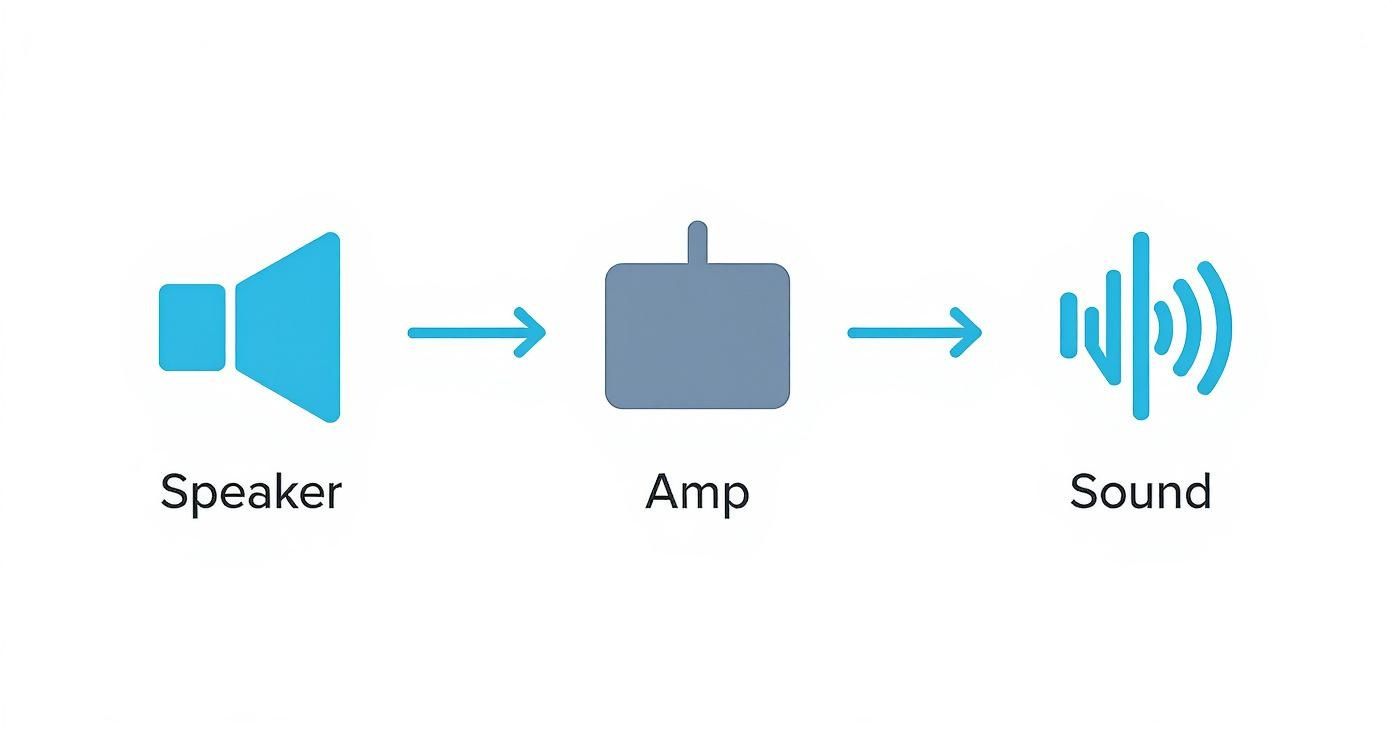
It’s a great visual of how a passive system keeps components separate. This lets you get really precise with your amp matching to achieve exactly the output you’re after.
Safety and System Compliance
Finally, any professional job is a tidy and safe one. Clean cable management isn't just about making things look good; it stops people from tripping over and makes troubleshooting a million times easier down the road. Use cable ties, looms, and proper trunking to keep everything neat and organised.
When it comes to equipment racks, amplifier ventilation is non-negotiable. Amps throw out a serious amount of heat, and stacking them without proper airflow is a sure-fire way to cause thermal shutdowns and kill them prematurely. Always follow the manufacturer's spacing advice—usually at least one rack unit (1U) of space above and below each amp—and think about adding rack-mounted fans for high-power systems.
By sticking to these practices, you'll build systems that don't just sound incredible, but are also professional, compliant, and built to last.
Optimising Speaker Placement for Peak Performance
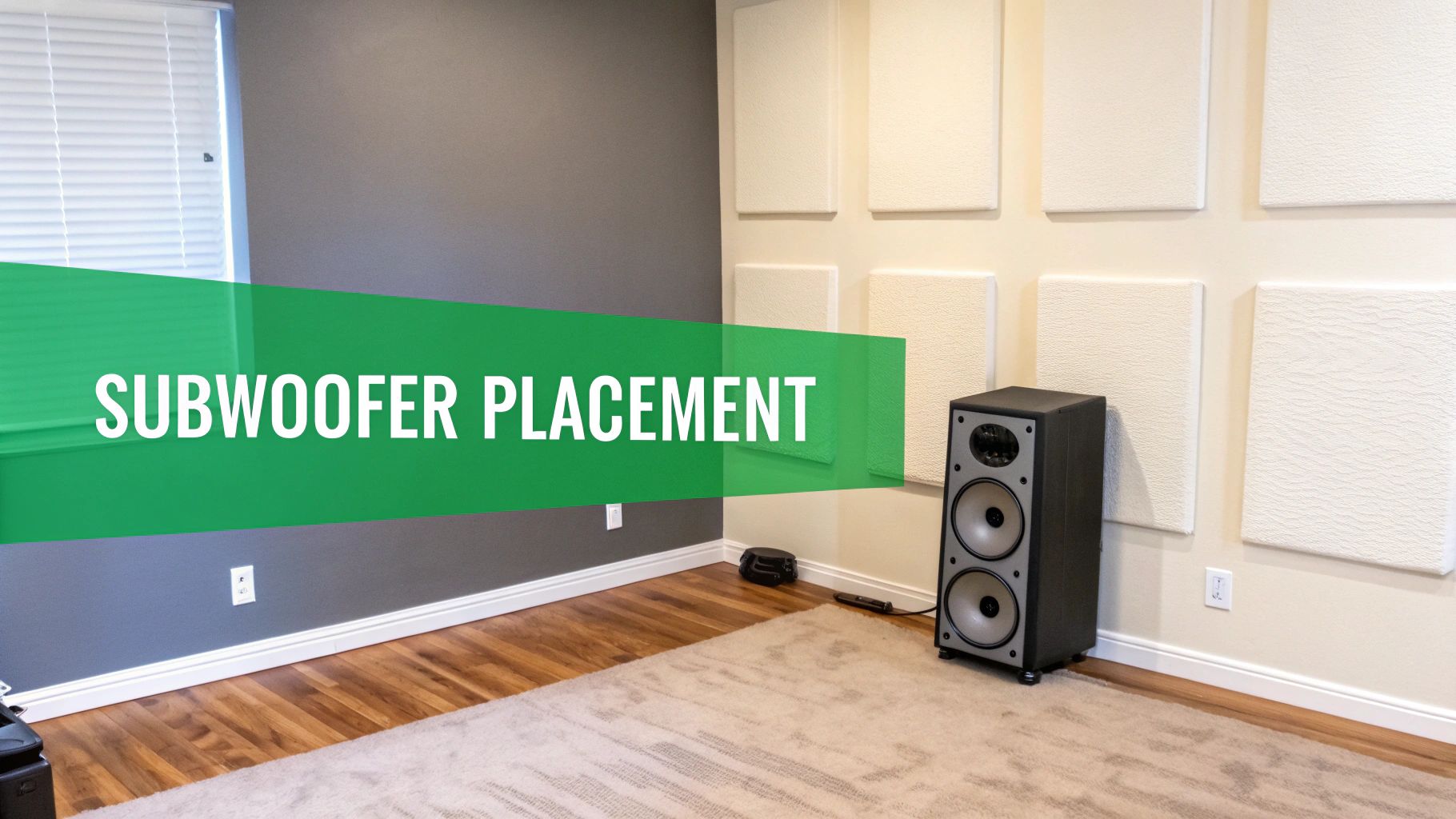
Where you position your passive bass speakers is just as crucial as the high-quality kit you’ve chosen. A perfectly specified system can sound muddy, weak, or patchy if placement is just an afterthought. This is where a pro installer’s expertise really shines, transforming a collection of boxes into a genuinely cohesive and hard-hitting sound system by mastering the physics of the room itself.
Low-frequency sound waves behave very differently to mids and highs. They are long, powerful, and omnidirectional, which means they bounce off every surface in a room—walls, floors, and ceilings. Getting placement right is all about controlling these interactions to your advantage, turning potential acoustic headaches into predictable performance gains.
The Power of Boundary Reinforcement
The first thing to consider is boundary reinforcement. When you place a subwoofer near a large surface like a wall, its output gets a natural boost. Shove it into a corner near two surfaces, and it gets amplified even more. This effect, often called “corner loading,” can be a powerful tool… or a massive problem.
- The Upside: You can get a serious lift in low-frequency output—up to +6 dB in a corner—without even touching the amplifier. This means hitting higher sound pressure levels with less power, making the whole system more efficient.
- The Downside: This boost isn't always even across the bass frequencies. It can excite problematic room modes (standing waves), leading to boomy, one-note bass that sounds huge in one spot but is practically gone a few feet away.
The trick is to use this boundary gain deliberately. Start by placing the sub near a wall, then experiment by moving it into and out of a corner to find that sweet spot between raw output and smooth, even bass.
Think of a room as a unique acoustic container. Placing a subwoofer is like dropping a stone into a pool of water; the waves will reflect off the edges. Your job is to control those reflections to create a smooth, consistent bass response across the entire listening area, not just a single "sweet spot."
Taming Room Modes with Multiple Subwoofers
The single most effective way to beat nasty room modes and get even bass coverage is to use multiple passive bass speakers. One subwoofer will always create peaks and nulls (loud and quiet spots) around the room. By strategically placing two or more subs, you can smooth out these inconsistencies.
This isn't about getting more volume; it's about improving the quality and consistency of the bass. The sound waves from each sub interact, with the peaks from one cancelling out the nulls from another.
Common Multi-Sub Placement Strategies
- Mid-Wall Placement: One sub at the midpoint of the front wall and another at the midpoint of the back wall.
- Corner Placement: Placing subs in diagonally opposite corners.
- Quarter-Point Placement: Placing subs a quarter of the way in from the side walls along the front wall.
Every room is different, so measurement tools and a good pair of ears are essential. The goal is to find the layout that delivers the most consistent low-end for the largest number of listeners.
Achieving Perfect System Cohesion
Once your subwoofers are in position, the final step is getting them to blend seamlessly with your main speakers. This involves two critical tweaks, usually handled by a digital signal processor (DSP).
- Time Alignment: Sound takes time to travel. If your subs are physically further from the listening position than your mains, their sound will arrive a fraction later. Time alignment (or delay) electronically holds back the signal to the closer speakers so that all sound waves hit the listener's ears at the exact same moment.
- Phase Alignment: Phase is all about the timing of the sound wave's cycle. To get the tightest, punchiest bass, the sound waves from the subs and main speakers need to be moving in the same direction at the crossover frequency. A simple polarity switch (0° or 180°) can often fix major phase issues, resulting in a much fuller, more integrated sound.
Mastering these placement and alignment techniques is what truly separates a DIY setup from a professional installation. It’s a meticulous process, but it’s the only way to guarantee your passive bass speakers deliver the deep, tight, and articulate low-end they were designed for.
When you're speccing out a sound system, the debate between passive and active subwoofers always comes up. It’s not about which one is inherently "better," but which one is the right tool for the specific job you're tackling. Whether it's a permanent nightclub install or a touring band’s mobile rig, the demands of the project will always point you to the right choice.
Think of passive bass speakers as high-performance components in a custom-built machine. The real magic lies in their flexibility. Because the amplifier is a separate unit, you get complete control over the power, processing, and overall system design.
This modular approach is a huge win for large-scale, permanent installations where you need absolute peak performance and easy serviceability down the line.
Why Go Passive?
Passive setups really shine in environments that demand customisation, scalability, and rock-solid reliability. For complex projects, the benefits are crystal clear:
- Total System Flexibility: You can hand-pick and match drivers, enclosures, and amplifiers from different manufacturers to build a system that’s perfectly dialled in for a specific room's acoustics.
- Easy Scalability: Need more low-end punch? It's as simple as adding more speakers and another amp to your central rack. You don't have to rip out and replace every single component.
- Streamlined Maintenance: Having all your amplifiers racked up in one accessible equipment room makes cooling, troubleshooting, and repairs a breeze, which means less downtime for a busy venue.
A great example is a custom-designed theatre or house of worship. You’d use a passive system to tuck all the amplification away in a control room, running only speaker-level signals to subwoofers that are discreetly hidden from view.
The Case for Active Systems
On the flip side, active subwoofers are the undisputed champions of convenience. With the amplifier, crossover, and often DSP all built right into the cabinet, they are a brilliantly efficient, all-in-one solution.
For anyone on the move, the plug-and-play simplicity of active subwoofers is a game-changer. A touring band or a mobile DJ can set up and tear down their rig in a fraction of the time, knowing that the internal amplifier is already perfectly matched to the driver.
This integrated design means the manufacturer has done all the hard work of matching the amp and speaker for you, guaranteeing optimal performance straight out of the box. Many active subs also pack in their own onboard processing for EQ and time alignment, which adds a ton of value.
Before we get into a direct comparison, it's worth noting how important this choice is in the current market. The demand for high-quality, flexible audio solutions is pushing the UK speaker market forward, which was valued at around USD 1.17 billion in 2024. Traditional passive bass speakers are holding their ground in professional installs precisely because they offer that next-level audio quality and customisation. You can dig into the full analysis of the UK speaker market on Expert Market Research.
So, how do you decide? Let’s break it down.
Passive vs. Active Subwoofers: A Professional's Decision Matrix
Choosing the right low-frequency foundation for your system means weighing up several critical factors. This table cuts through the noise and lays out the core differences to help you make the right call for your project.
| Consideration | Passive Bass Speakers | Active Subwoofers |
|---|---|---|
| System Design | Highly flexible. Mix and match components for custom performance. | Integrated system. Amp and driver are pre-matched by the manufacturer. |
| Installation | More complex. Requires separate amplification, cabling, and rack space. | Simple and fast. Plug-and-play setup, minimal external components. |
| Scalability | Excellent. Easy to add more speakers and amps to a central system. | Less scalable. Expanding often means adding more self-contained units. |
| Maintenance | Centralised. Amps are in one rack, simplifying service and cooling. | Decentralised. Each unit has its own amp, requiring individual access for service. |
| Portability | Less portable. Separate heavy amps and speakers make for a bigger haul. | Highly portable. All-in-one design is perfect for mobile and touring rigs. |
| Best For... | Permanent installs: nightclubs, theatres, houses of worship, stadiums. | Mobile applications: live bands, DJs, corporate events, portable PA. |
Ultimately, your project's priorities should be your guide. If you need ultimate control, peak performance, and long-term scalability for a fixed venue, a passive system is the professional’s choice. But if you're all about speed, simplicity, and portability, an active system delivers a powerful and reliable alternative that won't let you down.
Frequently Asked Questions
When you're deep in the technical weeds of a sound system build, a few common questions about passive bass speakers always seem to pop up. Let's tackle the ones we hear most from fellow AV pros and installers.
Can I Just Use Any Old Amp with My Passive Subs?
In a word, no. Getting this pairing wrong is one of the fastest ways to wreck your gear, and it's a costly mistake to make.
Your amplifier and speaker need to be properly matched for both power (watts) and impedance (ohms). A mismatch won't just sound bad; it can cause clipping, distortion, and permanent damage to both the amp and the sub.
Here's the professional rule of thumb we stick to: pick an amplifier that can deliver 1.5 to 2 times the speaker's continuous (RMS) power rating. So, if you've got a 500W RMS sub with an 8-ohm impedance, you'll want an amp that pushes out between 750W and 1000W into an 8-ohm load. This gives you crucial 'headroom' to handle big, sudden bass drops without the amp breaking a sweat.
So, What's the Real Advantage of a Passive System?
It really boils down to flexibility and scalability. Because your amplifier is a separate piece of kit, you're free to upgrade or swap out individual components as your needs change or better tech comes along. It's a modular approach that's perfect for big, permanent installations like theatres, clubs, or houses of worship.
Think about it: centralising all your amps in a single equipment rack makes life so much easier. Cooling, system management, and maintenance are all streamlined in one place. It's a lot less hassle than trying to access individual active speakers mounted high up on a rig. For complex venues, it’s the only practical long-term choice.
Does Speaker Cable Actually Make a Difference?
Absolutely. The length and thickness (gauge) of your speaker cable directly impact performance, especially as you start running longer lines.
If you use a cable that’s too thin for the distance, you're introducing resistance. This chokes off power from the amp and, crucially, reduces its damping factor. A low damping factor means the amp has less control over the speaker cone's movement. The result? Your bass will sound flabby and loose instead of tight and punchy.
- For shorter runs (under 15 metres) into an 8-ohm sub, a 14 AWG cable will usually do the job just fine.
- For longer runs, or when you're dealing with lower 4-ohm loads, you need to step up to a thicker 12 AWG or even 10 AWG cable. This is vital to keep the signal clean and ensure your passive subs perform exactly as they were designed to.
Here at Epic Audio Ltd, we live and breathe this stuff. We specialise in supplying the right components and expertise to help you build powerful, reliable audio systems. From the first sketch to the final soundcheck, our team is here to help you select the right passive bass speakers and matching amps for any project. See our full range of pro AV solutions at https://epicaudio.co.uk.