

Picking the right amplifier for a PA system is a bit like choosing the engine for a car. It's the absolute core of the setup, dictating how much power you have on tap, how reliable it's going to be, and what the overall performance feels like. At its simplest, an amplifier takes a quiet audio signal and gives it the muscle needed to drive speakers, filling a room with sound – whether that’s for background music or a critical announcement.
Getting to the Heart of Your PA System
Think of a Public Address (PA) system as a chain of components all working in harmony. In that chain, the amplifier is undeniably its beating heart. Without it, even the most advanced audio sources and the highest-spec speakers are just expensive paperweights. Its job is simple in theory but critical in practice: it provides the raw power that brings your audio to life.
This guide is your roadmap to selecting the perfect amplifier for any commercial audio job. We're going to break down all the essential things every AV integrator and contractor needs to get right, making sure every installation sounds powerful, clear, and is built to last. The goal here is to cut through the jargon and give you a practical understanding that builds real-world confidence.
Why Does Amplifier Choice Matter So Much?
Getting the amplifier right has a massive impact on the success of any project, and it goes way beyond just making things louder. Nail this decision, and you'll ensure:
- Crystal Clear Audio: An underpowered amp will really struggle when you push it, leading to nasty distortion known as 'clipping' at higher volumes.
- Rock-Solid Reliability: A properly matched amplifier works comfortably within its limits, which stops it from overheating and failing prematurely.
- A Sensible Budget: Over-speccing an amp is a waste of money, but under-speccing it means poor performance and having to replace it down the line – which costs even more.
- Room to Grow: A smart choice today can handle future system expansions without needing a complete and costly overhaul.
The importance of these systems is clear when you look at the market. In the UK, amplifier market consumption recently shot up to $140 million, a massive 16% jump from the year before. That surge shows just how strong the demand is from places like hospitality, retail, and education, where a dependable PA system is simply non-negotiable. You can dig into more data on the growing UK amplifier market on IndexBox.
An amplifier doesn't just make sound louder; it makes sure the right sound is delivered with clarity and consistency, every single time. It’s the difference between a muffled, garbled announcement and a crisp, clear message that everyone can hear and understand.
This intro sets the stage for the deeper dives to come. We’ll cover everything from calculating power needs and matching impedance to understanding advanced features like DSP and EN 54 compliance. By the end, you'll have all the knowledge you need to make informed decisions that guarantee fantastic audio performance on every job.
Calculating Your Power Needs Without the Headache
Choosing the right amplifier can feel like a bit of a dark art, but getting the power calculation right is the single most important step towards clean, reliable audio. Get it wrong, and you're either looking at distorted, weak sound or you've spent good money on power you’ll simply never use. The good news is, it's a lot more straightforward than it sounds.
The core goal is simple: make sure the amplifier can comfortably power all your speakers, with a crucial safety margin built in. This stops the amp from being pushed to its limits, which is exactly where audio quality starts to fall apart.
This diagram shows the basic signal flow, highlighting the amplifier's central role as the engine of the whole setup.
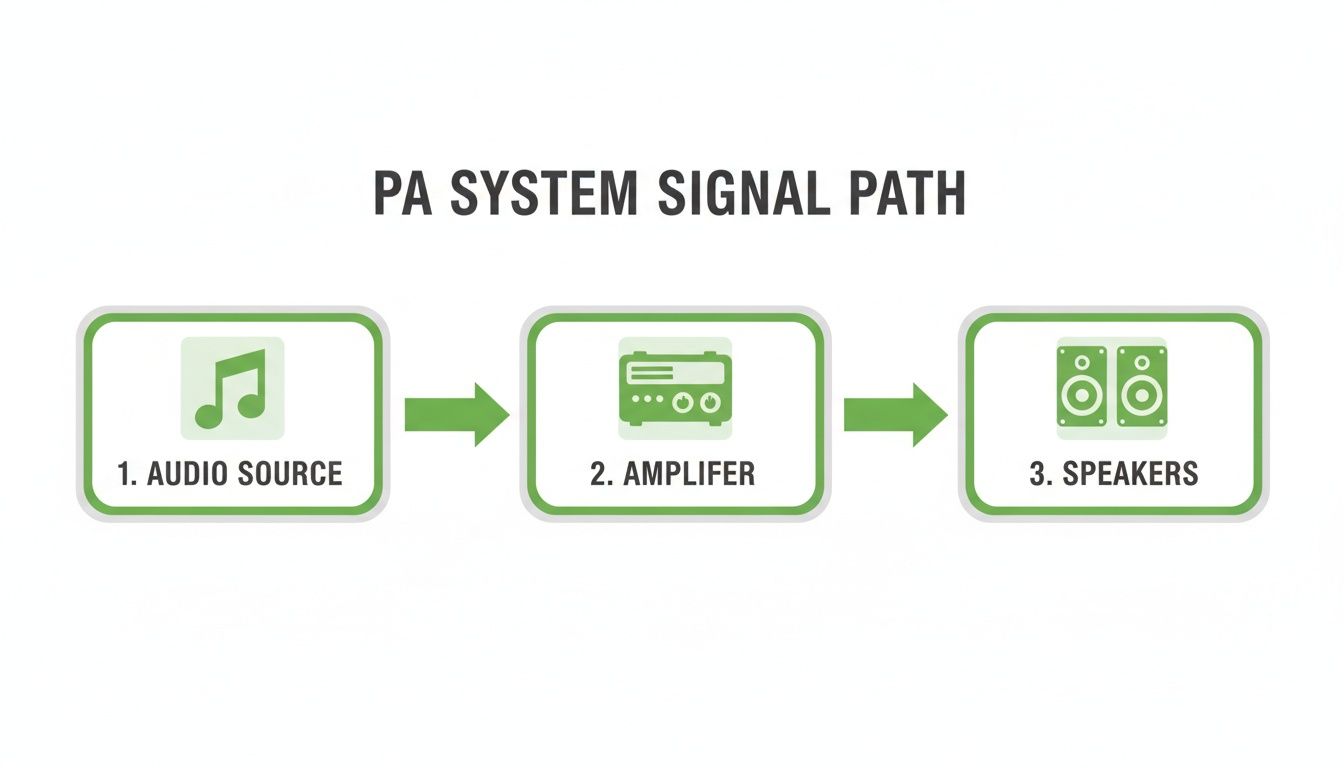
As you can see, the amplifier takes the signal from your source and gives it the grunt needed to make the speakers work.
RMS vs Peak Power: A Quick Primer
When you're looking at spec sheets for amps and speakers, you’ll come across two wattage ratings: RMS and Peak. It's vital to know the difference.
- RMS (Root Mean Square): Think of this as the continuous, day-to-day power an amp can deliver or a speaker can handle. This is the number that really matters for matching your components.
- Peak Power: This is the absolute maximum power the gear can handle in tiny bursts, like a sudden drum hit. It’s often double the RMS figure, but it's not a reliable number to base your system design on.
For a dependable, professional installation, always base your calculations on the RMS wattage. It’s the true reflection of what your equipment can do, day in, day out.
The Headroom Rule: The Installer’s Safety Net
Once you've added up the total power your speakers need, the next step is absolutely critical: adding headroom. Headroom is essentially extra power capacity you build into the system to handle unexpected audio peaks without distorting. It’s like having a slightly bigger water tank than you need – it prevents an overflow during a sudden downpour.
A solid professional standard is to spec an amplifier that can deliver 20-25% more power than the total combined RMS wattage of your speakers.
Forgetting to add headroom is one of the most common mistakes in PA system design. This safety margin ensures the amplifier never has to run flat-out at 100%, which is where you get nasty audio clipping and put serious stress on the components.
Let's run through a real-world example. Imagine you're fitting out a busy restaurant with 12 ceiling speakers.
- Each speaker is rated at 10 watts RMS.
- Total speaker power = 12 speakers x 10 watts/speaker = 120 watts.
Now, let's apply the headroom rule. We'll add 25% just to be safe.
- Headroom calculation: 120 watts x 1.25 = 150 watts.
In this scenario, you’d be looking for an amplifier that can deliver at least 150 watts RMS of power. This simple bit of maths prevents you from underpowering the system (which causes weak, distorted sound) and stops you from overpowering it (which is a waste of money and can damage speakers). It’s the key to designing a system that’s both technically solid and commercially smart.
Choosing Your Path: 100V Line Versus Low-Impedance
When you're specifying an amplifier for PA systems, one of the first, most crucial decisions you'll face is whether to go with a 100V line or a low-impedance (low-Z) design. This choice is a fundamental fork in the road that defines the entire architecture of your installation. Each path has distinct advantages and is built for very different jobs, so getting this right is the key to a successful project.
Think of it this way: a 100V line system is like a city's public transport network—built for efficiency and covering large areas with many stops. A low-impedance system, on the other hand, is like a high-performance sports car, engineered for pure audio quality and power over a shorter distance.
Neither one is inherently "better"—the right choice always comes down to the specific demands of the job.
The 100V Line System: The Marathon Runner
A 100V line system is the undisputed champion of distributed audio across large spaces. We're talking about environments like schools, warehouses, shopping centres, and sprawling office buildings. The principle behind it is beautifully simple: the amplifier steps up the audio signal to a high voltage (100V in the UK and Europe), which dramatically cuts down on power loss over long cable runs.
At each speaker, a small, built-in transformer steps the voltage back down to a useable level. This smart setup lets you connect a huge number of speakers to a single amplifier channel in a simple parallel circuit, a bit like wiring up a string of Christmas lights.
The practical benefits are massive:
- Simplified Wiring: You can daisy-chain multiple speakers on a single cable run, saving a huge amount of time and material costs.
- Long Cable Runs: Power loss is minimal, meaning you can confidently run speaker cables for hundreds of metres without the signal turning to mush.
- Consistent Volume: Every speaker gets a consistent power level, ensuring you get uniform volume across a massive area.
- Easy Power Calculation: You just add up the wattage 'taps' of all the speakers on the line and make sure the total is comfortably under the amplifier's power output.
This design makes 100V systems incredibly scalable and cost-effective for background music and public address announcements where raw audio fidelity isn't the number one priority.
The Low-Impedance System: The Powerlifter
Low-impedance (low-Z) systems are all about one thing: audio quality. This is the traditional setup you’ll find in home hi-fi systems, music venues, buzzing bars, and houses of worship. Here, the entire focus is on delivering high-fidelity sound with a full, rich dynamic range. These systems typically use speakers with an impedance of 4, 8, or 16 ohms.
Unlike their 100V cousins, low-Z setups demand careful impedance matching. Every time you connect multiple speakers to one amplifier channel, you change the total load impedance. If that load drops below the amplifier's minimum stable rating, you're asking for trouble. For example, wiring two 8-ohm speakers in parallel gives you a 4-ohm load.
The biggest mistake you can make in low-Z installations is overloading the amplifier by creating an impedance load that's too low. This forces the amp to work harder than it was designed for, leading to overheating, distortion, and eventual failure.
Because they prioritise sound quality, low-Z systems are the perfect choice for foreground music and live sound reinforcement. The direct connection between the amplifier and speakers—with no transformer in the way—allows for a much better frequency response, especially in the low end.
For projects where clear, intelligible vocal delivery is the main goal, you can learn more about optimising your setup in our guide to selecting an amplifier for voice applications.
100V Line vs Low-Impedance: Which Amplifier System Is Right for Your Project?
To help you decide at a glance, here’s a quick breakdown of how the two systems stack up against each other. This table should make it clear which path is best suited for your next installation.
| Feature | 100V Line System | Low-Impedance (Low-Z) System |
|---|---|---|
| Best For | Large areas, many speakers, long cable runs | High-fidelity sound, performance venues, bars |
| Sound Quality | Good for voice and background music | Excellent for music and live sound |
| Wiring Complexity | Simple (parallel daisy-chain) | Complex (requires impedance matching) |
| Cable Length | Very long runs (100s of metres) possible | Short runs (ideally under 20 metres) |
| Scalability | Highly scalable and easy to expand | Limited by impedance matching calculations |
| Cost-Effectiveness | High for large distributed systems | High for smaller, quality-focused setups |
Ultimately, the choice comes down to the project's priorities. If you need to cover a vast area with consistent announcements and background music, the 100V line path is your most reliable and efficient route. But if the project demands impactful, high-quality audio for a more contained space, the low-impedance route will deliver the performance you need.
Designing Flexible Audio Zones for Modern Venues
These days, commercial spaces are rarely just one big, monolithic room. Take a hotel, for instance. You've got a bustling lobby, a quiet restaurant, maybe a lively poolside bar—and each space has its own vibe and audio needs. A truly effective PA amplifier has to be able to juggle all this complexity, delivering the right sound to the right place, at the right time.
This is where audio zoning comes in. It’s a lot like the smart lighting in a modern home. You wouldn't want a single switch flicking on every light in the house at once, would you? Of course not. You create zones—kitchen, living room, bedroom—and control them independently. Audio zoning applies the exact same logic to sound, and it's all made possible by two key amplifier types: multi-channel and mixer amplifiers.
Multi-Channel Amplifiers for Independent Control
A multi-channel amplifier is the real workhorse behind any sophisticated, zoned PA system. It’s essentially several independent amplifier channels packed into one box, letting you power different sets of speakers in separate zones. Better yet, each channel can often handle a different audio source and have its own volume level.
This gives you incredible flexibility, which is a lifesaver in venues with diverse needs. Think about a typical corporate office:
- Zone 1: Reception Area - You'll want some gentle, welcoming background music from a dedicated media player.
- Zone 2: Conference Rooms - Here, the audio needs to come from presentation laptops or video conferencing kit.
- Zone 3: Open-Plan Workspace - This might need a different stream of ambient music, or maybe just silence, depending on the company culture.
A multi-channel PA amp lets you manage all three zones from a single piece of equipment. It doesn't just simplify the installation; it provides a clean, organised, and scalable way to handle complex audio distribution.
Mixer Amplifiers: The All-in-One Solution
While multi-channel amps are brilliant for granular control, sometimes a simpler, more integrated approach is the right call. A mixer amplifier combines the job of a pre-amp, a mixer, and a power amplifier into one convenient chassis. This makes them a fantastic choice for smaller-scale installations that still need to manage a few different sound sources.
Picture a village hall or a small shop. You might need to play background music from a Bluetooth device, make announcements on a microphone, and maybe even hook up a TV for special events. A mixer amp lets you plug all of these in, tweak their levels individually, and send the final mixed audio out to a single zone of speakers.
A mixer amplifier streamlines the entire audio chain. For straightforward single-zone or basic two-zone setups, it removes the need for separate components, reducing cost, complexity, and the amount of rack space required for the installation.
For anyone wanting to see how this works in the real world, checking out a modern unit like the PA-4125DX gives great insight into how a 4-zone multifunctional mixing amplifier provides a compact yet powerful solution for these exact scenarios.
Giving End-Users Effortless Control
Let's be honest, even the most brilliantly designed zoned audio system is useless if the end-user can't actually control it easily. Clunky, overly technical interfaces are just a recipe for frustration. Thankfully, modern control options have made managing zoned audio more intuitive than ever.
These can range from simple, hard-wired wall plates with a volume knob and source selector, right up to sophisticated mobile apps that give staff full control from a smartphone or tablet. This is what allows a restaurant manager to adjust the music on the patio without leaving the floor, or an office manager to mute the reception audio during an important call. When designing flexible audio zones for modern venues, consider how your PA system can be seamlessly integrated with integrating effective event lighting solutions like par can lighting to enhance the overall atmosphere. By providing user-friendly control, you empower your clients to get the most out of their investment.
Understanding Advanced Amplifier Features
Beyond just raw power and impedance, modern PA amplifiers are often packed with smart features. These turn what used to be a simple power box into the central brain of an entire audio system. It's these advanced capabilities that really separate a basic, functional amp from a high-performance one, giving you the tools to shape the sound, manage complex systems, and even handle life safety duties.
Getting to grips with these features is the key to designing a truly professional and future-proof installation. They offer a level of control and flexibility that once required a whole rack of expensive, separate equipment, but now it’s all built right into the amplifier itself.
Digital Signal Processing: The Onboard Sound Engineer
Think of Digital Signal Processing (DSP) as having a skilled sound engineer living inside your amplifier. It’s a powerful set of tools that lets you digitally tweak the audio signal before it even thinks about hitting the speakers, allowing you to correct for room acoustics and optimise performance with incredible accuracy.
Instead of just turning the volume up or down, an amp with DSP lets you get surgically precise. The most common tools in the DSP kit include:
- Equalisers (EQ): These let you boost or cut specific frequencies. Got a boomy, reverberant hall? You can tame the bass. Need more vocal clarity in a heavily carpeted conference room? EQ is your friend.
- Limiters: A limiter is your safety net. It stops the audio signal from ever going past a level you set, which is absolutely vital for protecting your speakers from damaging power spikes and getting rid of distortion when things get loud.
- Delays: In big venues with speakers all over the place, sound can reach a listener's ears at slightly different times, creating a messy, echoey sound. Delay lets you digitally hold back the signal to certain speakers, making sure the sound from every speaker arrives at the same time, perfectly in sync.
With DSP, you can make an average-sounding room sound great, and a great room sound absolutely flawless. It’s the ultimate tool for tailoring audio to the unique challenges of any space, ensuring every word and note is heard with total clarity.
Networked Audio: Scaling Up with Ease
For huge, complicated sites like a university campus, a stadium, or a sprawling corporate HQ, running traditional analogue audio cable everywhere is a massive headache and costs a fortune. This is where networked audio protocols, like Dante, change the game completely.
Imagine it like a computer network, but for pristine audio. Instead of pulling hundreds of individual speaker cables from a central rack, you can send hundreds of audio channels down a single, standard network cable. An amplifier with networked audio capabilities can then simply ‘subscribe’ to the channels it needs, no matter where it is on the network.
This gives you incredible flexibility and makes scaling up a system so much easier. Need to add a new audio zone? Just plug another compatible amplifier into the network. It's the perfect solution for large, distributed systems that you know will need to grow or change in the future.
Voice Alarm Compliance: Meeting Critical Safety Standards
In public buildings, a PA amplifier is often much more than a source for background music—it’s a critical part of a life safety system. Voice Alarm (VA) or Public Address Voice Alarm (PAVA) systems are a legal requirement in many places to help people evacuate safely during an emergency. For these systems, amplifiers have to meet incredibly strict standards.
In the UK and Europe, the big one is EN 54-16. This certification isn't a friendly suggestion; it’s a non-negotiable requirement for any piece of kit used in a building's fire detection and alarm system. An EN 54-16 certified amplifier has been put through its paces to ensure it meets tough criteria for:
- Reliability: It absolutely has to work, without fail, in an emergency.
- Monitoring: The amp must constantly check itself and its speaker lines for any faults, reporting any problems instantly.
- Power Integrity: It must have a backup power source, usually batteries, to guarantee it stays on even if the mains power goes out.
Specifying an EN 54-16 compliant amplifier is a core responsibility for any integrator working on projects where public safety is a factor. Demand for these systems is growing fast, driven by tighter regulations and new building projects. The global PAVA market was valued at $3.3 billion and is expected to hit $5.8 billion by 2033, with amplifiers being a crucial part of that growth. You can get more insight into this expanding market by checking out the global PAVA systems market report at imarcgroup.com. For installers, choosing a certified product isn't just about ticking a box; it's about protecting lives.
Installation Best Practices That Protect Your Investment
An amplifier’s long-term performance and reliability are often decided on the day you install it. While modern units are built tough, how you physically set up a professional PA amplifier directly impacts its lifespan and consistency. Getting the fundamentals right protects your investment, your reputation, and gives your client peace of mind.
The biggest enemy of any power amplifier? Heat. It’s the number one cause of premature component failure, and it’s almost always preventable. At its core, proper installation is all about giving the amplifier the 'room to breathe' it needs to operate within its ideal temperature range.
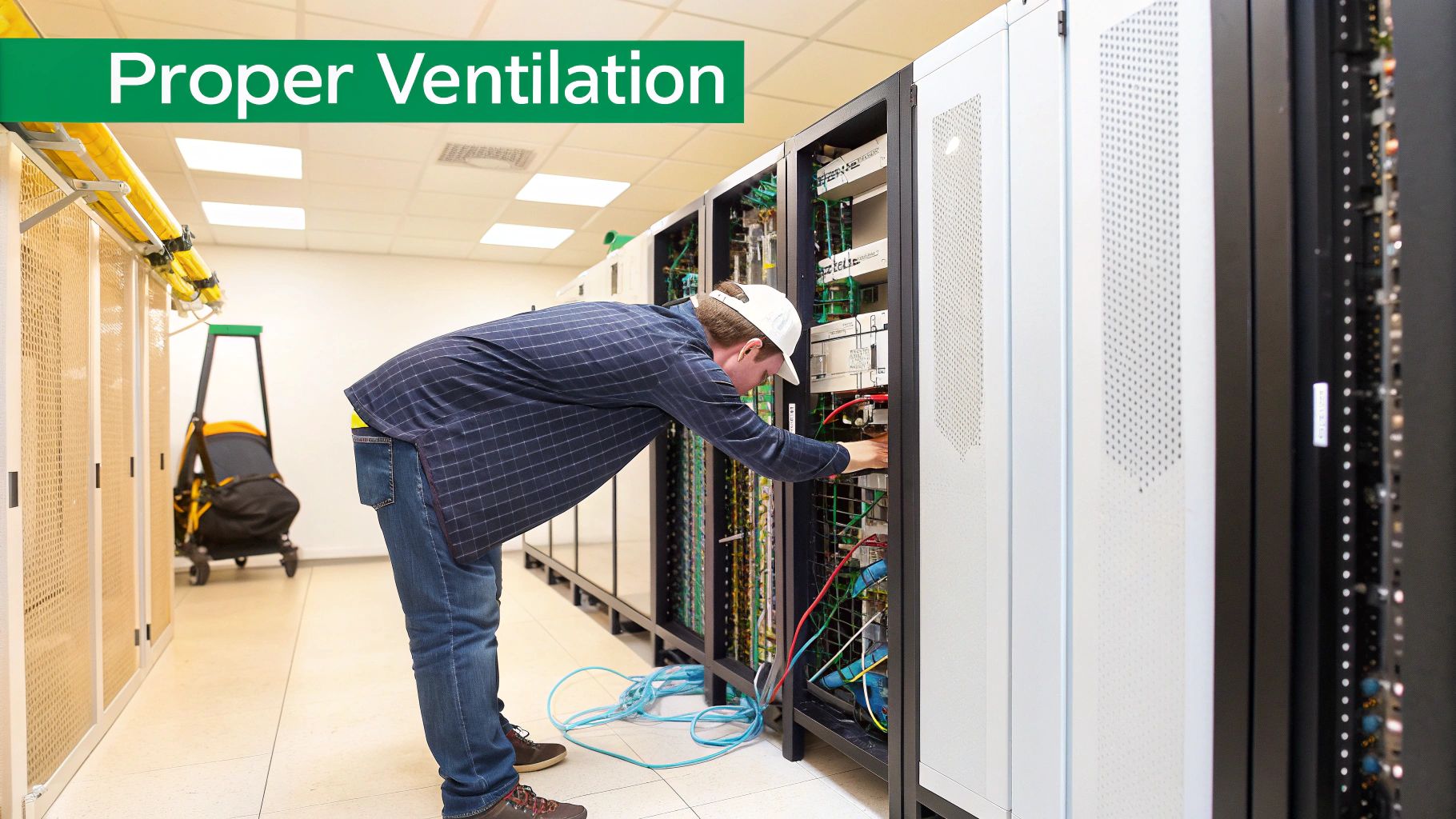
This starts with good rack-mounting habits. Never stack amplifiers directly on top of each other with no gaps. Best practice is to leave at least one unit (1U) of rack space between them. This allows for proper airflow and stops one amp from soaking up the waste heat from its neighbour.
Prioritise Ventilation and Airflow
Ensuring proper ventilation goes beyond just spacing. You have to look at the entire environment where the equipment rack lives. A cramped, unventilated comms cupboard can quickly turn into an oven, putting every single piece of kit inside at risk.
Here are a few practical tips for keeping things cool:
- Use Vented Panels: Pop vented blanking panels into any unused rack spaces. This helps with convection, pulling cool air up from the bottom and pushing hot air out of the top.
- Consider Fan Trays: For a densely packed rack or one sitting in a warm room, a rack-mounted fan tray is a smart move. These units actively force air through the rack, ensuring a constant stream of cool air over your gear.
- Keep It Clear: Make sure nothing is blocking the front or back of the rack. Amps are designed to pull in cool air from the front and chuck hot air out the back – blocking this path is asking for trouble.
Choose Thermally Efficient Amplifier Classes
The amplifier's design itself plays a massive part in managing heat. Modern Class D amplifiers are incredibly efficient. They convert far more of their electrical energy into actual audio power, wasting much less as heat compared to older Class A/B designs.
This thermal efficiency makes them a brilliant choice for installations where space is tight and ventilation might not be perfect. It's no surprise that the industry is moving this way; the Class D audio amplifier market is set to grow at a 7.3% CAGR within a global market already worth $4.9 billion. Their design is a perfect match for the demand for energy-efficient commercial installations.
Our comprehensive ceiling speakers with amplifier setup guide also has some valuable tips that tie in nicely with these practices.
Understand Built-In Protection Circuits
Finally, any quality PA amplifier will come with its own set of built-in protection circuits. These are your automated safety nets, designed to shut the amp down before any permanent damage can happen.
Think of protection circuits as an airbag for your amplifier. You hope you'll never need them, but they provide critical, component-saving intervention when something goes wrong, like a short circuit or extreme overheating.
Key circuits to look out for include:
- Short Circuit Protection: Instantly cuts the power if a dodgy speaker or cable creates a short.
- Thermal Protection: Keeps an eye on the internal temperature and shuts the unit down if it gets dangerously hot.
- DC Protection: Stops damaging direct current from ever reaching your speakers if there's an internal fault.
Knowing these features are there provides an essential layer of security for every installation you complete.
Frequently Asked Questions About PA Amplifiers
Even with the best plans laid out, you always run into practical questions on site. This section tackles some of the most common queries we hear from installers about PA system amplifiers, with clear, concise answers to help you solve challenges in the field.
Can I Mix Different Speaker Models on the Same Amplifier Channel?
On a 100V line system, you absolutely can, provided the total wattage of all the speaker taps doesn’t creep over the amplifier's rating. Easy.
For low-impedance systems, however, it’s a definite no-go. We strongly advise against it. Mismatched speakers will have different sensitivity levels and impedance curves, which leads to unbalanced volume across the room. More seriously, it can present an unstable load to your amplifier, and that’s a quick way to cause damage. For clean, reliable sound, always use identical speakers on a single low-Z channel.
What Does Bridged Mode on an Amplifier Do?
Bridging is a neat feature that lets you combine two separate amplifier channels into a single, more powerful mono channel. It's the perfect solution when you need to drive something that demands more power than one channel can deliver on its own, like a big passive subwoofer.
Be aware that bridging changes the amplifier's minimum stable impedance. An amp that’s stable at 4 ohms per channel, for instance, might only be stable down to 8 ohms when you bridge it. Always check the manufacturer's manual first to avoid frying the unit.
How Far Can I Run Speaker Cable for Each System Type?
Cable length is one of the most critical differences between the two system types, and it often dictates which one you’ll choose for a job.
- 100V Line Systems: You can run speaker cable for hundreds of metres with barely any power loss. This is what makes it the go-to for large buildings, warehouses, and outdoor spaces.
- Low-Impedance Systems: Here, you want to keep your cable runs as short as possible—ideally under 20 metres. Go much longer and you'll need much thicker (and more expensive) cable to prevent signal degradation. You’ll really notice the loss in audio quality, especially in the bass frequencies.
For expert project support and access to a complete range of professional audio solutions, Epic Audio Ltd provides the hardware and technical expertise to ensure every installation is a success. Discover our full line of commercial amplifiers and speakers at https://epicaudio.co.uk.