

At its most basic, a Public Address (PA) system is all about making sound bigger. It grabs a small audio signal—like someone speaking into a microphone—and gives it enough muscle to be heard clearly by a crowd or across a wide area. Think of it less like a simple megaphone and more like a sophisticated sound network for an entire building, stadium, or venue.
Understanding the Journey of Sound
To really get to grips with what a PA system is, it’s best not to see it as one single piece of kit. Instead, picture it as a path that sound travels along. Every announcement, background music track, or fire alarm has to make this journey before it hits your ears.
This path, or signal flow, is the key to understanding how any PA system works, whether it’s a simple setup in your local pub or a massive, multi-zone installation at an airport. It can be broken down into three core stages, and each one has a vital job to do.
Let's take a high-level look at how sound moves through any PA system, from the initial source all the way to the listener.
The Three Core Stages of a PA System Signal Path
A high-level look at how sound travels through any PA system, from the source to the listener.
| Stage | Core Function | Example Components |
|---|---|---|
| Input | This is where the sound starts its journey. It captures an acoustic sound (like a voice) or a pre-recorded track and converts it into an electrical signal the system can work with. | Microphones, media players (CD, MP3), laptops, instrument pickups. |
| Processing | Once inside the system, the signal goes to the 'brain'. Here it can be mixed with other sounds, have its tone adjusted (EQ), and be directed to different places. This stage is all about control. | Mixers, signal processors (DSPs), equalisers, amplifiers. |
| Output | This is the final, audible part of the journey. The processed signal is boosted by an amplifier and then sent to loudspeakers, which turn the electrical energy back into sound waves. | Amplifiers, loudspeakers (speakers), horns. |
A good way to think about it is like a water delivery network. The Input is the reservoir (the source), the Processing is the pumping and filtration station (controlling the flow and quality), and the Output is the network of pipes and taps delivering water to homes (the speakers).
Each of these stages relies on specific pieces of hardware to do its job. By breaking a system down into this simple three-part structure, you can make the task of specifying, installing, or even troubleshooting the most complex setups far more manageable.
Decoding the Core Components of Any PA System
To really get your head around what a PA system is, you have to look past the general idea and get to know the individual bits of kit that make it all work. Every component has a very specific job, and together, they form a perfect chain that takes a quiet sound and turns it into a clear, powerful message.
Let's break down the four essential building blocks: the input source, the mixer, the amplifier, and the output devices. Think of it like a relay race for audio; each component grabs the signal from the one before it, does its thing, and passes it on.
The Input Source: Where Sound Begins
Every public address system starts with an input source. This is simply the device that captures the original sound—be it a voice, a playlist, or an alarm—and translates it into a tiny electrical signal.
Common input sources you'll see everywhere include:
- Microphones: By far the most common input, used for everything from live announcements to performances. That reception desk microphone in a hotel lobby is a classic example.
- Media Players: This covers a lot of ground, from laptops and smartphones to dedicated music players pumping out background music in a retail shop.
- Paging Stations: In bigger places like schools or warehouses, dedicated paging consoles let staff make announcements to specific zones.
The quality of this first signal is absolutely critical. A cheap, nasty microphone or a noisy audio source will just get amplified, resulting in a poor-quality output for everyone to endure.
The journey of sound from its source to the listener's ear is a clean, logical path. This visual shows the simple three-step flow: from input, through processing, and out to the final output.
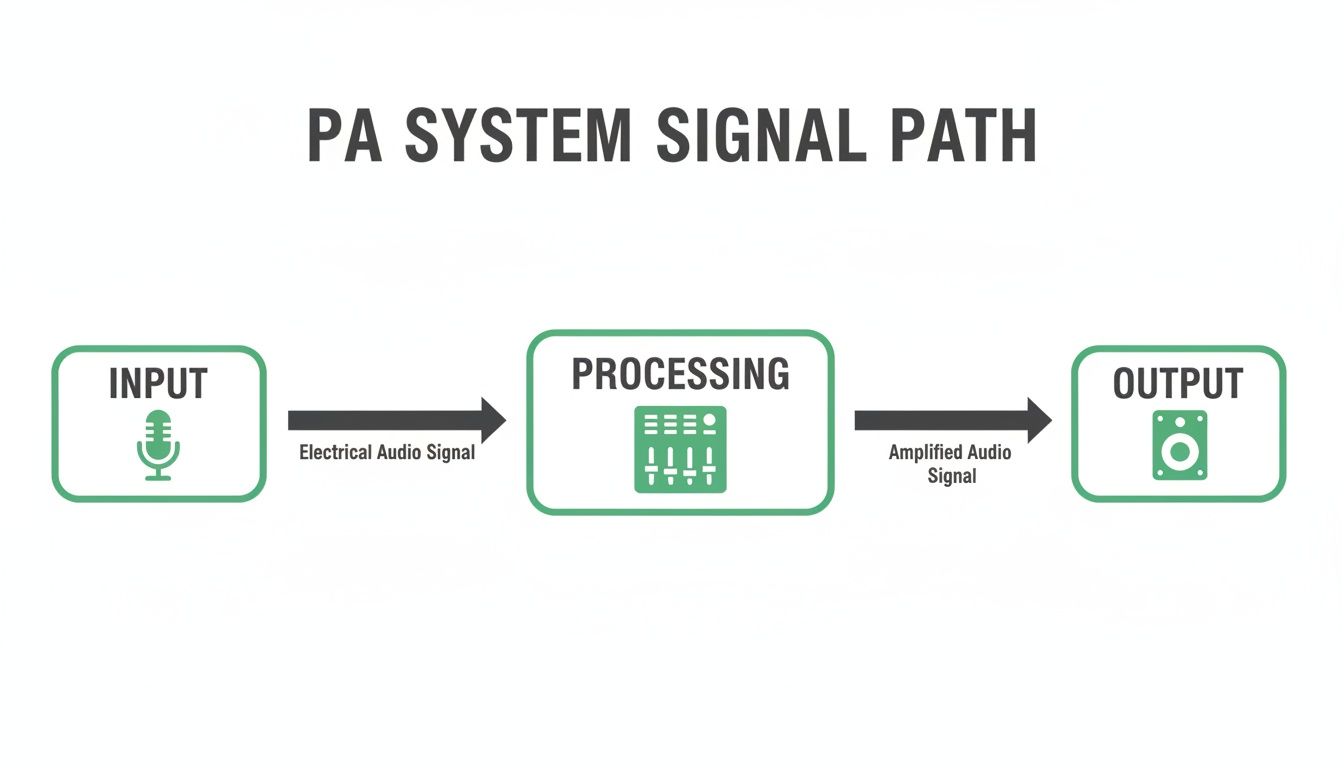
This just goes to show that every component plays a distinct role in shaping the final audio experience.
The Mixer: The System's Control Centre
Once the input source creates its electrical signal, that signal heads straight for the mixer. The mixer is the central hub where all the audio signals meet up. It’s a bit like an air traffic controller, managing multiple incoming signals and sending them exactly where they need to go.
A mixer’s main jobs are to:
- Combine Signals: It lets you blend multiple inputs. For instance, a gym instructor can have their microphone audio playing clearly over a background music track.
- Adjust Levels: Each input's volume can be dialled in independently, making sure you get a balanced, coherent final mix.
- Shape the Tone: Most mixers have equalisation (EQ) controls, letting you tweak the bass, mids, and treble to improve clarity and kill any feedback.
For a simple pub setup, a small, four-channel mixer might be all you need. But for a large hotel with a conference centre, restaurant, and lobby, you’d be looking at a sophisticated audio matrix mixer to route different audio to different areas all at once.
The Amplifier: The Powerhouse
After leaving the mixer, the neatly organised signal is still far too weak to actually drive a loudspeaker. It needs a serious boost in power, and that’s where the amplifier comes in.
The amplifier is the engine of the PA system. It takes the low-level signal from the mixer and provides the electrical muscle needed to physically move the speaker cones and create audible sound waves.
The amount of power an amplifier needs depends entirely on the number and type of speakers it's driving and the size of the space it needs to fill. An underpowered amp will give you distorted, weak sound and could even get damaged. An overpowered one is just a waste of money. Choosing the right amplifier is a massive part of getting the system design right. You can learn more about how to select the perfect amplifier for your PA system in our detailed guide.
The Output Devices: The Voice of the System
Finally, the now-amplified signal reaches the output devices—most often, loudspeakers (or just speakers). These are the final pieces in the puzzle, converting all that electrical energy back into the acoustic sound waves we actually hear.
There’s a huge variety of speaker types out there, each designed for a specific job:
- Ceiling Speakers: Discreet and excellent for wide, even coverage. They’re perfect for background music in offices, shops, and restaurants.
- Cabinet/Wall-Mount Speakers: The go-to choice for venues needing more punch and higher sound levels, like bars, gyms, and smaller live music spaces.
- Horn Speakers: These are highly efficient, weatherproof, and designed to project clear speech over long distances in noisy outdoor areas like train station platforms or factory floors.
The choice of speaker always comes down to the acoustic environment and what the system is for, ensuring the final sound is both crystal clear and perfectly suited to the space.
Exploring the Main Types of Commercial PA Systems
Not all PA systems are built for the same job. Think of it like this: a van and a sports car are both vehicles, but they’re designed for wildly different purposes. Getting a handle on the main categories of PA systems is the first, most crucial step for any UK installer looking to nail the perfect solution for a client.
The world of public address technology is massive, but thankfully, most commercial jobs fall into a few key types. Each one is engineered to solve a specific set of challenges, whether it's pumping out music at a pop-up event or delivering life-saving evacuation instructions when it matters most.
Let's break down the most common systems you’ll be working with.
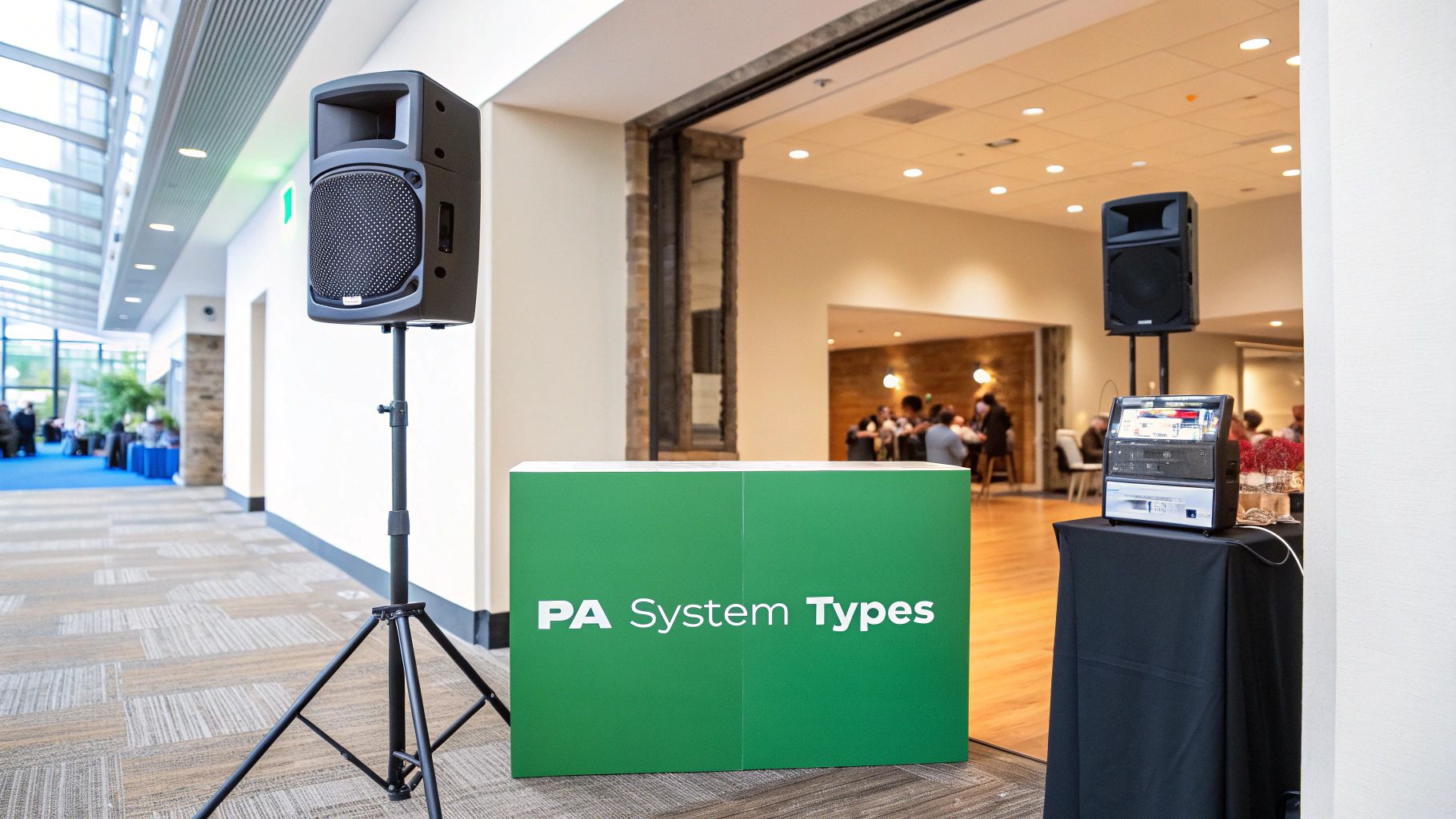
Portable PA Systems
A portable PA is essentially a ‘system in a box’. These all-in-one units are designed from the ground up for mobility and lightning-fast setup. They’re the bread and butter for mobile DJs, fitness instructors, public speakers, and anyone running a small, temporary event.
They usually pack a speaker, a simple mixer, and an amplifier into a single, easy-to-lug-around enclosure. Many even run on battery power and come with wireless microphone capabilities, giving you total freedom from mains outlets and messy cables.
Fixed Installation Systems
This is a huge category that covers most of the permanent PA setups you see every day. A fixed installation system is hard-wired into a building's fabric to provide consistent, reliable audio for a specific job, like background music, announcements, or a bit of both.
You'll find fixed installation systems everywhere:
- Retail Stores: Think discreet ceiling speakers that create an even wash of background music for a pleasant shopping vibe.
- Restaurants and Pubs: These often use wall-mounted cabinet speakers to deliver higher-quality audio for background music, quiz nights, or live events.
- Boardrooms: Here you’ll see integrated systems with mics and speakers, all fine-tuned for crystal-clear speech during important meetings.
These systems are built for long-term reliability, not portability. All the components are securely mounted and the cabling is run neatly out of sight.
100V Line Distributed Systems
When a project involves covering a large area, running long cable distances, or hooking up a ton of speakers, the 100V line system is the undisputed champion. This technology is the backbone of commercial audio in schools, warehouses, train stations, and sprawling office buildings.
Instead of the low-impedance (low voltage) signal you’d find in a home stereo, a 100V line system uses a high-voltage, low-current signal. It’s a bit like the National Grid but for audio; a high-voltage signal can travel for miles over relatively thin cable with hardly any power loss.
This high-voltage approach is the secret sauce. It lets an installer daisy-chain dozens of speakers in parallel—like fairy lights on a string—all from a single amplifier channel. This massively simplifies the wiring and slashes cable costs. Each speaker has a small transformer that 'steps down' the 100V signal to a level the speaker can use.
This design makes it incredibly easy to scale up a system and calculate your amplifier power needs, which is why it's the most practical choice for widespread audio distribution.
Voice Alarm VA Systems
While you can use a 100V line system for general announcements, a Voice Alarm (VA) system is a highly specialised, life-safety version that must meet incredibly strict regulations. In the UK, these systems are governed by the BS 5839-8 standard, which works hand-in-glove with the European EN 54 family of standards.
A VA system is designed to get people out of a building safely and in an orderly fashion during an emergency like a fire. It hooks directly into the fire alarm system to broadcast clear, unambiguous spoken instructions instead of just blasting bells or sirens. This is proven to reduce panic and speed up evacuation times.
Key features of a VA system include:
- Full System Monitoring: Every single component, right down to the microphone capsule and the speaker line, is constantly checked for faults.
- Battery Backup: The system has to stay fully operational even if the mains power goes out.
- Certified Components: All hardware, from speakers to amplifiers, must be certified to EN 54 standards.
The UK's serious commitment to these safety standards is a big reason for its strong market position. The United Kingdom commands 21.00% of the European PA system market share in 2025, reflecting our advanced infrastructure and non-negotiable compliance with EN 54 protocols. You can dig into more data on the European public address systems market on cognitivemarketresearch.com.
For any installer, it’s absolutely vital to understand that a VA system isn’t just a PA system with a few extra bells and whistles. It's a critical piece of life-safety equipment where compliance is mandatory, not optional.
How to Design and Specify the Right PA System
Moving from the 'what' to the 'how', designing a public address system is all about asking the right questions. A truly successful installation isn't about throwing the most expensive gear at a problem; it’s about choosing the right tools for the job. That means taking a methodical approach, long before you plug in a single speaker.
Every design kicks off with one simple but absolutely vital question: what is this system for? Is it meant to create a relaxed vibe with background music in a restaurant? Or is it for pumping out crystal-clear voice announcements in a noisy factory where clarity is a serious safety issue?
The answer shapes every single decision that follows, from speaker choice to amplifier power. A system fine-tuned for music will have very different characteristics to one designed purely for speech. Trying to make one system do both without careful planning usually means it ends up doing neither particularly well.
Starting with a Thorough Site Survey
You just can't design a system properly from behind a desk. A comprehensive site survey is non-negotiable—it's the foundation of any good specification. Walking the space lets you spot potential challenges and opportunities that plans and drawings will never show you.
During the survey, you're on a mission to gather crucial intel:
- Assess the Acoustics: Look for hard, reflective surfaces like glass, concrete, and tiled floors. These are notorious for creating echo and killing clarity. On the flip side, take note of soft furnishings, carpets, and acoustic panels that absorb sound. A library and a school sports hall are worlds apart, acoustically speaking.
- Identify Ambient Noise Levels: Get a handle on the typical background noise. A quiet office has a very low noise floor, but a bustling train station concourse needs a system with enough grunt to cut through the constant din.
- Map Out Speaker Locations: Start visualising where speakers need to go for even coverage. Look for sensible mounting points, check for ceiling voids, and spot any potential obstructions that could block the sound.
- Plan Cable Routes: Trace the most practical paths for running speaker and signal cables back to the amp rack. Think about distances, ease of access, and any fire regulations you'll need to follow.
Calculating Power and Coverage
Once you've got a feel for the space, it’s time to crunch the numbers. This is where you move from observation to specification, making sure the system has enough muscle to do its job without being over-engineered.
Speaker placement is the secret to even sound distribution. The goal is to eliminate 'hot spots' (where it’s way too loud) and 'dead spots' (where you can barely hear a thing). For ceiling speakers in a big room, this usually means laying them out in a grid, where the coverage from one speaker slightly overlaps with its neighbours.
Think of speaker coverage like overlapping circles of light from several torches. You're trying to light up the whole floor without any dark patches or blindingly bright spots. It’s the exact same principle for sound.
Next up, you need to calculate the required amplifier power. In a 100V line system, this is pretty straightforward. Each speaker has a transformer with several power 'tappings' (like 3W, 6W, or 10W). You just add up the total wattage of all the speakers you're connecting.
For instance, if you have 20 ceiling speakers all tapped at 6W, your total load is 120W. The crucial next step is to add 20-25% headroom. This stops the amplifier from running flat-out, which can lead to distortion and overheating. So, for that 120W load, you'd specify an amplifier with a power rating of at least 150W.
The Rise of Networked Audio Solutions
For years, PA system design was all about analogue cabling—pulling individual wires from amps to speakers. It works, but it can get messy and time-consuming in large or multi-building projects. Now, there's a much more flexible and scalable way to do things: Audio over IP (AoIP).
Technologies like Dante send high-quality, uncompressed audio over standard computer networks using Ethernet cables. Instead of a tangled mess of audio cables, you can route dozens of channels through a single network switch. It's a total game-changer for modern installations.
This move to networked systems isn't just a trend; it's a fundamental shift in how we handle audio distribution. Digital systems are now leading the pack in public address and voice alarm, especially here in the UK where modern infrastructure is ready for it. By 2024, digital solutions already accounted for over half of the global market. The IP system segment is the fastest-growing category, projected to expand at 10.2% annually from 2025 to 2034, which shows just how strong the demand is. You can dig into more data by reading the full market research on public address systems.
This network-based approach brings huge benefits:
- Flexibility: Need to re-route audio to a different zone? It’s just a few clicks in a software interface. No physical re-wiring required.
- Scalability: Adding new speakers or sources is incredibly simple. Just plug them into the nearest network port.
- Reduced Cabling: One Ethernet cable can carry dozens of audio channels, slashing installation time and material costs. Many AoIP devices also use Power over Ethernet (PoE), so that single cable delivers both data and power. Check out our detailed guide to better understand the benefits of Power over Ethernet for your next job.
Essential Tips for Installation and Maintenance
A great system design is one thing, but it’s the quality of the installation and commissioning that really makes it sing. Flawless on-site execution ensures the system performs reliably, sounds fantastic, and keeps the client happy day in, day out. This is where the pros really earn their stripes.
Getting the fundamentals right from the word go saves a world of headaches later on. A methodical, detailed approach is what separates a professional job from a messy, unreliable one. It’s not just about connecting wires; it's about building a robust and dependable audio solution from the ground up.

Best Practices for Physical Installation
A clean, organised installation is the hallmark of a skilled professional. Sticking to best practices guarantees system longevity, safety, and makes any future servicing a whole lot easier.
Here's a quick checklist of the absolute must-dos for any installation:
- Verify Speaker Polarity: Always, always double-check that the positive (+) and negative (-) terminals on your speakers are wired consistently back to the amplifier. Getting the polarity wrong, where some speakers are out of phase, will result in a thin, weak sound with almost no bass.
- Use Secure Mounting Techniques: Whether you're fitting ceiling speakers or hanging heavy wall-mounted cabinets, always use the correct fixings for the surface. Make sure every component is securely attached to prevent rattling or, worse, creating a safety hazard. Different speaker types have different needs, as you'll see in our guide to in-ceiling loudspeakers.
- Manage Cables Intelligently: Keep your speaker cables well away from mains power lines to avoid picking up that dreaded hum and interference. Use cable ties and proper trunking to create neat looms—it makes future fault-finding so much simpler.
- Ensure Adequate Amplifier Ventilation: Amplifiers can get seriously hot. You have to ensure they’re installed in a rack or location with plenty of airflow around them to stop them from overheating and failing prematurely.
Commissioning: The Final Quality Check
Once everything is wired up and mounted, it’s time for commissioning. This is the critical final stage where you test, tweak, and officially sign off on the system’s performance, making sure it works exactly as intended.
Commissioning isn't just switching it on to see if it works. It's a systematic process of verifying every single signal path, confirming every zone functions correctly, and balancing the audio for perfect clarity and coverage.
Your commissioning checklist should always include these steps:
- Signal Flow Testing: Play a test tone or some music through each input and check it reaches the correct outputs. This confirms all your mixer and amplifier routing is configured properly.
- Zone Functionality Checks: If the system is zoned, test each one individually. Make sure an announcement for Zone 1 is only heard there and that the volume controls for each zone work independently.
- Level Balancing: Walk the entire venue while audio is playing. Listen out for any obvious hot spots (too loud) or dead zones (too quiet) and adjust speaker tappings or amplifier levels to get a consistent, even sound pressure level (SPL) across the whole space.
Proactive System Maintenance
Your job doesn't end when the client signs off. Offering a proactive maintenance schedule provides real long-term value and ensures the system stays reliable for years to come. Regular checks can catch minor issues before they become major, expensive problems.
A simple but effective maintenance plan might include:
- Quarterly Checks: A visual once-over of all components, cleaning dust from amplifier vents, and testing key functions like paging mics.
- Annual Service: A deeper dive that involves testing every speaker individually, verifying battery backup systems on voice alarm installations, and checking that all connections are still tight and secure.
This structured approach not only delivers a top-quality result but also builds huge trust with your client. It opens the door for ongoing service contracts, turning you from a one-time installer into a long-term partner.
Frequently Asked Questions About PA Systems
Even when you've got the fundamentals down, a few questions about PA systems seem to pop up on projects time and time again. This section is all about giving you quick, clear answers to those common queries, helping you tackle specifications with more confidence.
We'll get into the practical differences between system types and the crucial calculations you need to get right. Think of this as your go-to reference for those nagging technical details that can make or break a design.
What Is the Real Difference Between 100V Line and Low-Impedance Systems?
This is probably the most common point of confusion for anyone new to commercial audio. The real difference isn't about quality, but about application—it all comes down to how they send power to the speakers.
-
Low-Impedance (8 Ohm): Think of this like your home hi-fi system. It pushes a high-current, low-voltage signal and is perfect for short cable runs to just one or two speakers per amplifier channel. It’s the go-to for high-fidelity audio in smaller spaces like a single meeting room, a bar, or a studio.
-
100V Line: This approach works more like the national grid, using a high-voltage, low-current signal. This clever trick allows you to send audio over incredibly long cable distances with almost no power loss. It also lets you daisy-chain lots of speakers in a simple parallel circuit, all running from a single amplifier channel.
The choice isn't about which is 'better,' but which is the right tool for the job. For a large school or warehouse needing dozens of speakers spread out over a huge area, a 100V line system is the only practical solution. For a small bar wanting premium sound quality from two main speakers, a low-impedance setup is absolutely the correct choice.
How Do I Know How Many Speakers I Can Connect to an Amplifier?
Getting your speaker load calculation right is one of the most critical steps in any system design. For a 100V line system, thankfully, it’s just straightforward arithmetic. Get this right, and you’ll avoid overloading and potentially damaging your amplifier.
First, you need to decide on the power ‘tapping’ for each speaker (e.g., 3W, 6W, 10W). Then, you simply add up the total wattage of all the speakers you plan to connect to that single amplifier line.
For example, if you connect 15 speakers and set each one to its 6W tap, your total load is 90 watts (15 x 6 = 90). A solid rule of thumb is to always ensure your amplifier's power rating is at least 20% higher than your total speaker load. In this scenario, you'd need an amplifier rated for at least 108W, making a 120W model a safe and reliable choice.
Do I Always Need a Mixer for My Setup?
Not always, but most of the time, yes. A mixer is all about control. If your system needs to handle more than one audio source—like background music from a media player and a paging microphone—then a mixer becomes non-negotiable.
It lets you balance the levels between your different sources, making sure important announcements can be heard clearly over any background music. Some amplifiers, often called 'mixer-amplifiers', come with basic mixing functions built-in. For a simple setup like a small shop with one mic and one music source, these can be a great all-in-one solution.
However, for any system with multiple zones or several different inputs, a dedicated mixer or an audio matrix is essential for giving you the proper control and routing you need.
Your Partner in Professional Audio Solutions
So, there you have it. You've now got a solid grasp of PA systems, from the basic signal path right through to the finer points of system design and installation. You're equipped with the knowledge to tell one system type from another, plan for proper coverage, and understand just how crucial compliant, reliable hardware really is.
The next step? Putting all that insight into practice on your projects.
That's where we come in. We know that navigating the vast world of audio equipment can be a challenge, but you don't have to go it alone. Our goal is to be more than just another supplier; we aim to be your trusted technical partner for every job, big or small.
From Design to Delivery
We're here to support UK installers by providing the tools and expertise you need to deliver exceptional results. Our services are built around your workflow, ensuring every project is a success from start to finish.
- Extensive Brand Portfolio: We offer a carefully curated range of industry-leading brands like Monacor, Fonestar, and IMG Stageline, ensuring you always have access to reliable and cost-effective solutions.
- Complimentary System Design: Take the guesswork out of complex specifications. Our in-house experts can help you design a complete system, from speaker layouts to amplifier calculations, all completely free of charge.
- Dedicated Technical Support: When you're on-site and need a quick answer, our technical team is on standby to provide practical support and help you push past any challenges.
Ultimately, a successful installation comes down to getting the right components to work together flawlessly. Our job is to make sure you have the correct equipment and the expert backing you need to deliver systems that are robust, clear, and perfectly matched to your client's needs.
For a broader look at the technology used across different settings, it's also worth exploring the wider category of professional audio visual equipment.
Ready to get your next project off the ground? Partner with Epic Audio Ltd to access trade pricing, expert design services, and a massive portfolio of professional audio solutions. Explore our full range of products today.